While the world is undergoing unprecedented geopolitical turbulence inflicted by the United States under the Trump administration, followed by an energy crisis, India’s buying of Russian crude oil is an exercise in pragmatic diplomacy and economy. While the morality of this kind of energy consideration is questioned, the numbers tell the compelling story of how Indian energy choices shielded their consumers from crushing fuel price inflation and, by default, kept Western consumers afloat in terms of energy prices.
Bharat’s Energy Shift
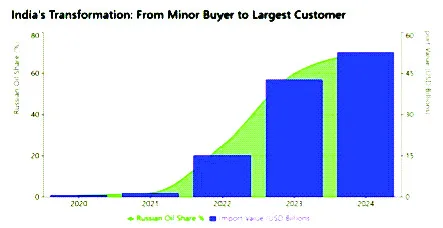
Numbers don’t lie! Since 2022, India has transitioned from being a minor purchaser of Russian oil to the biggest, buying 70 per cent of Russian crude exports by 2024. This radical change, which amounts to $52.73 billion annually in imports, is more than a commercial opportunity; it serves strategically to insulate 1.4 billion Indians from the energy shock that battered economies around the world; quite simply, it turns out to be “India’s Energy Shield.”
The energy transformation of India during 2021-24 has been one of the most important strategic policy pivots in recent economic history. In 2021, having almost no Russian oil presence, India started its strategic pivot in 2022, quickly garnering the main buyer status in 2023 and becoming Russia’s largest customer by 2024.
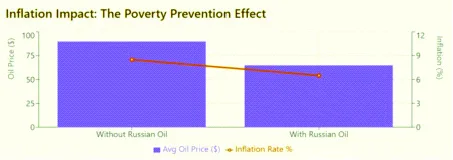
This calculated economic protection was nothing short of extraordinary. Had India not adopted the Russian oil strategy, it would have faced $90/barrel, which would have induced 8.5 per cent inflation and thrown 200 million citizens into poverty. Instead, India’s timely procurement of crude at $65/barrel, a discount of $25, kept inflation at 6.5 per cent and reduced the impact on poverty by 75 per cent, affecting only 50 million people.
RBI Endorses the Claims
The Reserve Bank of India has analysed and supports these claims: every $10/barrel rise causes inflation to go up by 0.4 per cent. India saved $25/barrel and thus had 1 per cent inflation prevented, protecting 1.4 billion people from economic devastation and relocating the nation firmly onto the energy map.
Price Stability
To comprehend the gravity of the situation, it must be considered that petrol prices soared to ₹160-200 per litre in places like the UK and Germany after the Ukraine War, while India kept prices very low at around ₹90 per litre. As if this were not enough, fuel prices in India actually are below the US average of somewhere around ₹100 per litre. This price stability was not fortuitous, it resulted from Russian crude being purchased with discounts of 25 per cent to 50 per cent below global prices.
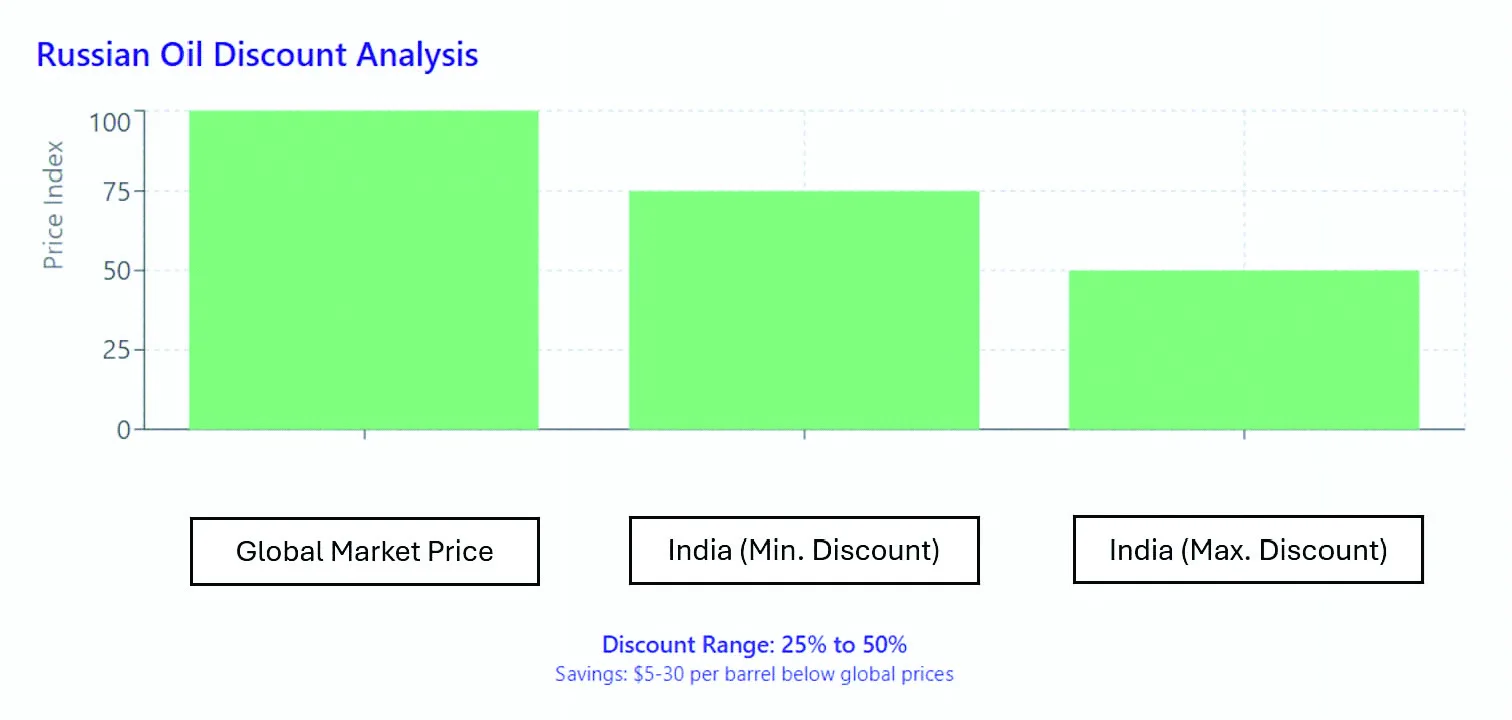
As per Reserve Bank of India’s charts, every $10 increase in oil prices per barrel leads to a 0.4 per cent increase in headline inflation. Discounted crude saves India from an inflationary spiral, where millions would have been forced into poverty in this already challenging period.
India’s energy diplomacy strategies provided notable safeguards for the country’s citizens. Aside from capturing 70 per cent of Russian crude exports worth $52.73 billion annually, India managed to keep petrol prices at ₹90/litre, which is 50 per cent lower than Europe’s ₹160-200. This strategy also averted 1 per cent additional inflation, prevented 150 million people from declining into poverty, and made India the largest oil customer of Russia, all while achieving unparalleled economic stability during the global energy crisis.
What is perhaps the most interesting part of the story, alongside the domestic economic benefits, is how westerners have become beneficiaries of India’s Russian oil strategies. India’s petroleum refinery role to the Western world, processing Russian crude oil, then selling the refined oil to Europe and America is a result of what specialists call the “refining loophole.”
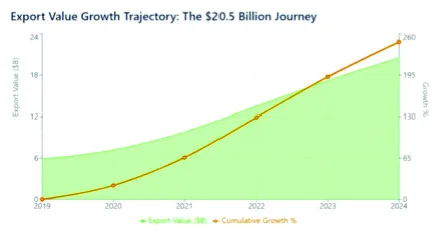
The data shows India’s exports of petroleum to Europe. Absolutely wild. There was a leap from $5.9 billion back in 2019 to $20.5 billion in 2024, showing a 247 per cent upward trend. India went from being, on the sixth place, to shipping more refined products to the EU than any other trade partners. With the Netherlands, the Indian oil imports went from a mere 9,740 metric tons in 2018-19 to an astounding record 24.73 million metric tons in 2023-24, recording a 2,540 per cent jump.
This scenario creates a win-win-win situation whereby India benefits from refining margins, Western consumers pay less for their fuel (between 15 and 30 per cent below market price), and Russia still has income opportunities despite sanctions. There is irony everywhere in that while Western governments openly criticise Russian energy, their citizens are paying less for Russian oil that has just been processed in India. To be fair to critics, if we look at profits, India’s oil companies are making insane profits, as IOC, BPCL, and HPCL have reached Rs 86,000 crore in combined profits for FY23-24, compared to profits of Rs 3,400 crore the previous year. But, in terms of direct benefit to consumers, little benefit has been passed along. The reasons for consumers still paying wholesale prices despite enormous discounts on crude are numerous and muddies the view on how profits are divided, striking at the corporate vs. consumer dilemma.
Yet this narrow lens blinds us to the greater context. That consumer benefit arises from a street price of fuel that has remained unchanged during a time of global energy crisis in which other countries experienced explosive fuel inflation that not only weakened purchasing power but also led to the breakdown of social harmony. In other words, India’s energy calculus has prevented an unimaginable consumer crisis.
Furthermore, the profits enabled by this approach have contributed to the strengthening of India’s energy security infrastructure, the increase of refining capacity, and put India on the global reference map for energy security. The long-term strategic benefits are significantly greater than any short-term considerations about pricing.
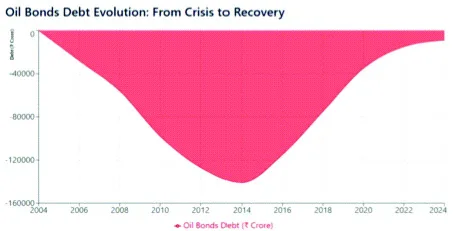
In terms of the modern energy equation, India’s rationality is undoubtedly a marked improvement over a decade of malaise. The UPA government from 2004-14 saddled the Indian economy with an estimated Rs 1.41 lakh crore in oil bonds debt by subsidising energy prices through liberal fuel policies without making sure to get favourable terms on oil and gas imports. The current Government has not only been able to timely repay Rs 1.32 lakh crore of oil bonds debt that was created in that decade of the UPA Government, it has also been able to prevent previous years’ price volatility by managing price through market not through unfettered fiscal excess.
In the future, India’s purchase of Russian oil may face pressure as the Trump administration will threaten to issue tariffs. Tariffs would decrease India’s imports, causing them to reconsider Russian oil purchases. The cost implications are massive as moving from Russian oil could translate into a greater cost on India’s imports of $9-11 billion per year, which will affect inflation and consumer prices.
The proponents of India’s termination of their Russian oil purchases need to wake up to the larger geopolitical reality. The European Union continues to import record Russian LNG, exporting at 17.8 million tons in 2024, increasing from 15.21 million tons in 2022. The United States, mainly by physically banning direct Russian oil imports, has imported fuel refined from 30 million barrels worth of Russian crude oil under the same “refining loophole” that India uses.
This creates double standards that constitute the hypocrisy of the Western condemnation of India’s energy choices. Consumption in Europe and America of Russian energy is accepted on an indirect basis, yet they criticise India for more closely revealing agreements.
When viewed in complement to India’s own domestic and international consumers, India’s procurement (at a price cap) of Russian oil has yielded a mixed impact. In the 10 months after Russia’s invasion of Ukraine, India imported heavily discounted crude from Russia saving them $3.6 billion. There is no precise accounting of where Russian oil is flowing to, but today, the share of Russian oil in India’s imports is now an estimated 35 percent to 40 per cent, compared to less than 0.2 per cent before the inception of the conflict.
However, the savings were not fully transferred to Indian consumers. Indian refiners are not passing on the cost savings made from buying Russian crude oil at a discounted price to the end consumer and instead earned windfall profits for the fuel sales at Rs 15 per litre for petrol and Rs 12 per litre for diesel, with oil marketing companies benefiting from a significant portion of the profits.
The implications are different for India’s trade partners. More than half of India’s imports of Russian oil is converted and exported from three overlapping Indian refineries, which are all providing these refined products to G7+ countries, meaning the western nations are benefitting from a derivative of Russian oil in spite of sanctions. India could also add $9-11 billion to its annual import bill if it is forced to reduce or abandon Russian oil imports, which could thus incidentally raise global oil prices and impact consumers around the world due to higher costs of and in the supply chain.
As India’s trade partner, the implications for the United States are a complex paradox generated by Russia oil usage. The US and UK are already among the largest buyers of India’s products refined from crude oil derived from Russia (albeit through the Indian refining process), and thus the tariffs imposed by the Trump administration for a 25 per cent duty, do not apply to the imports of Indian products refined from crude oil derived from Russia, such as gasoline or diesel, and sold back to the US.
Instead of chastising India for this pragmatic reality, the world should recognise how India’s energy decisions have helped to keep global energy markets stable
This creates conflicting effects, on one hand, the US is imposing tariffs on India for importing Russian oil, while on the other hand, American customers benefit from lower-priced refined products formed from discounted Russian crude oil. Four of India’s largest state-owned Oil Companies are suspending Russian crude oil purchases after significant US pressure, but this may increase costs for both countries. If India does not process the Russian oil, US consumers may find their fuel prices rising if they cannot access the supply of lower-priced refined products, and India would have to source crude oil elsewhere at a premium price, which could also change how they fit into the trade with the US.
It seems the world is witnessing India’s pragmatism over politics. In fact, India’s Russian oil case demonstrates the type of pragmatic foreign policy that places national interest above ideological posturing. By locking in energy supplies at discounted rates, India has helped shelter its consumers from rising inflationary domestic pressures, positioned itself as a global refining powerhouse, and inadvertently shielded energy markets for Western consumers.
The success of the policy essentially demonstrates there really is no black-and-white thinking as it relates to geopolitics. We live in a multipolar world with a multitude of competing interests along with the moral ambiguities that the idea of geopolitics tries to put in diffracted shades of black-and-white. In shaping their own energy policy that seeks not only energy security while also having a measure of strategic autonomy, India offers a picture of what middle powers may do when similarly faced with the dilemmas of many competing moralities.
Bharat Shows the Way
As global energy markets continue to change, India’s position of playing a key intermediary between East and West should only increase. Instead of chastising India for this pragmatic reality, the world should recognise how India’s energy decisions have helped to keep global energy markets stable in a time where they have been most unstable in recent memory.
The facts say it all; India’s Russian oil purchases has kept Indian end users from crippling fuel inflation, and has also provided cheaper energy for global markets. This isn’t just good policy, it is a textbook example of how emerging powers can use their strategic location to benefit domestic and international stakeholders. In the tag team effort that is international energy geopolitics, India is choosing pragmatism over politics, and you can see the result.