

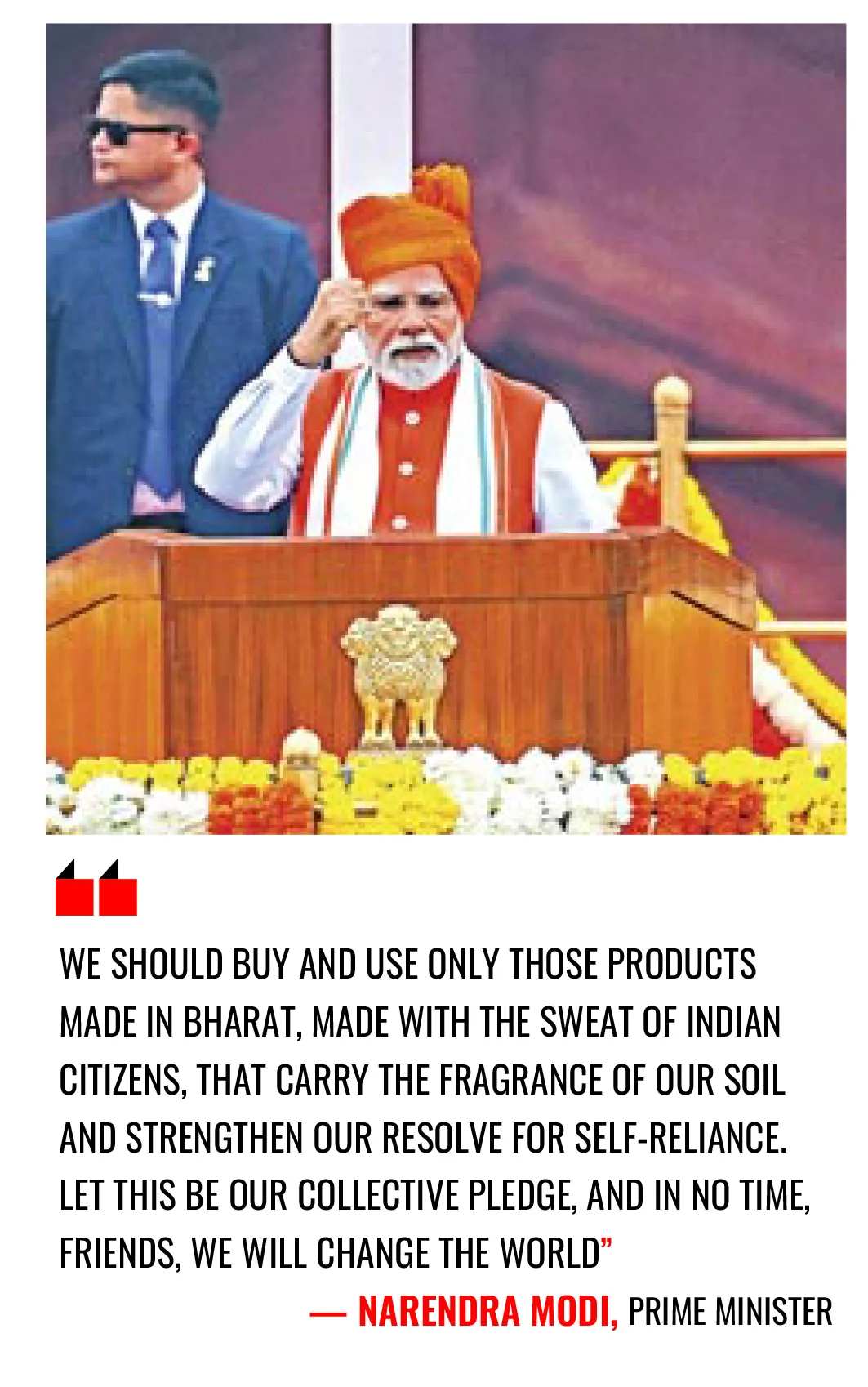
“Those who lived by the mantra of an independent Bharat gave us freedom. Now, the mantra for 140 crore Indians should be a prosperous Bharat. If the sacrifices of millions could bring us freedom, then with the resolutions, hard work, self-reliance, promotion of “Vocal for Local,” and the chanting of the mantra of Swadeshi by millions, we can also create a prosperous Bharat. That generation dedicated itself to a free Bharat; this generation must take bold new steps for a prosperous Bharat, that is what the times demand,” said Prime Minister Narendra Modi from the Red Fort in his Independent Day speech.
This is not merely a slogan—it is a call for economic freedom. The idea of Swadeshi is deeply rooted in Bharat’s struggle for Independence. The Swadeshi movement, launched in the early 20th century against the Partition of Bengal, was not only a boycott of foreign goods but also a declaration of India’s economic self-determination. It was a response to the de-industrialisation caused by British colonial rule and an effort to revive indigenous industries. As nationalism grew, even the colonial Government was compelled to impose tariffs to protect Indian industries, leading to the modest development of sectors such as textiles and steel.
Swadeshi in independent Bharat post-Independence, especially in the 1990s, a new threat emerged in the form of globalisation. Developed nations, through global institutions like the WTO, the IMF and the World Bank, began to dictate trade rules under the guise of liberalisation and free trade. These reforms, promoted in the name of progress, risked pushing India back into economic dependency. In response, organisations such as the Swadeshi Jagran Manch launched a mass awareness campaign—‘Swadeshi Suraksha Abhiyan’—reaching out to nearly every village and urban locality in the country. Lists distinguishing Swadeshi and foreign products were distributed, and a large-scale boycott of multinational goods began. Though the public was ready to support this movement, policymakers at the time remained enamored by globalisation and largely ignored the implications for national sovereignty. Today, we face a similar crisis—but this time, it is more complex and subtle.
Rise of Neo-Colonialism
In today’s global economy, Bharat faces a new form of economic colonisation—not through military conquest, but through cheap imports, trade manipulation, digital platforms and strategic investments. China, for instance, has flooded Indian markets with low-cost, low-quality goods. India’s trade deficit with China now exceeds $99 billion (Rs 8.6 lakh crore). These subsidised imports are crippling India’s small and medium industries, leading to large-scale de-industrialisation. This is not just economic harm—it is a national security threat. The same China that profits from our markets engages in border skirmishes, such as in Galwan and Doklam. How long can we continue to fund a hostile nation with our purchases?
Turkey Continues to Profit
Turkey presents a similar case. Despite its open support for Pakistan on Kashmir, anti-Bharat rhetoric at global forums, and even supplying arms to Pakistan, Turkish companies continue to profit from Indian markets. This economic engagement weakens India’s geopolitical stance.
Even more dangerous is the rise of digital imperialism. Companies like Amazon and Walmart (Flipkart) operate as modern-day East India Companies—burning foreign capital, offering deep discounts, and wiping out local traders. Their practices threaten lakhs of small retailers and startups. Meanwhile, they extract data from Indian consumers without transparency or accountability, posing long-term risks to privacy and national control.
Boycott as a Strategic Measure
The call to boycott foreign goods is not driven by resentment but by reason. It is a strategic step in protecting Bharat’s economy, industry, and sovereignty. This boycott is not an impulsive reaction; it is a considered national duty based on the foundational principles of self-reliance, national pride, and economic independence. Boycotting Chinese and Turkish products, and scrutinising the operations of foreign e-commerce giants, is essential to secure Bharat’s future. These are not merely economic decisions, but patriotic actions aimed at rebuilding Bharatiya industry and empowering local enterprise.
Building Self-Reliance
The boycott must go hand-in-hand with an active push for self-reliance. Swadeshi is not just a rejection of foreign goods, but an affirmation of Indian enterprise. The Aatmanirbhar Bharat campaign is a continuation of this philosophy. The COVID-19 pandemic, the Galwan clash, and global supply chain disruptions have shown the dangers of over-dependence on foreign imports.
Self-reliance must begin with reviving our MSME sector, increasing indigenous production in critical areas, and supporting local innovation. Policy changes alone won’t suffice—there must be collective action from consumers, entrepreneurs, and the government. India’s defense sector is a shining example. A few years ago, over 70 per cent of defense purchases were imported. Today, over 65 per cent are made in India. In 2024–25, India exported military equipment worth Rs 23,622 crore. Indigenous weapons played a key role in operations like ‘Sindoor’, demonstrating not only technological capability but global competitiveness.
Every Rupee is a Vote
Consumers play a central role in shaping India’s economic future. Every rupee spent is a vote—either strengthening self-reliance or feeding foreign dominance. This is the heart of the Swadeshi philosophy: prioritise Indian goods, support local entrepreneurs, and participate in national building. It is vital to understand that Swadeshi is not anti-globalisation. It opposes exploitative and unequal globalisation. India welcomes fair and equitable trade, but rejects economic systems that undermine its sovereignty and long-term interests.
A Call for Action
Swadeshi is not a one-time campaign—it is a continuous movement, a mindset, and above all, a national responsibility. It demands active citizen participation. Every Indian—student, worker, policymaker, businessperson, and homemaker—must act as a foot soldier in this economic freedom struggle. India is not just a market. It is an awakening nation with the resolve to shape its own destiny. We must stop seeing ourselves merely as consumers and start acting as stakeholders in the nation’s development.
Companies like Amazon and Walmart (Flipkart) operate as modern-day East India Companies—burning foreign capital, offering deep discounts, and wiping out local traders.
The Road to 2047: A Developed Nation
Bharat aspires to become a developed nation by 2047, when it marks 100 years of Independence. This vision cannot be achieved without full self-reliance. To achieve developed nation status, India must focus on:
- Manufacturing electric vehicles and clean energy equipment.
- Developing solutions for air, water, and soil pollution.
Achieving breakthroughs in semiconductors and strategic technologies.
This demands a rethink of our economic model, guided by Indian traditions, values, and realities. Where necessary, India can collaborate internationally—but the primary emphasis must remain on building internal capacity and strategic autonomy.
Swadeshi is a National Dharma
Swadeshi is not a narrow or regressive idea. It is a dynamic and progressive framework for holistic development—economic, social, and strategic. It empowers citizens, protects sovereignty, and fosters innovation. Most importantly, it aligns with Bharat’s civilisational ethos of self-reliance, fairness, and sustainability. The journey from a colonised economy to a global leader cannot be completed without Swadeshi as its soul and boycott of exploitative forces as its shield. With conscious consumption, patriotic entrepreneurship, and policy reorientation, we can build a truly developed and self-reliant India.