
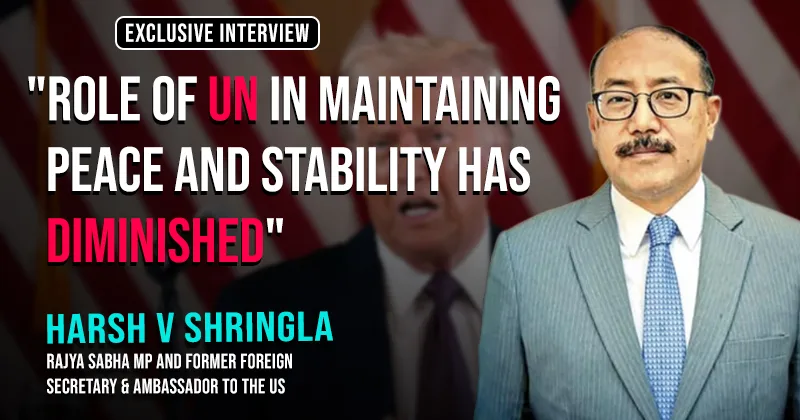
Role of UN in maintaining peace and stability has diminished: Rajya Sabha MP Harsh V Shringla
August 31, 2026
  • Read Ecopy
  • Circulation
  • Advertise
  • Careers
  • About Us
  • Contact Us
Android AppiPhone AppArattai
Organiser
  • ‌
  • Bharat
    • Assam
    • Bihar
    • Chhattisgarh
    • Jharkhand
    • Maharashtra
    • View All States
  • World
    • Asia
    • Europe
    • North America
    • South America
    • Africa
    • Australia
  • Editorial
  • International
  • Opinion
  • RSS @ 100
  • More
    • Op Sindoor
    • Analysis
    • Sports
    • Defence
    • Politics
    • Business
    • Economy
    • Culture
    • Special Report
    • Sci & Tech
    • Entertainment
    • G20
    • Azadi Ka Amrit Mahotsav
    • Vocal4Local
    • Web Stories
    • Education
    • Employment
    • Books
    • Interviews
    • Travel
    • Law
    • Health
    • Obituary
  • Subscribe
    • Subscribe Print Edition
    • Subscribe Ecopy
    • Read Ecopy
  • ‌
  • Bharat
    • Assam
    • Bihar
    • Chhattisgarh
    • Jharkhand
    • Maharashtra
    • View All States
  • World
    • Asia
    • Europe
    • North America
    • South America
    • Africa
    • Australia
  • Editorial
  • International
  • Opinion
  • RSS @ 100
  • More
    • Op Sindoor
    • Analysis
    • Sports
    • Defence
    • Politics
    • Business
    • Economy
    • Culture
    • Special Report
    • Sci & Tech
    • Entertainment
    • G20
    • Azadi Ka Amrit Mahotsav
    • Vocal4Local
    • Web Stories
    • Education
    • Employment
    • Books
    • Interviews
    • Travel
    • Law
    • Health
    • Obituary
  • Subscribe
    • Subscribe Print Edition
    • Subscribe Ecopy
    • Read Ecopy
Organiser
  • Home
  • Bharat
  • World
  • Operation Sindoor
  • Editorial
  • Analysis
  • Opinion
  • Culture
  • Defence
  • International Edition
  • RSS @ 100
  • Magazine
  • Read Ecopy
Home Bharat

Role of UN in maintaining peace and stability has diminished: Rajya Sabha MP Harsh V Shringla

Ravi MishraRavi Mishra
Aug 12, 2025, 08:00 pm IST
inBharat, World, Interviews
Follow on Google News
Facebook
Twitter
WhatsAppTelegramEmail

The world is in turmoil due to ongoing tariff wars and conflicts around the world. Amid this uncertainty, Bharat, world’s oldest and largest democracy and a growing economy, can provide solution to the global problem. Against this background, Organiser Assistant Editor Ravi Mishra talked exclusively to Harsh V Shringla, Rajya Sabha MP and former Foreign Secretary & Ambassador to the US. Excerpts:

The United States has arbitrarily imposed a 50 per cent tariff on Bharat, citing our crude oil imports from Russia. How do you view this move by the US?
We have been negotiating a free trade agreement with the US since the past few months. The negotiation process is still ongoing. In fact, a US delegation is expected to visit us, and we are supposed to continue negotiations. If you refer to the joint statement issued by Prime Minister Modi and President Trump, it mentions concluding the free trade agreement by September. So, from our perspective, there is still time. These kinds of agreements typically involve a certain level of discussion to arrive at an acceptable settlement, and that process is very much underway.

Prime Minister Narendra Modi made a statement recently that Bharat will not compromise on the interests of farmers. Was he pointing out a hurdle in the US-Bharat trade deal?
If you look at statements by Prime Minister Narendra Modi and Ministry of External Affairs, it is very clear that the interests of farmers, small and medium enterprises, and other vulnerable sections of our society cannot be compromised. Obviously, there are red lines on our side, just as there are on the US side. What we need to find is an acceptable middle ground that allows both countries to derive maximum benefit from the free trade agreement without impinging on the welfare or economic well-being of citizens in either country.

 Do you think globalisation is in crisis?

It is very evident that we are living in an uncertain world, not just in the short term, but also in the medium and long term. This uncertainty arises from multiple factors: strategic rivalry, geopolitical maneuvering, and competition for resources. Unfortunately, it is the most vulnerable countries, particularly in the developing world, that are feeling the greatest impact. I believe we are witnessing a weakening of global governance systems, which have not been able to effectively respond to the challenges and needs of the 21st century.

There is a clear emergence of multipolar world following the decline of America- made world order which it established after Second World War. How do you see the role of Bharat in this multipolarity?

India (Bharat) is already seen as a responsible nation that has supported other countries in difficult times. In many senses, it is a leader of the Global South. Prime Minister Modi’s vision of human-centric globalisation, working for the global common good, has been greatly appreciated by these countries. This was also evident during the COVID–19 crisis, when India, one of the few countries capable of manufacturing its own vaccines, was willing to share vaccines, which no other country did at that time. India has always been forthcoming in sharing its experiences in digital public infrastructure, financial inclusion, renewable energy, and a range of other areas. Today, many countries feel that India is one of the few that can actually provide solutions to global challenges.

There is also a decline in democracy across the globe, and Bharat is the only country that has a very strong democracy. So how do you see Bharat’s role in establishing democracy across the globe?

India is the mother of democracy. Prime Minister Narendra Modi, in a historic speech in September 2021 at the United Nations, said that democracies have worked and democracies will work. In other words, he illustrated how democracies, like the one in India, have worked to deliver for millions of people in our country, bringing 25 crore people out of poverty. I think this is a major illustration of how democracy has truly delivered to so many people, because of its inherent need to cater to the needs of the people, especially the more vulnerable, in an inclusive and sustainable manner.

Conflicts around the world clearly point out a total failure of the UN system. What steps should be taken to reform the United Nations system?

The UN system was created in the aftermath of the Second World War. It was designed to provide peace and security and to cater to the economic needs of the world through a multilateral process. But as we see today, 70 years after the formation of the UN, it has clearly not been able to live up to the challenges and requirements of the 21st Century. The UN budgets are shrinking. Major donors are not providing the funds needed for the functioning of UN system, even at a suboptimal level. Peacekeeping is being reduced. The UN’s role in maintaining international peace and stability has diminished due to budgetary constraints. Major powers are unable to come to decisions on conflicts and how to resolve them or bring about peace. One of the main reasons for this is that the UN Security Council, the main organ for international peace and security, is not representative of the realities of the 21st Century. A country like India, which is the fourth-largest economy in the world, with the largest population and representing the aspirations of the Global South, is not a permanent member of the UN Security Council. Without a change in the composition of the UN Security Council, the UN will not be able to respond effectively.

Topics: UN systemPrime Minister Narendra ModiHarsh V ShringlaDemocracy
Ravi Mishra
Ravi Mishra
Ravi Mishra is a Delhi based journalist, covers politics, strategic and security affairs. He is currently working with Organiser Weekly as Assistant Editor. [Read more]
Share
Tweet
SendShareSend
✮ Subscribe Organiser YouTube Channel. ✮
✮ Join Organiser's WhatsApp channel for Nationalist views beyond the news. ✮
Previous News

Independence Day Special: Another prediction true

Next News

Odisha CM Launches OMBRIC: A groundbreaking step towards marine biotechnology leadership

Related News

Why objection to Vande Mataram? A symbol of national consciousness, struggle & sacrifice!

Modi Govt’s ‘One Day, One University’ Plan: Union Ministers to Interact With Students Across India (This image is generated from AI)

One Day, One University: Modi Govt plans direct outreach to Gen Z students; Check details

CJP's protest was inconsistent with egalitarian values that youth-led agitations often seek to project

Demeaning Bharatiya Women: Freedom of gendered violence

Representative Image

Leftist agenda targets emotional Gen Z; Logical thinking crucial for next generation for national well-being

Why are young people forced to protest? A question that demands reflection!

Road politics and street-driven pressure are increasingly challenging India’s constitutional institutions and democratic framework

Democracy or Mobocracy? How road politics is challenging India’s constitutional institutions

Load More

Latest News

Students at the Gautam Buddha University, Greater Noida

Mann Ki Baat: PM Modi praises GBU’s mission ShakthiSAT, says dreams of daughters are now taking flight to space

Dutch TikTokker Angelo Bryson, known as Superhuman Unchained, at a pro-Palestine protest.

Dutch TikTokker recently converted to Islam livestreams stabbing three in Amsterdam; Watch video

From Kanchipuram to Kalamkari, India’s traditional textiles reflect its rich regional cultures and centuries-old craftsmanship

From Kanchipuram to Kalamkari: Exploring India’s rich traditional textiles and regional clothing heritage

Punjabi Influencer Abducted, Burnt Alive Near Morinda

Punjab Law and order crisis: Influencer Manjeet Kaur abducted, burnt alive after attack near Morinda

‘Dimagi Naxals’ romanticising Mao, Stalin and Pol Pot

The Swadeshi movement turned Indian enterprise into a powerful force for economic self-reliance, national pride and the struggle for Swaraj

Building Economic Swaraj: How Indian enterprises fought foreign rule and reclaimed national pride

Prime Minsiter Narendra Modi and Uzbekistan President Shavkat Mirziyoyev

India-Uzbekistan Herald New Chapter: Uranium deal, 30-day visa-free entry to Indians & $5bn trade propel bilateral ties

The new FCRA rules seek to curb unchecked foreign funding, strengthen financial accountability, and protect Bharat’s national security

Stopping Unchecked Foreign Money: How new FCRA rules protect Bharat’s security and financial sovereignty

Keralam CM VD Satheeshan, DCC member Chembil Anil (Left to Right)

Keralam Congress infighting surfaces in CM VD Satheeshan’s vehicle blockade; DCC member Chembil Anil arrested, remanded

Indian Logistics Data Bank tracks ten crore containers, transforming freight visibility and strengthening the nation’s logistics network

From Lothal Dockyard to Ten Crore Containers: India’s Logistics Data Bank transforms EXIM freight tracking

Load More
  • Privacy
  • Terms
  • Cookie Policy
  • Refund and Cancellation
  • Delivery and Shipping

© Bharat Prakashan (Delhi) Limited.
Tech-enabled by Ananthapuri Technologies

  • Home
  • Search Organiser
  • Bharat
    • Assam
    • Bihar
    • Chhattisgarh
    • Jharkhand
    • Maharashtra
    • View All States
  • World
    • Asia
    • Africa
    • North America
    • South America
    • Europe
    • Australia
  • Editorial
  • Operation Sindoor
  • Opinion
  • Analysis
  • Defence
  • Culture
  • Sports
  • Business
  • RSS @ 100
  • Entertainment
  • More ..
    • Sci & Tech
    • Vocal4Local
    • Special Report
    • Education
    • Employment
    • Books
    • Interviews
    • Travel
    • Health
    • Politics
    • Law
    • Economy
    • Obituary
  • Subscribe Magazine
  • Read Ecopy
  • Advertise
  • Circulation
  • Careers
  • About Us
  • Contact Us
  • Policies & Terms
    • Privacy Policy
    • Cookie Policy
    • Refund and Cancellation
    • Terms of Use

© Bharat Prakashan (Delhi) Limited.
Tech-enabled by Ananthapuri Technologies