In a troubling convergence of political opportunism, geopolitical manoeuvring, and separatist propaganda, three forces, Congress under Rahul Gandhi, Pakistan’s ruling and military elite, and Khalistani separatist groups, are increasingly aligned in their objective, strain India-US relations, disrupt the Modi-Trump working relationship, and weaken India’s strategic leverage. From Rahul Gandhi openly echoing Donald Trump’s “dead economy” jibe at India, to Pakistan deepening its US outreach as tariffs bite, and Khalistan lobbies manufacturing anti-India narratives in Washington, the pattern is unmistakable. The beneficiaries of this discord are not the Indian people but those who thrive on economic instability, diplomatic isolation, and communal fault lines. While their methods differ, Rahul Gandhi seeking political capital, Pakistan pursuing strategic space, Khalistanis chasing separatist legitimacy, all benefit from strained India-US relations and a weakened Modi-Trump rapport.
Congress and Rahul Gandhi: Politicking Over National Interest
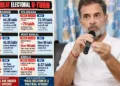
Donald Trump’s initial announcement of 25% tariff on Indian goods and a penalty for India’s continued import of Russian crude oil and military hardware was met with predictable criticism from New Delhi, but from Rahul Gandhi, it drew endorsement. Within hours of Trump labelling India a “dead economy,” Rahul declared, “Yes, he (Trump) is right, Everybody knows this except the Prime Minister and the Finance Minister. Everybody knows that the Indian economy is a dead economy. I am glad that President Trump has stated a fact… The entire world knows that the Indian economy is a dead economy. BJP has finished the economy to help Adani…” In doing so, Rahul not only legitimised a foreign leader’s hostile economic claim against India but actively weaponized it for domestic politics. Instead of defending India’s economic interests, sovereign rights or challenging Washington’s punitive measures, he sided with the tariff-imposing president, precisely when unity was needed to protect India’s trade and strategic autonomy.
Rahul’s stance fits into a broader Congress approach, undermining India’s economic credibility abroad to weaken the Modi government domestically, hoping strained India-US ties will divert investment to China, thereby amplifying the “dead economy” narrative, and avoiding criticism of US penalties on Russian imports despite these measures targeting India’s sovereign defence and energy decisions.
Even as China, despite border tensions, criticised US tariffs on India, Rahul refused to align with national interest. By standing with Trump’s assertion, he indirectly backed a position that would limit India’s strategic independence and expose its economy to external coercion. This mirrors his earlier willingness to amplify foreign narratives during sensitive moments, such as during Operation Sindoor, when Trump’s comments on “mediation” in Indo-Pak disputes were being used to pressure India on trade negotiations. In essence, Rahul’s politics thrives on portraying India as weak abroad to create anger at home, an approach that risks long-term national damage for short-term political gain.
Pakistan: Exploiting Tensions for Strategic Leverage
If Rahul Gandhi sees strained India-US ties as a political opportunity, Pakistan sees them as a strategic opening. Islamabad’s posture of seeking “better relations” with India immediately after Trump second victory in 2024 was never an act of goodwill, it was pure geopolitical calculation brough out of fear. When Donald Trump, in his first term, took an openly hard line against Islamabad, cutting foreign aid, halting USAID projects, and publicly slamming its record on terrorism, Pakistan realised it was cornered. Trump’s history of warm working relationship with Prime Minister Modi left Islamabad with little room for provocation.
So, when Trump returned to power in 2024, Pakistan initially tried to avoid direct confrontation with India, not because it embraced peace, but because it knew that crossing swords with New Delhi would invite diplomatic and economic isolation. However, Pakistan’s ultimate objective never changed, to see India-US relations weakened, creating space for itself to regain lost influence in Washington.
As soon as the current trade tensions and tariff disputes between New Delhi and Washington surfaced, Islamabad saw its opportunity like Rahul Gandhi. With cracks appearing in the India-US dynamic, Pakistan moved quickly to reinsert itself into the American orbit. This was evident in the sudden spate of high-profile engagements, US Secretary of State Marco Rubio’s meeting with Pakistan’s Deputy PM and Foreign Minister Ishaq Dar in Washington, the June Whitehouse visit by Pakistan Army Chief Field Marshal Asim Munir and the July trip by CENTCOM chief Gen. Michael Erik Kurilla, who was even awarded Pakistan’s Nishan-i-Imtiaz.
These were not routine diplomatic courtesies, they were calculated steps to exploit the rift between India and the US. Far from playing a constructive role, Pakistan has been quietly adding fuel to the fire, using its renewed access to the Trump administration to spread anti-India narratives, undercut India’s position in Washington, and lobby for increased US financial and military aid to shore up its collapsing economy and faltering military apparatus after Operation Sindoor.
In short, Pakistan’s so-called outreach to India was never about stability, it was about biding its time. Now that it senses weakness in the India-US partnership, it is rushing to fill the gap, not to promote peace, but to deepen the fracture its own strategic gain. The deeper the trade rift between Washington and New Delhi, the more space Islamabad gets to position itself as a useful partner to the US, at India’s expense. Congress’s posturing plays into this design. By echoing Trump’s economic attacks on India, Rahul Gandhi inadvertently strengthens Pakistan’s narrative that India is economically mismanaged under Modi and thus unfit for equal footing in Washington’s eyes. In the zero-sum strategic thinking of Islamabad, every strain in the Modi-Trump dynamic is a gain for Pakistan.
Khalistan: Manufacturing Propaganda from Washington to Punjab
Khalistani separatists, facing a hostile White House under Trump, have seized on the India-US tariff dispute to revive their anti-India propaganda similar to Pakistan and Congress. Trump’s re-election was a setback for their cause, given his alignment with moderate Sikh communities, support for Hindu nationalist positions, and open condemnation of separatist violence.
With genuine support in US political circles, Khalistani outfits have turned to information warfare. The latest example a fabricated letter allegedly from Trump to terrorist Gurpatwant Singh Pannun, timed to circulate just days before a pending US-India trade deal.
This letter, built on a generic White House template easily traceable online, was pushed by dubious pro-Khalistani platforms such as deepstatepress.com. Its purpose is to create the illusion of US endorsement for the August 17 Khalistan “referendum” in Washington DC, undermine Indian diplomatic credibility by suggesting the US President is sympathetic to separatist demands, and exploit trade tensions to plant doubts about US reliability as an Indian ally.
Pannun himself has a history of publicity stunts, including paying his way into Trump’s swearing-in ceremony to stage photographs suggesting political influence. The August referendum is being aggressively marketed as having “US support,” with Pakistan Strategic Forum (PSF) and pro-Khalistani handles amplifying the falsehood across social media. By using the tariff dispute as a smokescreen, Khalistan lobbies aim to convince diaspora audiences that Washington is rethinking its stance on separatism, when in reality, this is a manufactured lie designed to fracture trust between India and the US.
A Unified Front Against India’s Strategic Position
The ultimate aim of this invisible alliance of convenience is regime change in New Delhi, undermine India’s sovereignty and global standing. Rahul Gandhi and Congress seeking to seize power by dislodging the Modi government, Pakistan working to destabilise India through strategic disruption and radicalisation, and Khalistanis’ striving to tear Punjab away from the Union. These agendas, though packaged differently, operate through overlapping methods, and all benefit from strained India-US relations and a weakened Modi-Trump rapport. Congress damages India’s economic reputation by amplifying foreign criticism during sensitive trade disputes. Pakistan uses the rift to deepen its US ties, seeking aid and military patronage while presenting itself as a “reasonable” counterweight to India. Khalistan exploits the tensions to peddle fabricated claims of US sympathy for separatism, targeting both India’s territorial integrity and its international standing.
For India, the challenge is not just countering tariffs or propaganda, but recognising that these actors, domestic, foreign, and separatist, are part of a mutually reinforcing ecosystem. Their shared interest lies in weakening India’s negotiating hand, isolating it from key partners, and eroding public trust in its leadership.
At a moment when global politics demand strategic cohesion and national unity, these agendas serve only to fracture India’s position. The Modi-Trump working relationship, however imperfect, remains a pillar of India’s leverage in Washington. To undermine it is to play directly into the hands of those, whether in political opposition, foreign capitals, or separatist enclaves, who see a diminished India as their best opportunity.