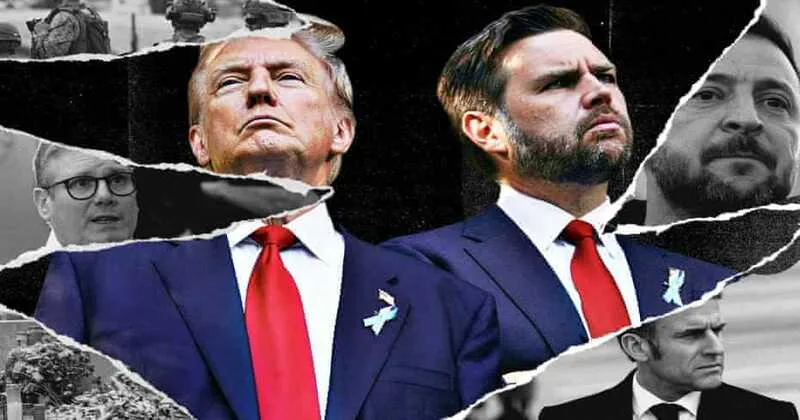
In a deeply troubling turn of events, the world appears to be spiralling back into the darkest chapters of the 20th century, as Western powers, led by the United States and Europe, stoke both a nuclear arms race and a tariff-driven trade war. With Russia officially withdrawing from the historic 1987 Intermediate-Range Nuclear Forces (INF) Treaty and US President Donald Trump launching a punitive wave of protectionist tariffs, the fragile global order is being deliberately upended. At a time when nations like India are championing multilateralism, strategic autonomy, and collective growth, the West is reviving Cold War militarism and interwar-era economic nationalism.
Cold War Treaties in Ruins
Russia’s latest decision to exit the INF Treaty, signed to end the Cold War arms race, comes amid escalating tensions with the United States over Ukraine. The treaty, originally brokered between Mikhail Gorbachev and Ronald Reagan, banned land-based nuclear and conventional missiles with ranges between 500 and 5,500 kilometres. It led to the destruction of nearly 2,700 missiles and stood as a rare pillar of mutual disarmament between the two nuclear giants. But with the US having already walked away from it in 2019 under Trump’s first term, citing alleged Russian violations and China’s exclusion, the treaty had been on life support.
Now, six years later, Russia has followed suit,revoking its earlier moratorium and accusing the US and its allies of threatening its security. The immediate provocation came after Trump ordered the deployment of nuclear submarines near Russian waters and announced the planned stationing of Typhoon and Dark Eagle missile systems in Germany by 2026. In response, Russia has warned of “serious consequences,” announced new missile deployments in Belarus, and reaffirmed its lowered nuclear threshold under a revised doctrine. The global arms control regime is in freefall.
Protectionism Returns to the Global Stage
At the same time, President Trump has reignited a global trade conflict by slapping 50 percent tariffs on Indian exports, accusing New Delhi of profiting from discounted Russian crude oil. Ignoring India’s sovereign trade choices and its pursuit of energy security, Trump’s tariff offensive mirrors the protectionist surge of the 1920s and 30s that deepened the Great Depression, fractured global cooperation and ended in WW2. Worse still, Trump has issued ultimatums to Russia over the Ukraine war, threatened severe sanctions, and mocked India’s natural stance. This reversion to a zero-sum, might-is-right approach to diplomacy has shattered decades of economic integration.
Instead of learning from the horrors of two world wars and the Cold War, the West seems intent on repeating them. The United States has successively dismantled the arms control architecture built over decades: the Anti-Ballistic Missile Treaty withdrawn under George W. Bush in 2002, the Open Skies Treaty scrapped by Trump in 2020, and now, the INF and New START Treaties are all but defunct. The final thread, New START, signed in 2010 to limit strategic nuclear warheads, hangs by a thread. After halting data sharing in 2023, Russia suspended its participation, accusing Washington of non-compliance. This systematic erosion of arms control agreements and trade pacts signals a dangerous drift toward a world dominated by unchecked militarism and isolationism. Instead of fostering cooperation, the Western powers are accelerating division, competition, and confrontation.
Even as the US accuses Russia of breaching the INF by deploying the Oreshnik missile in Ukraine, it fails to reflect on its own violations and escalations. The deployment of nuclear-capable assets in Europe, coupled with aggressive rhetoric and military posturing, fuels instability across the continent and beyond. The Trump administration’s decision to cut a 50-day ultimatum to Russia down to just 10–12 days, backed by nuclear threats, reflects the sheer recklessness at play. When former Russian President Dmitry Medvedev warned of Cold War-style retaliation, Trump responded by dispatching submarines and dismissing the crisis as political theatre.
India’s Voice of Stability and Peace
Amid all this, India, one of the global powers, stands as a voice of sanity. Rather than choosing sides in a polarised world, India continues to uphold the principles of multilateral dialogue, diplomacy, collective growth and peaceful development. Its independent foreign policy allows it to engage both the West and Russia, advocating for diplomacy over threats, for energy security over sanctions, and for development over destruction.
Yet Trump’s administration has responded to this maturity with hostility. By targeting India’s economic interests and criticising its legitimate oil trade with Russia, Washington exposes its frustration at being unable to dictate global narratives. Ironically, while claiming to promote freedom and democracy, the West is punishing countries for exercising their sovereignty. India, far from fuelling war, has consistently advocated for ceasefire, peace negotiations, and humanitarian support, principles abandoned by the war-hardened West.
The broader consequence of this dual-front escalation, military and economic, is catastrophic. A renewed arms race, particularly with intermediate-range nuclear missiles, threatens not only Europe but large parts of Asia. Simultaneously, an escalating trade war undermines global supply chains, stokes inflation, and jeopardises the economic recovery post-COVID. For developing nations, who bear the brunt of these crises, this is nothing short of imperial arrogance dressed up as global leadership.
In their hunger for dominance, Western powers are reversing the gains of globalisation, diplomacy, and disarmament. By weaponizing both trade and treaties, they are dragging the world back by a century, to an age of trenches, tariffs, and total war. Instead of building a shared future, they are tearing down the very frameworks that enabled decades of relative peace and prosperity.