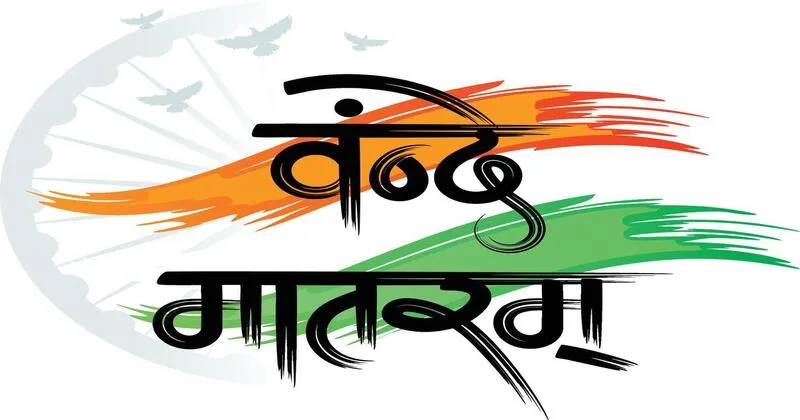
In the long and painful journey of India’s struggle for independence, certain words ignited revolutions, not just thoughts. Some phrases transcended literature to become battle cries, prayers, and sacred chants of devotion to the motherland. Of these, none is more powerful and enduring than ‘Vande Mataram’ not merely a song, but a mantra, a soul-stirring invocation that awakened a sleeping civilization. As the nation commemorates 150 years of ‘Vande Mataram’, this is not merely an act of historical remembrance. It is a moment of national reawakening, to recognize the words that forged a collective conscience, inspired countless revolutionaries, and infused into the Indian heart a sense of sacred patriotism that was spiritual, cultural, and political all at once.
Penned in 1875 by the literary titan and philosopher Rishi Bankimchandra Chattopadhyay, ‘Vande Mataram’ first appeared in the novel ‘Anandamath’ (published in 1882). But long before that, it was alive in his heart. The song’s first stanza, “Sujalam suphalam malayaja shitalam” painted an idealized image of a lush, nourishing, and protective Mother India. Bankim saw the nation not as a mere landmass, but as a divine mother sacred, sentient, and worth every sacrifice. ‘Vande Mataram’ provided what India desperately needed: a unifying symbol and a mantra to bind diverse peoples into one national consciousness.
The idea that India is a mother was not new in Hindu thought; it had always existed in the spiritual traditions of Bharatvarsha. But Bankim crystallized this spiritual concept into a modern political identity. For the first time, India was not just a territory but a deity, a living goddess in whose service all duties and sacrifices became sacred. This transformation of land into mother, and of song into mantra, laid the ideological foundation for Bharat’ nationalist struggle. Bankim did not preach rebellion in slogans. He whispered it into the Indian soul through rhythm, raga, and reverence.
Ironically, in the early years, ‘Vande Mataram’ did not receive widespread attention. Even after ‘Anandamath’ was published, the song failed to capture the popular imagination. Bankim, deeply pained, expressed this disappointment in a letter to his friend Kali Prasanna Ghosh: “What good is it if I write Anandamath and you explain its meaning, if our people care more about their stomachs than their souls? Call it Vande Udaram!” Yet, even amid that despair, he held an unshakable conviction. On his deathbed, Bankim told his daughter, “Just wait 20 or 30 years, and you’ll see this song dance in the blood of the people.” Indeed, his words came true. The silent chant would soon turn into the battle cry of a new India.
If Bankim was the composer, then Sri Aurobindo was the priest who awakened the mantra into conscious force. Writing in the nationalist journal ‘Bande Mataram’ in 1907, Aurobindo called Bankim ‘the Rishi of the new age’, and wrote, “Among the Rishis of the later age we must include the man who gave us the reviving Mantra which is creating a new India the Mantra, Vande Mataram.” For Aurobindo, ‘Vande Mataram’ was not merely a national song; it was a spiritual awakening, a mantra that invoked divine power into the life of a subjugated people. He further stated, “This is the religion of patriotism…the master idea of Bankim’s writings. The third and supreme service of Bankim to his nation was that he gave us the vision of our mother.” This vision of the mother, as a ten-armed Durga, as Lakshmi, as Saraswati, became the spiritual fuel of India’s revolutionary fire. The ‘Mother’ was not a metaphor, she was real. And fighting for her freedom was a religious duty.
The moment of national ignition came on August 7, 1905, in Kolkata’s College Square. In protest against Lord Curzon’s Partition of Bengal, thousands of students gathered, chanting ‘Vande Mataram’ as they marched towards Town Hall. That day, the air trembled with the sound of liberation, ‘Vande Mataram’ was no longer a song, it was a battle cry. The meeting at Town Hall began with a rendition of the song. It wasn’t mere symbolism, it was a spiritual invocation before battle. From that day onwards, ‘Vande Mataram’ became the anthem of India’s independence movement, sung at Congress sessions, revolutionary secret societies, and street protests. Its power was so overwhelming that British authorities began to ban its public recitation, fearing its explosive emotional impact. But it was too late. The mantra had entered the bloodstream of the nation.
The earliest music for ‘Vande Mataram’ was composed by Yadu Bhatta, a musical genius who set the song to Raag Mallar with Taan in Qawali style. His rendition gave the mantra sonic power a rhythm to match the heartbeat of revolution. Music and mantra combined to create a spiritual war-drum. Over time, several musical adaptations followed, but the essence remained unchanged; it was a devotional offering to the motherland. One that moved not just feet, but souls.
And yet, despite its immeasurable contribution to India’s freedom, ‘Vande Mataram’ did not receive the full national status it deserved after independence. Yes, it was designated the ‘national song’, but never accorded the equal status of the national anthem. Worse, under sectarian pressure, several lines particularly the ones referring to the goddess Durga, such as “Tvam hi Durga Dasapraharnadharini”, were removed or excluded from public renditions. Under pressure from sectarian quarters and a rising Nehruvian consensus that equated secularism with the systematic erasure of Indic spiritual symbols, these lines were censored from public renditions. This was not an act of neutrality, rather it was an act of appeasement.
A conscious decision was made to pacify certain vote banks and ideological camps that saw Bankim Chandra Chattopadhyay’s vision of Bharat Mata as incompatible with their narrow definition of secularism. In reality, this wasn’t secularism at all, it was soft bigotry dressed in liberal robes, a selective suppression of civilizational pride to curry favour with those uncomfortable with India’s cultural roots. This distortion is not just a cultural loss, but a civilizational disservice. It erases the very spirit in which our freedom fighters Hindus, Muslims, Sikhs, Christians alike embraced ‘Vande Mataram’ as their own.
As we mark 150 years of ‘Vande Mataram’, it is time to reclaim the song in its totality. The present Government of India has taken steps to give the song its due reverence. But mere legal recognition is not enough. We need to reinfuse its spiritual power into national life in schools, in public ceremonies, in popular culture not as a forced slogan, but as a shared heritage.
As we stand at a new crossroads fighting ideological subversion, civilizational confusion, and cultural amnesia ‘Vande Mataram’ offers more than nostalgia. It offers the proper direction. It reminds us that Bharat is not just a geography, but a spiritual idea. That freedom is not just a legal status, but a state of collective soul-awakening. And that the nation is not a contract, but a mother worth loving, serving, and dying for. Let us bring back the full glory of this mantra. Let us restore Bankim’s vision, Aurobindo’s fire, and India’s pride in the sacred syllables of ‘Vande Mataram’.