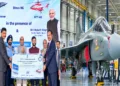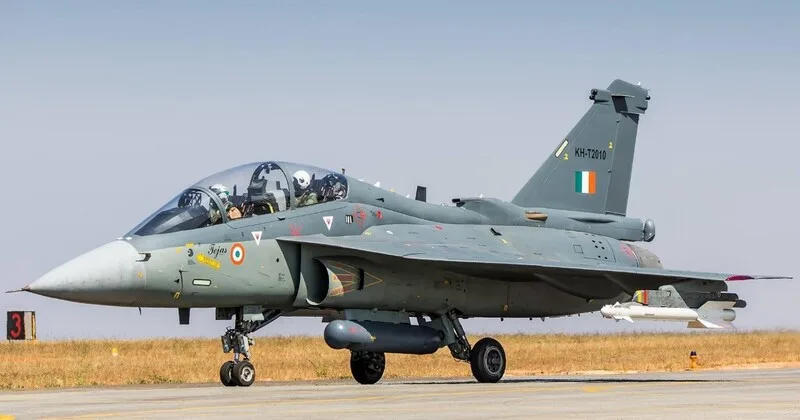
After arrival of GE 404 engine for Tejas MK1A, another milestone event took place in Coimbatore, Tamil Nadu on July 17, 2025. First swadeshi set of wings for the locally designed Light Combat Aircraft (LCA) Tejas Mk1A was formally handed over by Larsen & Toubro (L&T) to Hindustan Aeronautics Limited (HAL). This handover ceremony has marked a significant step forward of Bharat’s defence self-reliance mission under the Aatmanirbhar Bharat Abhiyan. For Bharat this was not a production milestone. It is a moment that reflects nation growing capability to mass-produce defence systems indigenously.
Referring to this event, Secretary (Defence Production) Sanjeev Kumar, called it a crucial step towards strategic independence. He praised HAL for fostering cooperation with private players, helping them to upgrade and enhance their manufacturing capacity. “The Tejas is not merely a fighter aircraft, each indigenous component we produce is a step towards strategic independence. We must look beyond and reduce our reliance on foreign vendors,” he stated. The assemblies were handed over to M Abdul Salam, General Manager of HAL’s LCA Division, symbolising the successful partnership between the public and private sectors in Bharat’s defence production network.
The handover also remarks the growing involvement of the private sector, in creating a parallel aircraft structural assembly line to support nations growth without compromising the production and to accelerate delivery schedules. L&T, which has been trusted with manufacturing from long time ago, the wing assembly line expects to produce four sets annually. Scaling up to 12 sets per year through automation and advanced assembly methods is the new target. Senior Vice President at L&T Precision Engineering & Systems pointed out that the project is not just about manufacturing, it is all about building capabilities for future indigenous aircraft programmes.
Indigenous development matters to Bharat
The Tejas Mk1A holds strategic value for the Indian Air Force which is acquired to fulfil the declining squadron strength amid rising regional threats from China and Pakistan. The strategic importance of the Tejas Mk1A cannot be ignored. IAF operating only 31 squadrons against a total sanctioned strength of 42, early induction of Tejas aircraft is critical to maintaining air superiority, especially along borders. Its indigenous manufacturers also guarantee that, during crises spares and maintenance will be readily available. Defence experts believe that the Tejas will become the backbone of the IAF’s light combat fleet in the coming decade.
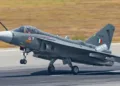
Tejas Mk1A is a landmark in indigenous engineering. Designed by the Aeronautical Development Agency (ADA) and manufactured by HAL. The advanced jet is equipped with the indigenous ‘Uttam’ Active Electronically Scanned Array (AESA) radar, air-to-air refuelling capability and a modern electronic warfare suite for enhanced survivability and the increased capability to fire advanced weaponry like the Astra Mk beyond visual-range air-to-air missile.
The Indian Air Force (IAF) has already ordered 83 Tejas Mk1A jets at a cost of Rs 48,000 crore, with negotiations underway for 97 more worth ₹67,000 crore. These aircraft will gradually replace aging MiG-21s, enhancing the IAF’s combat readiness while reducing dependence on foreign jets and spare parts.
Benefits of Tejas Wing and its capabilities
The delta wing design on the Tejas, provides excellent manoeuvrability at both low and high speeds. Even at a high speed, the delta wing allows it for tighter turns and quicker direction change which is crucial for air-to-air combat. This delta design also allows the aircraft to operate at higher angles of attack, so it can fly with the nose pointed upwards at a steeper angle without stalling by generating more lift.
Short Take-off and Landing (STOL) capabilities are there in Delta wings, which make Tejas Mk1A suitable for both Indian Navy and Air Force. Combat aircraft such as the Dassault Mirage fighters and the Eurofighter Typhoon has utilized delta wings in order to attain higher agility, speed, and manoeuvrability. With increasing interest in hypersonic flight where flight speeds are more than five times faster than sound, delta wings are once again under consideration for their aerodynamic capability at ultra-high speeds.
Atmanirbhar Bharat and Private organisation
In past four months we have witnessed the deliviery of different entites of aircraft by different organizations is, what makes the Tejas Mk1A programme a true intitative of Aatmanirbhar Bharat is its indigenous supply chain. Several Bhartiya companies contribute by making components: Lakshmi Machine Works provides air intake assemblies, Alpha Tocol manufactures the rear fuselage of jets, Tata Advanced Systems produces fin and rudder assemblies, Amphenol work on loom assemblies and VEM Technologies delivering the centre fuselage. L&T wing assemblies complete the chain of LCA component. This wide participation of private firms and MSMEs ensures that nearly all of the aircraft’s structural parts are made in Bharat, thus minimising dependency on foreign and strengthening the strategic position through advancements.
HAL has made three production lines, with two in Bengaluru and one in Nashik aiming to supply 24 aircraft per year and planning to increase this to 32 per year. GE Aviation is supplying F404-IN20 engines at a rate of two engines per month. The Ministry of Defence has also supported this ecosystem by committing that 75% of its defence capital procurement budget will be directed to domestic industries. Thus, inviting private manufacturers to invest in defence manufacturing.
Future of Indian Air Force
Apart from meeting local requirements, the Tejas Mk1A also offers enormous export potential. The aircraft make in has already generated interest from various NATO and non-NATO allies in Southeast Asia, the Middle East and Africa as a low-cost alternative to Western fighter aircrafts. With L&T’s manufacturing ability and HAL’s increasing global outreach. Tejas is set to become a part of friendly nation fleets, Bharat is shifting from a defence importer to a world supplier of cutting-edge military platforms. The Tejas programme also opening the way for indigenous fighter planes in the future, such as the LCA Mk2 and the ambitious Advanced Medium Combat Aircraft (AMCA) programme.
The Tejas wing sets that were exported to HAL are not just structural components but also a reflection of Bharat’s determination to own its air dominance and its future through self-reliant technology. As HAL’s DK Sunil rightly claimed, “The Tejas programme is not a defence project; it is the pride of Bharat, the essence of Aatmanirbharta.” With every indigenous part produced and every fighter jet inducted, Bharat is one step closer to becomes a fighter jet dominant country. The Tejas Mk1A wings are truly Aatmanirbhar Bharat’s wings, ready to soar high on national pride, innovation and confidence.