India-Taiwan ties amid China tensions
June 24, 2026
  • Read Ecopy
  • Circulation
  • Advertise
  • Careers
  • About Us
  • Contact Us
Android AppiPhone AppArattai
Organiser
  • ‌
  • Bharat
    • Assam
    • Bihar
    • Chhattisgarh
    • Jharkhand
    • Maharashtra
    • View All States
  • World
    • Asia
    • Europe
    • North America
    • South America
    • Africa
    • Australia
  • Editorial
  • International
  • Opinion
  • RSS @ 100
  • More
    • Op Sindoor
    • Analysis
    • Sports
    • Defence
    • Politics
    • Business
    • Economy
    • Culture
    • Special Report
    • Sci & Tech
    • Entertainment
    • G20
    • Azadi Ka Amrit Mahotsav
    • Vocal4Local
    • Web Stories
    • Education
    • Employment
    • Books
    • Interviews
    • Travel
    • Law
    • Health
    • Obituary
  • Subscribe
    • Subscribe Print Edition
    • Subscribe Ecopy
    • Read Ecopy
  • ‌
  • Bharat
    • Assam
    • Bihar
    • Chhattisgarh
    • Jharkhand
    • Maharashtra
    • View All States
  • World
    • Asia
    • Europe
    • North America
    • South America
    • Africa
    • Australia
  • Editorial
  • International
  • Opinion
  • RSS @ 100
  • More
    • Op Sindoor
    • Analysis
    • Sports
    • Defence
    • Politics
    • Business
    • Economy
    • Culture
    • Special Report
    • Sci & Tech
    • Entertainment
    • G20
    • Azadi Ka Amrit Mahotsav
    • Vocal4Local
    • Web Stories
    • Education
    • Employment
    • Books
    • Interviews
    • Travel
    • Law
    • Health
    • Obituary
  • Subscribe
    • Subscribe Print Edition
    • Subscribe Ecopy
    • Read Ecopy
Organiser
  • Home
  • Bharat
  • World
  • Operation Sindoor
  • Editorial
  • Analysis
  • Opinion
  • Culture
  • Defence
  • International Edition
  • RSS @ 100
  • Magazine
  • Read Ecopy
Home Bharat

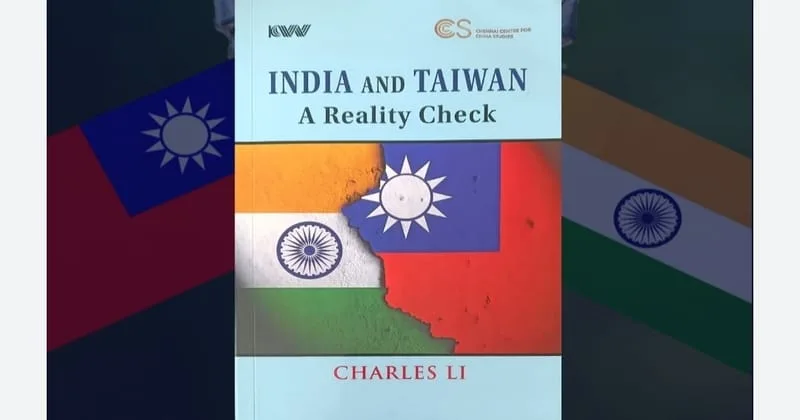
Book review| India and Taiwan: A reality check

India and Taiwan: A Reality Check by Charles Li offers a rare, insightful exploration of the complex and discreet India-Taiwan relationship shaped by historical ties and geopolitical challenges. This book sheds light on the strategic significance of Taiwan for India amid evolving China dynamics

Ameya KulkarniAmeya Kulkarni
Jul 12, 2025, 06:30 pm IST
in Bharat, World, East Asia, Book Review, International Edition
Follow on Google News
FacebookTwitterWhatsAppTelegramEmail

There are few books on India-Taiwan relations, let alone a comprehensive one. That is why India and Taiwan: A Reality Check, written by a Taiwanese career diplomat who was posted in India, merits attention. India and Taiwan — two robust and pulsating democracies — do not share diplomatic relations. India withdrew diplomatic recognition to the Republic of China (RoC), the official name of Taiwan, after its decision to recognise the People’s Republic of China (PRC) on December 30, 1949.

Also Read: From Palm Leaves to Pixels: Gyan Bharatam Mission set to digitise 50 crore pages of Indian manuscript treasure

Following India’s “One China Policy”, New Delhi has had no diplomatic relations with Taiwan. But, as Charles Li points out, India’s interaction with Taiwan has generally been discreet, primarily at non-official or mid-level government circles. Highlighting the strategic significance of Taiwan for India, the author quotes former foreign secretary Rajiv Sikri’s observation that closer Taiwan-China relations could allow Beijing to redeploy many of its missiles, and other military assets, currently targeted at Taiwan, to Tibet and Xinjiang, altering the military balance and creating security concerns for India.

After the protracted civil war between the Communist Party of China under Mao Zedong and the Kuomintang (KMT) under Chiang Kai-Shek, the latter fled to Taiwan and proclaimed the Republic of China with US support. Ever since, Taiwan has lived under the shadow of Communist China, which aims at national reunification with the estranged sibling by all means, including coercive military tactics. While Communist China rules the mainland, it was the KMT under the leadership of its founding father, Sun Yat-sen, that ended the moribund imperialism in the Xinhai Revolution of 1911 and ushered in republicanism. Dr Li points out that Taiwan was the first Republic in Asia.

Half of a comprehensive introduction running to about 30 pages discusses India’s economic rise, and the rest highlights the complementarity and synergies between India and Taiwan in terms of investment and high technology, including in the cutting-edge semiconductor industry.

The China factor adds an unpredictable dynamic to the delicate India-Taiwan ties. In chapter two, the author focuses on India’s relationship with China through the prism of cultural and civilisational interactions, setting the historical backdrop and political context when nationalist China under the KMT ruled the mainland before the advent of the Communist regime. The author throws light on some little-known facets of India-Taiwan relations. He relates how Kang Youwei, a reformist leader in the late Qing Dynasty, went into exile in Darjeeling in 1901 and toured India for nearly 18 months. As nationalist and anti-imperialist agitation took root in India and China, the Hindustan Ghadr Party was active in China during the period of British rule. He met with Indian students in China and offered various forms of support. Chiang Kai-shek and Madame Chiang visited India in 1942, declaring that true international peace could not exist if China or India were denied freedom.

Chapter three focuses on the evolution of India-Taiwan relations after India’s Independence. Dr Li, however, uses the terms “One China Principle” and “One China Policy” interchangeably without clarifying subtle differences between the two. “One China Principle,” which the PRC uses, denotes that if a country has diplomatic relations with China, then that country cannot have any kind of relationship with Taiwan. The “‘One China Policy,” which most countries follow, allows substantive relations with Taiwan while having diplomatic relations with the PRC. Quoting former foreign secretary Vijay Gokhale, the author contends that while withdrawing diplomatic recognition to Taiwan and recognising PRC, India unilaterally gave up crucial negotiating space and observes that “the current border dispute between India and PRC could have been avoided if proper negotiations had been conducted”. This reviewer believes India could have followed the US’s lead in the Shanghai Communique, recognising the PRC in 1972 with some caveats.

At a time when Operation Sindoor has cast a shadow on India-China relations because of China’s purported role in providing Pakistan with materiel, Dr Li recalls the recommendations of the Standing Committee on External Affairs, then headed by Shashi Tharoor. Following the border incursion by China in Doklam in 2017, the Committee observed, “… even when India is overly cautious about China’s sensitivity while dealing with China and Tibet, China does not exhibit the same deference while dealing with India’s sovereignty concerns, be it in the case ofArunachal Pradesh or that of China-Pakistan Economic Corridor (CPEC) in Pakistan Occupied Kashmir (PoK)… .The government should contemplate using all options including its relations with Taiwan, as part of such an approach….”

This is an informative and useful book in a generally under-studied field, offering analyses of the entire gamut of India-Taiwan relations. Its value would have been enhanced if the publisher and author had taken greater care to avoid numerous typos and printing errors.
 

Topics: Charles LiTaiwan diplomacyTaiwanIndia-China relations‘One-China’ policyIndia-Taiwan relations
ShareTweetSendShareSend
✮ Subscribe Organiser YouTube Channel. ✮
✮ Join Organiser's WhatsApp channel for Nationalist views beyond the news. ✮
Previous News

Tamil Nadu: HC slams IAS officers for failing to evict Church-run school from temple lands in Cuddalore for 50 years

Next News

Balrampur: Jamaluddin who ran multi-crore religious conversion racket referred to Hindu women as ‘Projects’

Related News

In China's strategic map of threats, geography continues to give India a significance that cannot be overlooked

The Rival China Cannot Ignore: Why India matters more than Beijing admits

Representative image

US-Iran-China-Taiwan: The paradox of conflicts

India rejects China’s latest renaming of places in Arunachal Pradesh, calling it a politically motivated move with no impact on ground reality

Renaming to Reclaiming Narratives: India pushes back as China expands its cartographic claims over Arunachal Pradesh

India’s expanding Indo-Pacific footprint takes shape through quiet support to Taiwan’s submarine program and deepening defence alignment with Japan.

India’s quiet Indo-Pacific strategy spans Taiwan subs, Japan defence shift, reshaping China calculus

Representative Image

Trump-synonymous with an erratic mindset; India denounces his hell-hole remark

Vikram Doraiswami

What Does Vikram Doraiswami’s appointment as India’s ambassador to China signal amid reset in bilateral ties?

Load More

Latest News

President Droupadi Murmu confers the Padma Shri on former civil servant R.V.S. Mani on June 23, 2026.

Former MHA official RVS Mani honoured with Padma Shri for contributions to internal security

Tamil Nadu: Temple funds only for temple property; TVK govt concedes before Madras High Court

Keralam’s former Industries Secretary, Mohammed Haneesh IAS (Right Side)

Keralam Cashew Scam: Former Industries Secretary Md Haneesh apologises before High Court after contempt proceedings

Tamil Nadu: Assembly Speaker directs all bureaucrats to strictly follow warrant of precedence after Mayor-MLA row

Kamakhya Mandir

Kamakhya Mandir’s Ambubachi Mela: The ancient tradition that honours the menstruation of mother Earth

Amazon in dock for mocking Hindu Gods

Amazon File: From Ganesha to Aryabhata-Has Amazon India become a platform for Anti-Hindu narratives?

The West Bengal Budget 2026–27 aims to drive growth through infrastructure, industry, innovation and welfare

Reimagining Bengal: How the West Bengal Budget 2026–27 seeks to balance growth, welfare & economic transformation

Pratiraksha is Gujarat Police's Aadhaar-based verification platform designed to identify illegal workers and prevent identity fraud in industrial sectors

Pratiraksha: How Gujarat police uses Aadhaar verification to secure industrial workforce against identity fraud

Israel-Iran crisis has highlighted not only shifting dynamics of West Asia but also growing confidence of India's foreign policy

India, Israel and the rise of strategic autonomy in an era of global geopolitical realignment

Saleem and Jaleel arrested in forced religious conversion case

Karnataka Conversion Case: Forced conversion of Hindu woman and minor son sparks outrage; Saleem and Jaleel arrested

Load More
  • Privacy
  • Terms
  • Cookie Policy
  • Refund and Cancellation
  • Delivery and Shipping

© Bharat Prakashan (Delhi) Limited.
Tech-enabled by Ananthapuri Technologies

  • Home
  • Search Organiser
  • Bharat
    • Assam
    • Bihar
    • Chhattisgarh
    • Jharkhand
    • Maharashtra
    • View All States
  • World
    • Asia
    • Africa
    • North America
    • South America
    • Europe
    • Australia
  • Editorial
  • Operation Sindoor
  • Opinion
  • Analysis
  • Defence
  • Culture
  • Sports
  • Business
  • RSS @ 100
  • Entertainment
  • More ..
    • Sci & Tech
    • Vocal4Local
    • Special Report
    • Education
    • Employment
    • Books
    • Interviews
    • Travel
    • Health
    • Politics
    • Law
    • Economy
    • Obituary
  • Subscribe Magazine
  • Read Ecopy
  • Advertise
  • Circulation
  • Careers
  • About Us
  • Contact Us
  • Policies & Terms
    • Privacy Policy
    • Cookie Policy
    • Refund and Cancellation
    • Terms of Use

© Bharat Prakashan (Delhi) Limited.
Tech-enabled by Ananthapuri Technologies