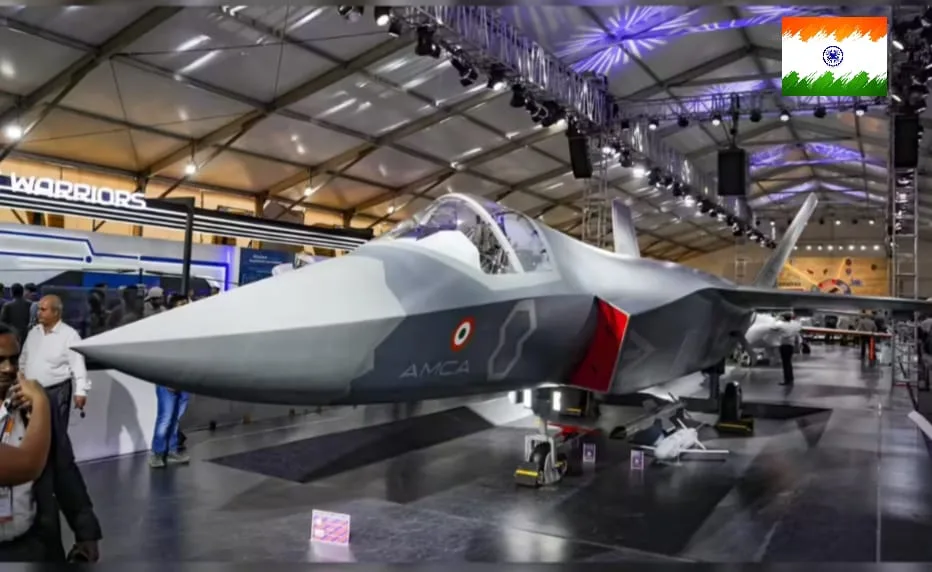
India’s ambitious fifth-generation Advanced Medium Combat Aircraft (AMCA) program is moving into a decisive phase, with Defence Secretary Rajesh Kumar Singh confirming that the development contract will be awarded within the next three to six months. His statement to media marks a major step forward in India’s pursuit of indigenous stealth fighter capability amid rising security challenges from China and Pakistan.
The AMCA, envisioned as a 25-tonne twin-engine stealth multirole aircraft for both the Indian Air Force and Navy, is being developed by the Aeronautical Development Agency (ADA) under the Defence Research and Development Organisation (DRDO). The project aims to establish the AMCA as a central pillar of Indian airpower by 2035.
Following Cabinet Committee on Security (CCS) approval in March 2024, the prototype development phase received a Rs 15,000 crore budget. The program has now adopted a public-private partnership (PPP) model approved by Defence Minister Rajnath Singh on May 27, 2025. This structure allows private firms such as Tata and Larsen & Toubro (L&T) to compete independently or in collaboration with Hindustan Aeronautics Limited (HAL), shifting away from India’s traditional reliance on HAL alone.
As part of this process, the ADA issued an Expression of Interest (EOI) on June 18, 2025, inviting Indian companies to participate in the prototype development, testing, and certification stages. Interested firms must respond by August 16, 2025. A preliminary EOI meeting held in early July provided an opportunity for potential bidders to engage with officials and ensure compliance with regulatory and technical requirements.
Once selected, the private partner will be required to establish production infrastructure and complete development within eight years of signing the contract. The first prototype is targeted for rollout by 2028, with a maiden flight anticipated by late 2028 or early 2029.
The AMCA is being designed for a wide spectrum of combat roles, including air superiority, ground attack, Suppression of Enemy Air Defenses (SEAD), and electronic warfare. It will feature internal weapons bays supporting up to 1,500 kg, an external payload of 5,500 kg, and an internal fuel capacity of 6,500 kg. The Mk1 version will initially be powered by U.S.-origin General Electric F414 engines producing 98 kN of thrust. The Mk2 variant will later incorporate a 110 kN indigenous engine being developed by DRDO’s Gas Turbine Research Establishment (GTRE), in collaboration with a likely foreign partner, reportedly France’s Safran.
The contract is expected to be awarded between October 2025 and January 2026, setting the stage for intensive development work. DRDO Chief Dr. Samir V. Kamat has stated that developmental trials will be concluded by 2034, enabling full-scale production by 2035.
As India pushes forward with engine co-production talks for the F414 and builds on recent operational successes, including the Tejas Mk1A’s performance in Operation Sindoor, the AMCA program stands as a symbol of India’s drive to establish a modern, self-reliant defense industry capable of responding to evolving regional threats.