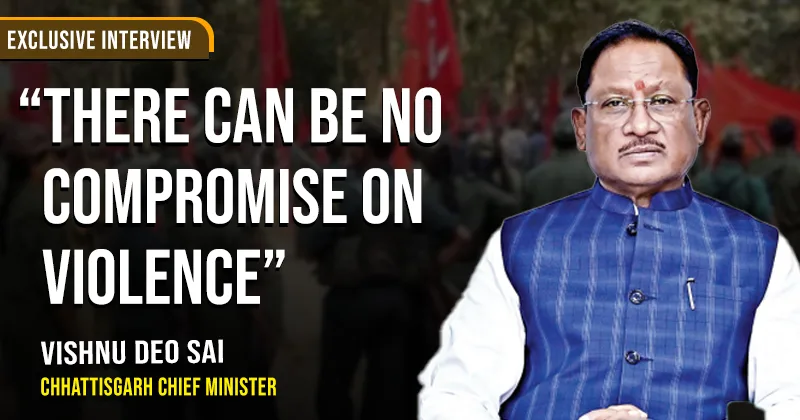
After the Modi Government’s deadline of eliminating the Left Wing Extremism (LWE) from the country by March 2026, security forces have stepped up operations against Maoists and eliminated big Maoist leaders recently. In an exclusive interview with Organiser Senior Assistant Editor Nishant Kumar Azad, Chhattisgarh Chief Minister Vishnu Deo Sai spoke about the ongoing anti-Maoist operations, peace talks request from CPI (Maoists), developmental work in Bastar region, and much more. The Chief Minister also shares his Government’s plan to transform Bastar through welfare projects and inclusive policies. Excerpts:
While security forces are conducting intense operations against Maoists, recently in a retaliatory action, Maoists killed three relatives of surrendered cadres. How do you see this major attack?
Maoism is counting its final breath. Under the successful leadership of Prime Minister Narendra Modi and in accordance with the resolve of Home Minister Amit Shah, it is certain that this terror will be eradicated by March 2026. The Maoists now have very few options left. Either they must surrender and join the mainstream, or the security forces will deal with them firmly. Defeated at every level, they are now carrying out cowardly acts in frustration. A fitting response will be given to this as well. Every drop of blood of our tribal brothers and sisters, who lost their lives in the attacks, and of the brave security personnel who made the ultimate sacrifice, will be accounted for.
Since your Government came to power, security forces have achieved major success. How important were these two missions?
The elimination of top Maoist leaders including Basavaraju and Sudhakar marked a critical turning point in the fight against LWE in Bastar. These missions sent a strong message to the Maoist network that even their most secure forest bastions are no longer beyond the reach of our forces.
The success of these operations reflected a broader strategic shift in the Government’s approach to Bastar. A concerted focus on expanding the security footprint with the establishment of new security camps in previously inaccessible areas provided the necessary ground control for long-term operations. In addition, the State launched an ambitious surrender & rehabilitation policy that offered monthly financial support, land allotments, and skill-based training to surrendered cadres. This twin-track policy—combining firm action against hardcore insurgents with genuine reintegration opportunities for those willing to give up arms—helped shift dynamics on ground.
Union Home Minister Amit Shah has set a deadline to end Maoist violence across the country by March next year. Do you think your Government is on track to achieve this goal?
The State Government appears firmly aligned with this target and has already demonstrated significant momentum in achieving it. Since our Government came to power, more than 1,355 Maoists have surrendered and over 1,437 have been arrested—figures that signal a weakening insurgency both in terms of manpower and morale. The killing of top leaders further crippled organisational structure of the CPI (Maoist), disrupting their strategic command. The progress we have made is substantial. We have witnessed a notable 40 per cent reduction in violent incidents. This shift, combined with our sustained efforts in security, development, and community engagement, gives us strong confidence that we will meet the deadline set for a Naxal-free Chhattisgarh by March next year.
After the recent operations in Abujhmad, Bijapur and other areas, some Leftist parties have started calling these encounters as ‘extra-judicial killings’.
Such allegations are baseless and agenda-driven. All operations have been conducted within the framework of the law and with due process. These were not just arbitrary actions; attempts to label them as ‘extra-judicial’ ignore both the ground realities and the sacrifices made by our bravehearts.
Now that security forces have tightened control in Naxal regions, Maoists are calling for peace talks.
While the Government is not opposed to dialogue, any talks must be unconditional and within the framework of the Constitution. There can be no compromise on violence or national integrity.
Last September, victims of Maoist violence protested in Delhi. They also met you and the Governor recently, asking for continued operations against the Maoists. Do you think people are now more vocal and want to end this problem for good?
Yes, there is a clear shift on the ground. People, who once lived in fear, are now speaking out and demanding a permanent end to Maoist violence. The protest in Delhi and recent meetings with victims reflect a growing public resolve to reject extremism. Families, who have lost loved ones to Maoist attacks, want justice and lasting peace, not empty assurances. This change in public sentiment is both powerful and encouraging—it strengthens Government’s mandate to continue strong operations and development efforts. People’s voice is now firmly against violence, and that is a crucial turning point in this fight.
“Since our government came into power, more than 1,355 Maoists have surrendered and over 1,437 have been arrested—figures that signal a weakening insurgency both in terms of manpower and morale”
What policies and support systems are in place for victims of Maoism in the State, and how do you plan to ensure their rehabilitation and justice?
Our Government is fully committed to supporting and rehabilitating all those who have suffered due to Naxal-related violence—be it families of victims or those who have taken the courageous step of surrendering arms. A key component of our strategy is the construction of 15,000 secure homes under PMAY in Naxal-affected regions, aimed at providing stability and dignity to such affected families. We have also implemented a comprehensive and humane rehabilitation policy for surrendered Naxalites. Schools that were once shut due to violence have reopened, and new schools and infrastructure are being established even in remote areas like Rekavaya in Abujhmad and Chilkapalli in Bijapur, where electricity and roads have reached for the first time.
Through initiatives like the Niyad Nella Nar Yojana, we are taking governance directly to the doorstep of tribal households—ensuring access to healthcare, education, infrastructure, and security. The state has targeted villages within a five‑kilometre radius of newly established security camps, ensuring they receive a full suite
of basic amenities. Efforts are being made to provide legal aid, counselling, and social security benefits to victims and their families. Steps are being taken to involve women in self-help groups and community-based livelihoods, making them active participants in local development.
Do you believe that development, along with strong security, is the real solution to eliminate Maoism?
Yes, I believe it is. Over 130 villages, previously cut off from progress, are now experiencing significant improvements. In these villages, the Government has facilitated the issuance of over 28,114 Aadhaar cards, 14,921 Ayushman cards, 2,587 Kisan Samman Nidhi benefits, and 7,881 MGNREGA job cards—connecting residents with identity, healthcare, income support, and livelihood schemes. In addition, 21 all-weather roads have been constructed, 17 new mobile towers installed, 18 fair-price ration shops set up, and 9 new sub-health centres made operational. These are not isolated interventions—they represent the re-entry of governance into areas previously dominated by insurgent influence.
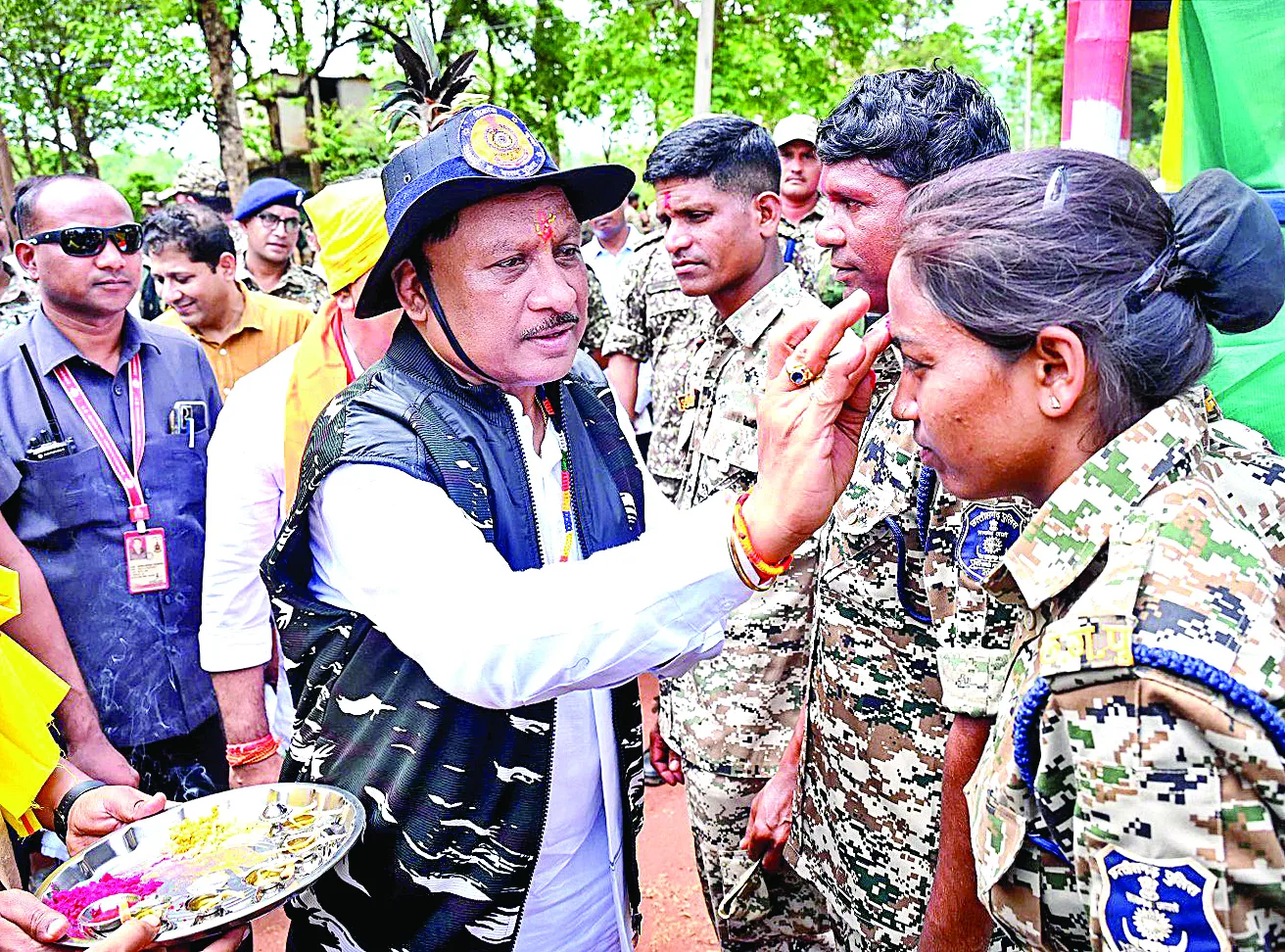
“People who once lived in fear are now speaking out and demanding a permanent end to Maoist violence. Families who have lost loved ones to Maoist attacks want justice and lasting peace, not empty assurances”
Security camps provide both physical protection and a platform for development to flourish. This integrated strategy is already bearing fruit. Where fear once bred silence and isolation, today we see active village life, renewed civic participation, and a visible shift in communal trust. Maoist narratives depend on alienation—when roads are built, lights switch on, and children go to school, that narrative begins to crumble.
Maoist sympathisers claim that the core of Maoism lies in poverty and oppression.
Maoism may have roots in poverty, but what sustains it today is ideological rigidity. The state has significantly expanded its reach in affected regions, bringing roads, schools, healthcare, and livelihood schemes to communities long ignored.The Government remains committed to addressing socio-economic challenges through inclusive development, but there can be no justification for armed rebellion in a democratic society.
Your Govt has introduced a new policy for the surrender & rehabilitation of Maoists and victims. What are the key changes in this new policy?
Chhattisgarh’s new Naxalite Surrender, Victim Relief & Rehabilitation Policy–2025 marks a significant shift from previous frameworks by offering more comprehensive, structured, and humane support to those laying down arms. One of the most notable changes is—surrendered Maoists now receive a monthly assistance of Rs 10,000 for three years, compared to lower provisions under earlier policies. Unlike the previous framework, the new policy specifically provides for land and housing: surrendered individuals are entitled to one hectare of agricultural land in rural areas or a four dismil housing plot in urban regions, a benefit that was not clearly guaranteed in the past.
A key feature of the policy is its structured 120-day reintegration process, during which surrendered cadres are housed in transit camps or rehabilitation centres and trained in employable skills—ranging from agriculture and artisan work to entrepreneurship—so they can become self-reliant. The new framework also offers reward money to surrendered Maoists, particularly those with bounties on their heads. If 80 per cent or more of a Maoist group surrenders collectively, they are eligible for twice the declared reward amount—another innovation aimed at incentivising group demobilisation. Furthermore, when an entire village is declared Maoist-free, the Government sanctions Rs 1 crore for local development.
PM Modi and other leaders of your party often use the term ‘Urban Naxal’. Is your Government planning to deal with them?
The threat of Naxalism is not confined to the forests alone; it also manifests in urban areas through individuals commonly referred to as ‘Urban Naxals’. These individuals are not only ideological sympathisers of Naxalism but also provide critical intellectual and financial support to the Maoist cadres operating in remote forest regions. The Government remains committed to tackling Naxalism in all its forms, ensuring that those who offer covert support to violent insurgency, even from within cities, are identified and dealt with under the framework of law.
What steps is the Government taking to mainstream tribal people in Naxal-affected areas?
Recognising the large tribal population in these areas, the administration is working to unlock economic opportunities by promoting agricultural development, animal husbandry, and value addition to forest produce. Plans also include transforming Naxal-hit zones into hubs of infrastructure, industry, and tourism. It includes the establishment of new industrial zones, processing units, and a balanced industrial ecosystem through the State’s new industrial policy. Educational infrastructure is also being strengthened with a focus on setting up more ITIs and polytechnic institutes. In a bid to empower the youth and curb migration or involvement with extremist groups, the Government aims to train 90,000 youths and create 40,000 job opportunities, with 32 skill development centres already operational.
With the changed efforts and new strategies, the Govt has been able to minimise Maoist activities. But are there any chances of their revival?
We are alert and committed to ensuring that they do not return. Our focus is on creating opportunities and trust among the people, so that the path of violence finds no support in the future.