
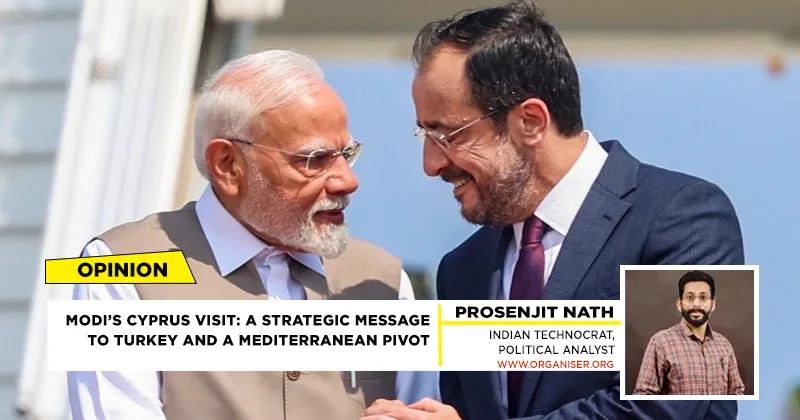
When Prime Minister Narendra Modi lands in Cyprus for his landmark visit, it will mark only the third time an Indian prime minister has visited the Mediterranean island nation. But this is far from a routine stopover or symbolic handshake summit. Modi’s meeting with Cypriot President Nikos Christodoulides signals a deliberate and calculated move in India’s evolving response to Turkey’s overt hostility. With the backdrop of the Pahalgam attack and Operation Sindoor and the increasingly combative rhetoric from Ankara on Kashmir and India’s domestic policies, New Delhi is now choosing to quietly counterbalance Turkey through a strategic encirclement and Cyprus is a crucial piece on that geopolitical chessboard.
The Turkey Factor: A Growing Rift
Turkey, under President Recep Tayyip Erdogan, has increasingly positioned itself as a champion of global Islamism, often using forums like the United Nations to attack India, especially over Jammu & Kashmir. Erdogan’s public criticism of India’s decisions in Kashmir, coupled with his deepening defense and diplomatic relationship with Pakistan, has turned Ankara from a neutral observer into a partisan player in South Asia’s conflict theater.
Whether it’s joint military exercises with Pakistan or backing Islamabad’s Kashmir stance in the Organisation of Islamic Cooperation (OIC), Turkey’s posture has become brazen. What has irked New Delhi more is Turkey’s seemingly open embrace of Pakistan’s strategic objectives an embrace that has extended beyond rhetoric to concrete defense cooperation and diplomatic support.
India’s response has not been emotional or reactive but strategically meticulous. Instead of escalating tensions directly with Turkey, it has chosen to build enduring relationships with countries that feel threatened by Ankara’s regional ambitions including Greece, Armenia, Egypt, and now Cyprus.
Cyprus and the Turkish Dispute: A Brief Overview
To understand the weight of Modi’s visit, one must examine the fraught history between Cyprus and Turkey. In 1974, Turkey invaded northern Cyprus following a failed coup backed by the Greek military junta. Although the legitimate Cypriot government was reinstated, Turkey did not withdraw its forces. To this day, Ankara occupies the northern third of the island, propping up a self-declared Turkish Republic of Northern Cyprus (TRNC) recognized by no one but Turkey.
The result is a divided island: the internationally recognized Republic of Cyprus governs the south, while Turkish troops continue to occupy the north. A UN buffer zone separates the two. This occupation has geopolitical, military, and economic implications. Turkey contests Cyprus’s exclusive economic zone (EEZ), particularly where energy exploration is concerned, and has regularly dispatched vessels into disputed waters flouting international maritime laws and brushing against EU boundaries.
In this context, Modi’s high-profile visit is not just a bilateral affair. It is a symbolic and strategic act of solidarity with a country under partial occupation and a direct adversary of Turkey.
Cyprus and IMEC: A Mediterranean Gateway
Modi’s visit also intersects with India’s broader infrastructure and trade vision especially the India-Middle East-Europe Economic Corridor (IMEC), announced at the 2023 G20 Summit. While Cyprus was not formally listed as a partner in the original IMEC blueprint, the nation’s geographical location makes it a natural fit.
Located south of Turkey, west of the Levant, and close to the Suez Canal, Cyprus is a strategic outpost in the eastern Mediterranean. Its proximity to Europe, Asia, and Africa makes it a compelling node for future trade, energy transit, and digital connectivity. As India looks to reduce its reliance on the Suez Canal bottleneck and navigate through the geopolitically unstable Gulf region, Cyprus offers both a foothold and a friend.
More critically, Cyprus sits atop significant natural gas reserves of about 12-15 trillion cubic feet. While modest compared to global giants, these reserves are politically valuable. Along with Israel and Egypt, Cyprus forms part of a new energy triangle in the Mediterranean. Its efforts to export gas via Greece or Egypt bypassing Turkish-controlled waters further irritate Ankara and underscore Cyprus’s growing role in regional energy politics.
Modi’s arrival, therefore, is not just about diplomacy; it’s about mapping India’s presence onto the future energy matrix of the region.
From Soft Power to Strategic Posture
Cyprus has consistently stood by India on the international stage. From supporting India’s nuclear tests in 1998 and the Indo-US nuclear deal in 2008 to backing India’s bid for a permanent UN Security Council seat, Cyprus has acted as a reliable partner. Unlike Turkey, Cyprus has never toed the OIC line on Kashmir, nor has it entertained Pakistan’s narrative on terrorism or international mediation.
India, in turn, has strongly upheld the territorial integrity of Cyprus and endorsed UN-led negotiations for a reunified island. Modi’s visit now upgrades this long-standing friendship to a new strategic partnership. This may include cooperation in energy, digital corridors, maritime security, and possibly even defense collaboration an area where India is already active with Cyprus’s neighbor, Armenia.
In 2023, India intensified its defense exports to Armenia another Turkish adversary including drones, missile systems, and surveillance technology. That, along with Modi’s landmark visit to Greece in the same year, confirms a subtle yet consistent shift: India is building a Mediterranean front against Ankara.
A Calibrated Signal to Ankara
Erdogan’s attempts to champion pan-Islamism and undermine India’s global standing have not gone unnoticed. Modi’s tour of Cyprus sends a clear, carefully calibrated message India will not remain passive in the face of such provocations. Instead, it will deepen ties with Turkey’s regional rivals, build lasting economic and strategic partnerships, and carve out influence where Turkey least wants it in its geopolitical backyard.
It’s also a message to the broader Islamic world: India’s friendships and strategic calculations are no longer confined by religious alignments. Realpolitik, shared interests, and mutual respect are the new driving forces.
Conclusion: A Pivot with Purpose
Narendra Modi’s visit to Cyprus is historic not only because of its rarity but because of its precise timing and layered significance. It reinforces India’s commitment to its Mediterranean partners, reasserts its presence in European corridors, and builds resilience against hostile narratives emerging from Ankara.
In a world where diplomacy is often shaped by subtle signals more than shouted declarations, Modi’s Cyprus visit is a masterstroke of strategic communication one that combines history, energy politics, defense cooperation, and geopolitical signaling in a single, consequential journey.
The message is unmistakable: India is not only watching the Eastern Mediterranean but is now actively shaping its future with Cyprus as a trusted partner and Turkey firmly on notice.