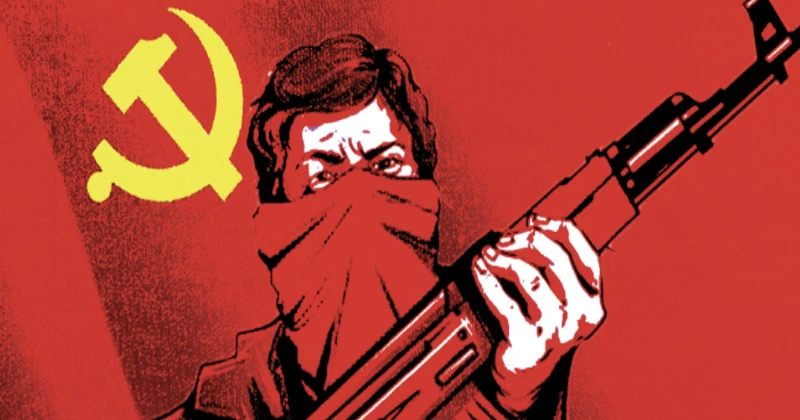
On May 21, Union Home Minister Amit Shah announced on his social media platform X that a landmark achievement had been made in the decades-long fight against Naxalism. For the first time in over 30 years, a general secretary-ranked Naxal leader was neutralized, a development Shah hailed as a historic breakthrough. In the aftermath of Operation Black Forest, 54 Naxals were arrested, and another 84 surrendered, signalling that Left-Wing Extremism was finally on its way out. The government’s stance is now sharply defined: those who choose the path of violence will be met with force; those willing to lay down arms and join the mainstream will be given a chance. With a clear deadline set — March 31, 2026 — for the complete eradication of Maoism, the tide appears to have definitively turned. Once called India’s “biggest internal security challenge” by PM Manmohan Singh in 2010, Naxalism is now visibly retreating. Naxals had planned the establishment of a Red Corridor—stretching from Pashupati in Nepal to Tirupati in Andhra Pradesh. In 2013, around 126 districts from different states reported Maoism-related violence; by March 2025, this figure had fallen to just 18 districts, with only six classified as ‘most affected.’
Driven by strong willpower, the government has shown that it will not relent under any kind of propaganda war from human rights activists in favour of hardcore Maoists who believe in acquiring power through the barrel of a gun and who don’t want to follow the democratic path. The government’s multi-pronged strategy, sustained over more than a decade, has proven highly effective. The success on the ground has been achieved by relentlessly and consistently pursuing the SAMADHAN strategy—a comprehensive approach adopted by the MHA since 2017, which combines both security measures and developmental initiatives and regularly tracks various targets using key performance indicators (KPIs).
Limitations of Early Strategies
During my deputation with the Central Reserve Police Force (CRPF) in 2010, I had the opportunity to witness firsthand the complexities of India’s prolonged conflict with Left-Wing Extremists under Operation Green Hunt.
The audacity of the problem can be gauged from the fact that in one devastating ambush of a CRPF patrol party by Naxals in Dantewada district, 76 security personnel were killed in a single incident, showing the extent of their strategic planning, skills, coordination and range of armaments. These types of attacks put the central forces in a defensive mindset. In Bijapur and Dantewada, the ground reality was so grim that road-opening parties (ROP) were deployed to avoid the risk of being ambushed or fired upon. The terrain was littered with mines, and the constant threat of IEDs or sudden burst-fire was a regular occurrence during the movement of troops.
As a result, the forces became highly defensive and remained confined to their camps instead of carrying out anti-Naxal operations. This, on the one hand, lowered the morale of the forces and, on the other, eroded the trust of the tribal population in them. This also led to a complete drying up of intelligence regarding Naxal movements. Tribals were forced to choose between the Naxals and the security forces as the state failed to offer them protection or viable alternatives. The Naxals were able to convince the tribals that they were fighting for their cause of Jal, jungle, and zameen.
The overall outcome was that in areas like Dantewada and Bijapur, the writ of the Naxals ran large. They even prevented government teams from carrying out developmental work, such as building roads and expanding telecommunication networks and electricity lines in the interior regions, to maintain their control over these so-called “liberated zones.”
A Turning Point: Strategy and Resolve
The shift from a reactive to an offensive strategy.
The overall success can be attributed to both developmental and security strategies. Targeted govt initiatives on the developmental front have been instrumental in restoring the faith of the people in this state. Road connectivity and telecommunication networks have improved significantly in the last decade. Civic action programmes carried out by CAPFs have helped win the hearts and minds of the locals, while the Roshni scheme has aided tribal youth in skill development and employment.
Apart from the developmental initiatives mentioned above, the Government has acted in a highly planned, coordinated and resolute way on the security front as well. What has made a big difference is:
- Strong political willpower shown by Central and state governments. For the first time, the Union Home Minister has set an example by leading from the front.
- Good coordination through a unified command structure between central and state forces
- The District Reserve Group (DRG), which has proven to be a game changer, primarily consists of surrendered Naxalites who possess extensive knowledge of the area and terrain and have established relationships with the locals as well. This led to improved intelligence gathering and the development of better strategies against the Naxals.
- Setting up security camps in interior areas and fortifying police stations.
- Technological intervention, especially surveillance through drones and satellite imagery, has effectively mitigated ambushes.
Bringing Naxals into the Mainstream
With the operational tide turning in favour of security forces, the next phase of counterinsurgency must focus on sustainable peace through inclusion. Winning battles on the ground is only half the victory; Rehabilitating and reintegrating Naxals into mainstream society is crucial for lasting peace. They should be encouraged to surrender and adopt democratic means to voice their grievances. The ballot, not the bullet, must drive change.
Way Forward
Although a lot has been achieved, and the Honourable HM’s deadline of ending Naxalism by March 31, 2026, is within sight, we cannot afford to be complacent.
We have to continue the pressure on the hardcore arms-wielding Naxalites relentlessly, and we have to keep dismantling their financial network as Naxals get funding from extortion and protection rackets.
The problem of Naxalism is not merely a security one but is also related to development and governance. Even as security forces dismantle the operational infrastructure of the insurgents, the risk of regrouping will remain unless structural issues are addressed. The regions most affected by Left-Wing Extremism have historically suffered from a grave development deficit. To ensure that leftist ideology does not find fertile ground again, the next phase must focus more on people-oriented governance, land rights, healthcare, education, and economic upliftment. A dual-track approach is essential: sustained security operations must be matched by a robust development strategy that addresses the root causes of extremism.
The last and most important element is an effective ideological counter-narrative. The fight is not just against armed insurgents but against an ideology; the likes of Basvaraju can be eliminated, but not an ideology. To ensure that there is no possibility of regrouping, we must remain vigilant, adaptive, and proactive. We need to counter the Naxalite propaganda effectively and regularly.
The battle for hearts and minds must be finally won not just by force but by plugging the gaps in development and governance through sustained efforts for the most marginalised sections.