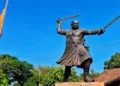
Chhatrapati Shivaji Maharaj is a legendary emperor of Indian history who will be remembered not only in the present but for generations to come. This is because, at a time when Indian society had become weakened under the continuous assaults of Islamic invaders, he undertook a successful and organised effort to awaken and revive the spirit of the nation.
In that era, when foreign aggressors attempted to destroy India’s cultural and religious values through forced conversions and widespread destruction, Shivaji Maharaj founded a powerful Hindu Samrajya, defeating all such disruptive forces.
Throughout his struggle, he not only demonstrated exceptional military acumen but also introduced visionary reforms in administration, agriculture, language, currency, and religious affairs, all rooted in the eternal Indian traditions. His rule was not just a regional power but a symbol of national pride, cultural resurgence, and the protection of Dharma.
WHY SHIVAJI – The aim of Shivaji’s Kingdom was protection of Hindu society
According to the noted Maratha historian G.S. Sardesai (Padma Bhushan in 1957), “Shivaji had a persuasive tongue. He addressed his comrades and brought home to then how the foreign Muslim rule inflicted hardships and wrongs upon their homeland and their religion. He narrated to them graphic stories of what he had seen and heard. Was it not their duty to avenge this wrong?”
He further writes, “Complete darkness prevails under Muslim rule. There is no inquiry, no justice. The officials do what they please. Violation of women’s honour, murders and conversions of the Hindus, demolition of their shrines, cow-slaughter, and similar despicable atrocities prevail under that government. The Nizam Shah openly murdered Jija Bai’s father, his brothers and sons. Bajaji Nimbalkar of Phaltan was forcibly converted to Islam. Countless instances could be quoted. The Hindus could not lead an honourable life. This is what moved Shivaji to righteous indignation. An intense feeling of revolt took possession of his mind. He at once set to work. He thought to himself, ‘One who is strong in his weapon has no difficulty and no fear’.”
According to the Dean of the Indian historians R.C. Majumdar, “He (Shivaji) at once won peoples’ hearts. He was alert and foremost in jumping into a risk and facing the consequences. He held secret conferences with his companions and anxiously deliberated on the liberation of his homeland from Muslim control so as to put an end to the wanton persecution of the Hindus.”
According to the renowned historian Jadunath Sardar, “Shivaji’s political ideals were such that we can almost accept them even today without any change. He aimed at giving his subjects peace, universal toleration, equal opportunities for all castes and creeds, a beneficent, active and pure system of administration, a navy for promoting trade, and a trained militia for guarding the homeland.”
Mahadev Govind Ranade point out that, “Like the first Napoleon, Shivaji in his time was a great organiser, and a builder of civil institutions.”
Noted Maharashtra based historian Gajanan Bhaskar Mehendale writes in his book ‘Shivaji His Life and Times’, Shivaji, from very early in his career, conducted himself as de facto sovereign. This is reflected in his seal; the earliest document which bears it is dated 28 January 1646 when he was just sixteen years old.”
Gajanan Bhaskar Mehendale, Paramanand, author of the Shivabharat, was Shivaji’s contemporary. He had been to Agra with him and had closely associated with him. He states that Shivaji himself ordered him to compose the Sanskrit epic, for which reason it may be regarded as an official biography of Shivaji. The following appears in the epic as part of an address that it claims was delivered by Ali Adilshah just before dispatching Afzal Khan against Shivaji: The Muslim Faith is being destroyed by that Shivaji who has pride in his own religion and that he [Shivaji] has been insulting the yavanas (Muslims) since his youth.
Another noted historian Kedar Phalke, “Shivaji had become the lord of hundreds of land forts, sea forts, and thousands of soldiers. The Indian populace started looking upon Shivaji as one who would change their fortunes. Bhushan (poet) called him ‘Hindupati Patshah’.”
Mahatma Gandhi, “A visit to the province in which Lokmanya Tilak Maharaj was born, the province which has produced heroes in the modern age, which gave Shivaji and in which Ramdas and Tukaram flourished, is for me nothing less than a pilgrimage.”
BIRTH AND TEACHINGS (19 FEBRUARY 1630)
Shahji Bhonsle’s wife Jija Bai bore him two sons, Shambhuji and Shivaji. The elder one worked far away from Maharashtra and died in early youth. Shivaji, their second son, was born in the hill-fort of Shivner, which towers over the city of Junnar, in the extreme north of the Puna (now Pune) district. His mother had prayed to the local goddess, Shivai Devi, for the good of her expected child, and she therefore named him after that deity.
In the year 1641-42, Shivaji came to Pune. He was twelve years old at that time. He had dependable and knowledgeable men with him and some additional officials. His mother Jijamata was a woman of extraordinary capabilities, character and determination and was very cultured lady. He grew up under the eagle eye of Jijamata. Shivaji developed respect for faith in religion and culture. Under Jijamata’s supervision, Shivaji developed a pride for the invaluable culture tradition of India, religious faith and a tolerant attitude.
VICTORIOUS SHIVAJI & HIS MARATHA EMPIRE
Forts: Shivaji had captured and built no less than two hundred and forty forts and strongholds. The importance of these forts in a defensive war had been amply demonstrated in his lifelong struggle against the Mughals, yet no one will concede for a moment that fortification of inaccessible hills and rocky isles formed Shivaji’s best claim to the reverence of posterity. His greatness as a military leader has never been contested, but his greatness as a civil administrator is perhaps still more undoubted.
Military Management: In his military organisation Shivaji aimed at efficiency. Vastly inferior to his enemies in numerical strength, he tried to compensate by quality the lack of quantity. He, therefore, tried to enforce strict discipline in his army and appealed not only to the military instinct but also to the patriotism of his soldiers.
Shivaji made the best use of his small army through military management. Such as Shivaji’s hill forts, impregnable by nature, did not require a strong garrison. Five hundred was the normal strength, but in some exceptional cases a stronger force was allowed. No single officer was ever placed in entire charge of the fort and its garrison.
In every fort, there should be a Havaldar, a Sabnis and, a Sarnobat; these three officers should be of the same status but dissimilar in caste to the others. These three should conjointly carry on the administration. There should be kept a store of grain and war materials in the fort. An officer called Karkhanis was appointed for this work. Under his supervision should be written all accounts of income and expenditure.
Impact of Shivaji: Scott-Waring says that, “before his death he (Shivaji) had established his authority over an extent of country four hundred miles in length, and one hundred and twenty in breadth. His forts extended over the vast range of mountains which skirt the western shore of India. Regular fortification barred the open approaches, every pass was commanded by forts, every steep and overhanging rock was occupied as a station to roll down great masses of stone, which made their way to the bottom, and impeded the labouring march of cavalry, elephants, and carriages.”
In the 17th century, the Mughal empire covered a major portion of India from the province of Kabul in the north to Trichinopoly in the south; from Gujarat in the west to the very outskirts of Assam in the east. The writ of the Mughal emperor ran in every part of the country. But in 1719, within twelve years of the mighty Aurangzeb’s death, the Maratha entered Delhi and marched in the main thoroughfares of the Mughal capital. By 1740 the Marathas held sway over Malwa and Bundelkhand; in 1751 they overran Orissa and levied chauth on Bengal and Bihar; in 1757 they captured Ahmedabad, the capital of Gujarat, and in 1758 we find them subjugating the Punjab and planting the Maratha banner on the fort of Attock.
The Maratha took upon themselves the responsibility of fitting the foreign foes. They liberated North Konkan from the occupation of the Portuguese, and laid down their lives on the battle-field of Panipat to drive out the raiders from Afghanistan. In 1784 the Mughal Emperor himself came under the protection of Mahadaji Shinde, and from 1784 to 1803 the Maratha flag fluttered proudly on the ramparts of Delhi’s Red Fort. As Forrest observes, it was only with the battle of Assai in 1803 that the supremacy over India passed to the British. If Shivaji had not been born, and if the Maratha revolution had not swept away the debris of the Mughal empire in the 18th century, the course of Indian history would probably have run on different and disastrous lines.
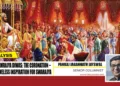
SIGNIFICANCE OF THE CORONATION (ज्येष्ठ शुक्ल त्रयोदशी)
Need of the coronation: The coronation of Shivaji is an extraordinary event in Indian history. The general belief was that the Mughal Empire represented India’s sovereignty. The treaties with the Mughals would be considered as treaties with India.
Shivaji and his ministers had long felt the practical disadvantages of his not being a crowned King. True, he had conquered many lands and gathered much wealth; he had a strong army and navy and exercised powers of life and death over men, like an independent sovereign. But in theory his position was that of a subject; to the Mughal Emperor he was a mere zamindar; to Adil Shah he was the rebellious son of a vassal jagirdar. He could not claim equality of political status with any King.
Gajanan Bhaskar Mehendale writes,, “The demand of stability and prevalence of the rule of law in the eyes of the common populace necessitated formal and legal recognition to the State through a coronation according to hoary, time-honoured custom. Perhaps, one of the important reasons for the survival of the Maratha state, even when Aurangzeb had executed Sambhaji and Rajaram was besieged within the fort of Gingee for several years, could be that Shivaji had imparted to it legitimacy by formally ascending the throne.”
Establishment of a sovereign Empire: Then, again, so long as he was mere a private subject, he could not, with all his real power, claim the loyalty and devotion of the people over whom he ruled. His promises could not have the sanctity and continuity of the public engagements of the head of a State. He could sign no treaty, grant no land with legal validity or an assurance of permanence. The territories conquered by his sword could not become his lawful property, however undisturbed his possession over them might be in practice. The people living under his sway or serving under his banners, could not renounce their allegiance to the former sovereign of the land, nor be sure that they were exempt from the charge of treason for their obedience to Shivaji. The permanence of his political creation required that it should be validated as the work of a sovereign.
For recognition of Hindavi Swarajya: Shivaji was then already the King of his newly acquired territory In the Konkan and Ghat districts of the present Bombay state and was so loved, his people. No special proclamation of his accession was necessary, nor was it then obligatory to notify the surrounding powers that Shlvaji became the King of the territory. However, as has been observed, for an orderly government of the masses and especially for maintaining the social and religious order in the country, the King had to be vested with power to rule over them in all the spheres of their activities, which Shivaji could not exercise without having himself been duly consecrated. This is all that he did, and thereby got the Hindavi Swarajya and its institution of the King established on a permanent basis.
Problem and its solution: It was therefore, necessary first to secure the support of a pandit, whose reputation for scholarship would silence all opposition to the views he might propound. Such a man was found in Vishweshwar, nicknamed Gaga Bhatta.
Who was Gaga Bhatta: He was from Benares. He was the greatest Sanskrit theologian and controversialist then alive, a master of the four Vedas, the six philosophies, and all the scriptures of the Hindus, and popularly known as the Brahma-deva and Vyasa of the modern age.
How coronation was performed: The ceremonies began on 30 May 1674 and concluded on 6 June 1674. The ceremony was going to be a grand affair. Officials of the jewellery department and Ramaji Datto created a thirty-two mound throne of gold. The Abhishek Shala and Hoam Shala took shape. The waters of seven holy rivers were brought to Raigad.
The preparations took many months. There was no unbroken tradition about the exact ceremonies and paraphernalia required at the coronation of an independent Hindu sovereign. The Sanskrit epics and political treatises were ransacked by a syndicate of pandits to find out the orthodox ancient precedents on these points, and agents were sent to learn the modern practice of the Rajahs of Udaipur and Amber.
Invitation had been lo learned Brahman of every part of India; report of the coming ceremony had attracted others. Eleven thousand Brahmans, making 50,000 souls with their wives and children, were assembled at Raigarh and fed with sweets for four months at the Rajah’s expense.
The daily religious ceremonies and consultations with the Brahmans left Shiva no time to attend to other business, as the English envoy, Henry’ Oxinden, found to his chagrin, Shiva began by bowing to his guru Ramdas Swami and his mother Jija Bai and receiving their blessings.
Other ceremonies Shivaji performed: (1) Worship the Bhawani Goddess and presented an umbrella of gold; (2) He was invested by Gaga Bhatt with the sacred thread, (3) He learned the mantras (sacred verses) and rules of Kashtriya or ruler, (4) Tuladan with gold, silver, copper, zinc, tin, lead and iron; (5) sacred fire was prepared for worship Indrani, and (6) Ghee, cow and Shankha were distributed to the Brahmins as the Dakshina.