From Hope to Despair: Why our students are giving up
September 15, 2026
  • Read Ecopy
  • Circulation
  • Advertise
  • Careers
  • About Us
  • Contact Us
Android AppiPhone AppArattai
Organiser
  • ‌
  • Bharat
    • Assam
    • Bihar
    • Chhattisgarh
    • Jharkhand
    • Maharashtra
    • View All States
  • World
    • Asia
    • Europe
    • North America
    • South America
    • Africa
    • Australia
  • Editorial
  • International
  • Opinion
  • RSS @ 100
  • More
    • World Hindu Congress 2026
    • Op Sindoor
    • Analysis
    • Sports
    • Defence
    • Politics
    • Business
    • Economy
    • Culture
    • Special Report
    • Sci & Tech
    • Entertainment
    • G20
    • Azadi Ka Amrit Mahotsav
    • Vocal4Local
    • Web Stories
    • Education
    • Employment
    • Books
    • Interviews
    • Travel
    • Law
    • Health
    • Obituary
  • Subscribe
    • Subscribe Print Edition
    • Subscribe Ecopy
    • Read Ecopy
  • ‌
  • Bharat
    • Assam
    • Bihar
    • Chhattisgarh
    • Jharkhand
    • Maharashtra
    • View All States
  • World
    • Asia
    • Europe
    • North America
    • South America
    • Africa
    • Australia
  • Editorial
  • International
  • Opinion
  • RSS @ 100
  • More
    • World Hindu Congress 2026
    • Op Sindoor
    • Analysis
    • Sports
    • Defence
    • Politics
    • Business
    • Economy
    • Culture
    • Special Report
    • Sci & Tech
    • Entertainment
    • G20
    • Azadi Ka Amrit Mahotsav
    • Vocal4Local
    • Web Stories
    • Education
    • Employment
    • Books
    • Interviews
    • Travel
    • Law
    • Health
    • Obituary
  • Subscribe
    • Subscribe Print Edition
    • Subscribe Ecopy
    • Read Ecopy
Organiser
  • Home
  • Bharat
  • World
  • Operation Sindoor
  • Editorial
  • Analysis
  • Opinion
  • Culture
  • Defence
  • International Edition
  • RSS @ 100
  • Magazine
  • Read Ecopy
Home Bharat

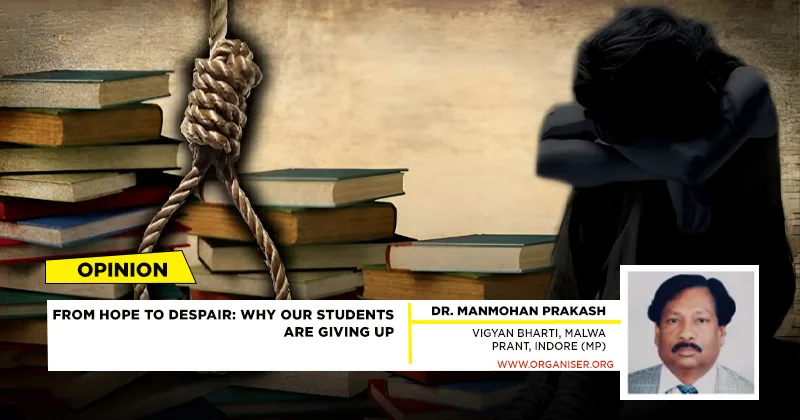
From Hope to Despair: Why our students are giving up

Student suicides are not isolated tragedies; they reflect deep cracks in our education, parenting, and societal systems. As numbers rise, it's time we ask: why are our youth losing hope, and what must we urgently change?

Dr Manmohan PrakashDr Manmohan Prakash
Jun 1, 2025, 01:00 pm IST
inBharat, Opinion
Follow on Google News
Facebook
Twitter
WhatsAppTelegramEmail

“When a student dies by suicide, it is not just a personal tragedy — it is a national failure.”

When a student takes their own life, the loss extends far beyond the individual. It is a heart-wrenching reflection of the flaws in our social fabric, parental expectations, educational systems, and policymaking processes. These incidents force us to confront difficult questions like- Why are our students losing hope? What drives them to such irreversible decisions? And most importantly — what can we do to prevent the next tragedy?

The Alarming Statistics: IC3 institute report says that over the last decade(2013-2022),103,961 student suicides, which is a 64 percent increase compared to the prior decade (2003-2012). The alarming condition is that over the last decade, while the population of 0-24-year-olds reduced from 582 million to 581 million, the number of student suicides increased from 6654 to 13044. Based on NCRB data(released 28 August 2024), overall suicide numbers increased by two per cent annually, and student suicide cases increased by four per cent. Kota, which is known as India’s coaching capital, paints an even darker picture. 15 student suicides in 2022, 26 student suicides in 2023, 17 student suicides in 2024, and  14 student suicides already till May 2025. It’s not just Kota. Students across India are silently succumbing to academic and emotional pressure.

Why Are Our Students Giving Up?

(a) Academic Pressure: Marks, exams, ranks, and the uncertainty of future careers have turned from motivators into sources of deep anxiety and fear.

(b) Institutional Insensitivity: Toxic environments of some of the institutions are filled with discrimination, ragging, and neglect. It is combined with the absence of counselling, which erodes students from within.

(c) Mental Health Neglect: Depression, anxiety, guilt, and loneliness are not mere weaknesses but serious medical concerns. Yet, shame and silence deepen. UNICEF report says that one in seven young people between the ages of 15 and 24 in India experience poor mental health, including symptoms of depression and disinterest.

(d) Parental & Social Expectations: Unrealistic aspirations, peer comparisons, and societal pressures often place unbearable burdens on young shoulders.

(e) Emotional Turmoil & Virtual Isolation: Teenage heartbreaks, social media dissatisfaction, and gaming addiction often detached students from reality and healthy coping mechanisms.

What Can Be Done — And By Whom?

(i) Parents: Rebuilding Emotional Safety, understand children’s emotional needs, spend quality time together, encourage open communication without judgment, avoid comparisons with others and finally be supportive in career decisions — don’t impose.

(ii) Educational Institutions: Create Healing Environments, provide regular mental health counselling, appoint sensitive mentors or teachers for every class, maintain zero tolerance for ragging, discrimination, insensitivity and trained the staff to identify and address distress signals early.

(iii) Teachers: Be more than educators teachers, must help students understand:”You are more than your marks. You are the hope of a better future”. Teachers should maintain dialogue, offer encouragement, and reassure students that failure in exams is not failure in life.

(iv) Students : Choose life over silence. Students must realise that ‘Life is precious, failures are lessons, not ends’. There are multiple paths to success. Students must keep in mind the words of Nobel laureate Dr Rabindranath Tagore, who said,”Storms are not uncommon, but only those who row the boat reach the shore.

“Similarly,  Dr A P J Abdul Kalam reminded students, “Giving up is the greatest failure. But trying again after failure is the beginning of the greatest success”. When overwhelmed, students should reach out — to friends, parents, teachers, or counsellors.

(v) Policymakers: Redesign curricula to reduce reliance on private coaching. Align university assessments system with competitive exams. If not in a position to close the Coaching centre, it must strictly regulate the same. Promote nationwide mental health helplines. Integrate emotional literacy and dialogue into the education system.

(vi) Society: Normalise struggle, de-stigmatise failure, respect struggle; don’t romanticise suicide. Media and social media must act responsibly and avoid glorifying such incidents. Build a culture where seeking help is seen as a strength, not a weakness

Every student who dies by suicide leaves behind a haunting question: “Was my life worth only my success?”.If we truly believe that education is meant to prepare one for life, then we must ensure students learn not only to study but also to live. Protecting their lives, dreams, and hopes must become our first and foremost responsibility — as parents, teachers, institutions, society, and as a nation.
 

Topics: student suicidesStudent Suicide CrisisMental Health AwarenessEducation ReformAcademic Stress
Share
Tweet
SendShareSend
✮ Subscribe Organiser YouTube Channel. ✮
✮ Join Organiser's WhatsApp channel for Nationalist views beyond the news. ✮
Previous News

Yukti and Yatharth: The scientist’s struggle with the self

Next News

Three major non-Defence achievements for India during the military operations

Related News

Keralam madrasa teacher Imbichikoya surrenders before Kollam court in POCSO case

Keralam madrasa teacher Imbichikoya surrenders before court after two POCSO cases registered over students’ complaints

EAC-PM member Sanjeev Sanyal called India’s coaching system a “mafia” and said NEET should be reformed, not scrapped

Sanjeev Sanyal calls India’s coaching system a ‘mafia’, says NEET should be strengthened instead of scrapped

RSS Sarkaryavah Dattatreya Hosabale

“Superstitions arise when education fails to convey civilisational scientific achievements,” says Dattatreya Hosabale

National Tele Mental Health Programme; Transforming lives via multiple languages

Prime Minister Narendra Modi distributes sweets among students while interacting with them on different aspects of stress-free exams under Pariksha Pe Charcha program in New Delhi (Photo: Old Image used for representative purposes)

Pariksha Pe Charcha 2026 emerges as a nationwide student movement engaging over 6.76 crore students across Bharat

Switch Off, Step Out & Stand Together: ABVP’s screen time to activity time campaign

Load More

Latest News

Representative Image

India crossed 80 Lakh HPV vaccine doses despite a sustained misinformation campaign

Riyadh’s search for Israeli intelligence and Islamabad’s refusal to deploy forces to Yemen expose growing cracks in the regional security equation

Saudi turns to Israel for intelligence as Houthis escalate; Sunni NATO ally Pakistan refuses troops for Yemen war

Bihar Temple Vandalism: Police detain 3 minor Muslim boys for stone-throwing, urination at Hanuman murti in Nalanda

IIT Madras hosts first universal brotherhood day celebration, highlights Swami Vivekananda’s legacy and vision for youth

Universal Brotherhood Day: IIT Madras hosts first celebration honouring Swami Vivekananda’s historic Chicago speech

SECL is powering India’s energy security today while advancing responsible mining, greener operations and a sustainable path towards Net Zero

Powering the present, building the future: How SECL is delivering energy security and a net-zero pathway together

Representative Image

Who Owns the Blueprint Inside Your Chip? How India is Moving from Chip Imports to Home-Grown Silicon

From Left to Right: Kamakshi Swaminathan, National Vice President, Saksham; Satish Bansal, National Treasurer, Saksham; Umesh Aandhare, National General Secretary, Saksham; Alok Kumar, Sah Sarkaryavah; Dayal Singh Panwar, National President, Saksham; Gurmeet Singh Mahal, Jodhpur Prant President, Saksham; Dr Jasraj Sharma, Jodhpur Mahanagar President, Saksham; and Dhananjay Kumar Singh, National Krida Ayam Pramukh, Saksham

Saksham’s resolve for inclusion

Kashmiri Pandits perform a ritual on Balidan Diwas of Kashmiri Pandits, organised by Panun Kashmir in Paloura

Panun Kashmir observes Balidan Diwas in Jammu & Bengaluru, pay homage to martyrs

Tamil Nadu: Emerald Murugan murti stolen from Nadu Palani temple recovered from abandoned quarry, three arrested

Vande Mataram Row: Karnataka Congress govt faces HC challenge over two-stanza restriction

Load More
  • Privacy
  • Terms
  • Cookie Policy
  • Refund and Cancellation
  • Delivery and Shipping

© Bharat Prakashan (Delhi) Limited.
Tech-enabled by Ananthapuri Technologies

  • Home
  • Search Organiser
  • Bharat
    • Assam
    • Bihar
    • Chhattisgarh
    • Jharkhand
    • Maharashtra
    • View All States
  • World
    • Asia
    • Africa
    • North America
    • South America
    • Europe
    • Australia
  • Editorial
  • Operation Sindoor
  • Opinion
  • Analysis
  • Defence
  • Culture
  • Sports
  • Business
  • RSS @ 100
  • Entertainment
  • More ..
    • Sci & Tech
    • Vocal4Local
    • Special Report
    • Education
    • Employment
    • Books
    • Interviews
    • Travel
    • Health
    • Politics
    • Law
    • Economy
    • Obituary
  • Subscribe Magazine
  • Read Ecopy
  • Advertise
  • Circulation
  • Careers
  • About Us
  • Contact Us
  • Policies & Terms
    • Privacy Policy
    • Cookie Policy
    • Refund and Cancellation
    • Terms of Use

© Bharat Prakashan (Delhi) Limited.
Tech-enabled by Ananthapuri Technologies