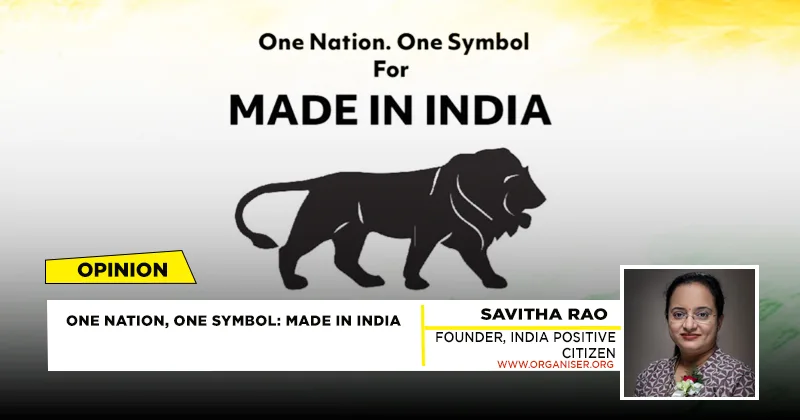
One Nation, One Symbol: Made in India
July 9, 2026
  • Read Ecopy
  • Circulation
  • Advertise
  • Careers
  • About Us
  • Contact Us
Android AppiPhone AppArattai
Organiser
  • ‌
  • Bharat
    • Assam
    • Bihar
    • Chhattisgarh
    • Jharkhand
    • Maharashtra
    • View All States
  • World
    • Asia
    • Europe
    • North America
    • South America
    • Africa
    • Australia
  • Editorial
  • International
  • Opinion
  • RSS @ 100
  • More
    • Op Sindoor
    • Analysis
    • Sports
    • Defence
    • Politics
    • Business
    • Economy
    • Culture
    • Special Report
    • Sci & Tech
    • Entertainment
    • G20
    • Azadi Ka Amrit Mahotsav
    • Vocal4Local
    • Web Stories
    • Education
    • Employment
    • Books
    • Interviews
    • Travel
    • Law
    • Health
    • Obituary
  • Subscribe
    • Subscribe Print Edition
    • Subscribe Ecopy
    • Read Ecopy
  • ‌
  • Bharat
    • Assam
    • Bihar
    • Chhattisgarh
    • Jharkhand
    • Maharashtra
    • View All States
  • World
    • Asia
    • Europe
    • North America
    • South America
    • Africa
    • Australia
  • Editorial
  • International
  • Opinion
  • RSS @ 100
  • More
    • Op Sindoor
    • Analysis
    • Sports
    • Defence
    • Politics
    • Business
    • Economy
    • Culture
    • Special Report
    • Sci & Tech
    • Entertainment
    • G20
    • Azadi Ka Amrit Mahotsav
    • Vocal4Local
    • Web Stories
    • Education
    • Employment
    • Books
    • Interviews
    • Travel
    • Law
    • Health
    • Obituary
  • Subscribe
    • Subscribe Print Edition
    • Subscribe Ecopy
    • Read Ecopy
Organiser
  • Home
  • Bharat
  • World
  • Operation Sindoor
  • Editorial
  • Analysis
  • Opinion
  • Culture
  • Defence
  • International Edition
  • RSS @ 100
  • Magazine
  • Read Ecopy
Home Bharat

One Nation, One Symbol: Made in India

A strong need for a distinct ‘Made in India’ symbol is felt across businessmen, entrepreneurs as well as consumers of Bharat to specifically identify and label Bharat-made products. It would be prudent for the Government to consider this strategic business move for Bharat's bright economic future

Savitha RaoSavitha Rao
May 25, 2025, 06:00 pm IST
in Bharat, Opinion
Follow on Google News
FacebookTwitterWhatsAppTelegramEmail

Each day, crores of Bharatiyas make millions of purchase decisions—in kirana stores, pharmacies, malls, haats, offices, and on e-commerce platforms. From pressure cookers to power banks, from school bags to switches—we are a nation of buyers.

These everyday decisions, while individual, form an invisible yet powerful economic force. The cumulative impact of our choices determines which industries expand, which brands flourish, which jobs are created, and where value gets retained – in Bharat or abroad.

Shaping Bharat’s Economy

The key question is – Are we, as consumers, helping build Bharat – or are we unknowingly fueling foreign economies? The answer isn’t always clear, because most of the time, the consumer simply doesn’t know.

The country of origin is often missing on unbranded or loosely packaged goods, printed in fine English text, unreadable by many, or buried in a sea of dense information.

This is the gap that must be bridged — urgently and systemically.

A Distinctive, Official Symbol For ‘Made in India’

Bharat needs a government-backed, single, mandatory symbol that clearly and instantly identifies products that are genuinely Made in India. This isn’t a design trend or patriotic flourish, it’s a strategic policy tool to channel Bharat’s purchasing power toward building Bharatiya industry, employment, and brand equity. A clear, easy-to-recognise symbol gives every Bharatiya — regardless of language, literacy, or location — the power to make informed and proud choices.

The economic rationale: Why it matters

  1. Jobs across the value chain: When Bharat-made goods are preferred, demand rises for domestic manufacturing, raw materials, packaging, logistics, and retail. Bharat’s 6.3 crore MSMEs, which employ over 11 crore people, stand to benefit directly from such consumer preference.
  2. Saving foreign exchange, strengthening the rupee: In 2023-24, Bharat’s overall import bill for products was 677.24 billion USD. If even a small percentage of that demand shifts to Bharat-made alternatives, the foreign exchange savings are massive. A stronger rupee and reduced trade deficit are national benefits that flow from everyday consumer decisions.
  3. Boost to Atmanirbhar Bharat and resilience: A self-reliant economy is one that can meet its own essential needs during global disruptions. We’ve seen the risk of overdependence during the pandemic. Supporting Bharatiya goods strengthens domestic capabilities and insulates us from external shocks.
  4. Rural and Tier-2 economic activation: Bharatiya products like khadi, ayurvedic goods, millet-based foods, and handicrafts are rooted in rural and small-town ecosystems. Buying Bharatiya directly uplifts these economies and generates local employment, especially for women and artisans.
  5. Brand Bharat on the global stage: A national symbol is not just for Bharatiya buyers. When Bharatiya products carry a trusted origin mark, it enhances their appeal and credibility in international markets. Just as ‘Made in Italy’ evokes luxury and ‘Made in Germany’ signifies engineering excellence, Bharat must project its own manufacturing identity confidently abroad — especially for sectors like Ayurveda, Yoga products, Eco-fashion, Organic food, and Tech accessories.
  6. A magnet for Foreign Direct Investment (FDI): A strong, government-backed ‘Made in India’ symbol can also influence international brands to manufacture in Bharat. When they see that Bharatiya consumers actively prefer domestically made products — backed by a credible, visible mark — it creates a powerful business case to shift sourcing and production to Bharat. This helps bring in FDI, enhances technology transfer, and integrates Bharat more deeply into global supply chains.
  7. Bharat’s Market should be served by Bharatiya manufacturers: Bharat is one of the world’s largest and fastest-growing consumer markets — a magnet for global brands eager to tap into our scale and spending power. While international participation is welcome, it is imperative that the primary beneficiaries of this vast demand are Bharatiya manufacturers. Serving our own market must become a national priority — to boost local employment, strengthen industry, and retain wealth within the country.

The Consumer and Retailer’s Dilemma

  • “Customers ask me if the product is Indian-made, but I have to squint to check — and sometimes I still can’t tell,” says Rajesh Yadav, a retailer in Pune.
  • “If I knew for sure a product was made in India, I would happily buy it. But I can’t trust the packaging,” shares Sonal Mehta, a teacher in Mumbai.
  • “I sell jute bags made in Kolkata, but customers mistake them for Chinese imports. A clear symbol would help me explain the difference,” says Neelam Banerjee, a craft entrepreneur.

It’s Not About Removing Choice – It’s About Enabling It

Some common questions deserve clarity –

“Won’t this restrict consumer freedom?”

  • Not at all. The symbol is not a mandate to buy — it’s a tool to make the origin visible. Consumers remain free to choose based on price, quality, or brand. But now they choose with full knowledge.

“What if an Indian brand manufactures abroad?”

  • The symbol is for products made in India, not companies of Bharatiya origin. If a brand makes its products overseas, it won’t qualify – regardless of ownership. This keeps the focus on domestic value creation.

“Will this hurt small manufacturers?”

  • No. In fact, it will help them. A free, standardised symbol increases trust in Bharatiya products, especially those from lesser-known or emerging brands. It levels the playing field.

The Government’s Next Step

In 2020, I catalysed a policy change that led to the mandatory display of country of origin labels on e-commerce platforms — a reform that has since empowered crores of Bharatiyas to make informed choices while shopping online.

Now, it’s time to extend that transparency to physical retail, where over 90% of Bharat’s purchases still happen.

The Government of India must:

  1. Design and launch a single official symbol for ‘Made in India’ products
  2. Recommend its use across sectors and product types that meet defined origin criteria
  3. Define clear, auditable standards for qualification (eg minimum domestic value addition)
  4. Offer free access to the symbol for registered Bharatiya manufacturers and MSMEs
  5. Enforce strict penalties for misuse to preserve trust
  6. Run a mass-awareness campaign to build citizen familiarity and pride in the mark

This is not a branding exercise. It is a nation-building intervention.

Let’s Build Bharat – One Purchase At A Time

A clear, trusted symbol for Made in India products gives every Bharatiya — rich or poor, rural or urban, online or offline — the power to participate in Bharat’s growth story.

Every rupee spent on Bharat-made goods is a vote for Bharatiya jobs, Bharatiya skills, and Bharatiya futures. Let this symbol become a daily tool, a national asset, and a strategic lever for self-reliance and prosperity.

It’s time we gave every Bharatiya the power to build Bharat – one purchase at a time.
Topics: FDIMade in IndiaConsumer freedomAtmanirbhar Bharat
ShareTweetSendShareSend
✮ Subscribe Organiser YouTube Channel. ✮
✮ Join Organiser's WhatsApp channel for Nationalist views beyond the news. ✮
Previous News

Why there is no alternative to the RSS Shakha model, explains Sarsanghchalak Dr Mohan Bhagwat

Next News

The Aim of Human Life: An evening discourse on Adi Shankaracharya’s teachings

Related News

Dr Syama Prasad Mookerjee's enduring legacy in education and Atmanirbhar Bharat (This image is generated by AI)

Dr Syama Prasad Mookerjee’s resonance with NEP 2020 and Atmanirbhar Bharat

Union Minister Sarbananda Sonowal unveils first India-made export-import shipping container

Union Minister Sarbananda Sonowal unveils India’s first Made-in-India EXIM shipping container for global trade

West Bengal's defence industry gets a new boost as indigenous warship production and military investments expand

How West Bengal is emerging as India’s next defence corridor under BJP govt’s industrial push

Amid rising global conflicts and uncertainty, the idea of ‘Swa’ offers Bharat a foundation for self-reliance, resilience, and civilisational confidence

The Geopolitics of Selfhood: Why the idea of ‘Swa’ is emerging as Bharat’s strategic compass in a turbulent world

PMRC Scheme 2026 launched to bring global Indian talent back into India's research ecosystem

PMRC Scheme 2026: Centre invites applications from global Indian scientists; Know eligibility, benefits & how to apply

India produces over 70 per cent of the world’s jaggery, carrying a Vedic legacy into today’s global superfood market

From Vedic Fields to Global Markets: India’s ancient superfood leading a global sweetener revolution

Load More

Latest News

Dignitaries on the stage on the occasion of 90 years of Rashtra Sevika Samiti and celebration of birth anniversary of its founder Lakshmibai Kelkar

Lakshmibai Kelkar Birth Anniversary | The need is not to give strength to women but to awaken it: Alka Inamdar

UP transformed from an electricity-deficient state to a model of household electrification and power reforms over the past decade

Ten Years of Power Reforms in UP: How electricity schemes transformed the state’s energy landscape

A representative image

Poshan Tracker: How India’s real-time nutrition monitoring platform is transforming nutrition governance

Melbourne [Australia], Jul 09 (ANI): Prime Minister Narendra Modi and Australian Prime Minister Anthony Albanese exchange a handshake, in Melbourne on Thursday. (@narendramodi X/ANI Photo)

India, Australia launch new era of strategic cooperation with uranium pact

ABVP's National General Secretary Dr Virendra Singh Solanki hoisted the flag at ABVP Lucknow Office on occasion of National Students' Day

ABVP’s 78th Foundation Day: World’s largest student organisation reaffirms its commitment to service & nation-building

T. Satisan speaks. L/R: E.N. Nandakumar, K.G. Venugopal, Adv. K. Ramkumar, Kummanam Rajasekharan and Sunil Vadayar

Keralam: RSS karyakartas in Kochi remember Emergency, honour anti-Emergency struggle veterans

Hindu Munnani protesting against the temple demolition move

Tamil Nadu: Hindu Munnani protests Rajakaali Amman Temple demolition in Ramanathapuram, alleges TVK is targeting Hindus

A representative image

How India turned a toy import crisis into a 152 Million US dollar trade surplus: Inside the Toy Story

NIA conducted a fresh search at Abdul Salam's Ballari residence, seizing a mobile phone in an ongoing online radicalisation probe

Karnataka: NIA raids suspected terrorist Abdul Salam’s house in Ballari in radicalisation case; Mobile phone seized

A representative image

Higher Education enrolment hits record 4.5 crore in 2023-24; GER reaches 30, shows AISHE Report

Load More
  • Privacy
  • Terms
  • Cookie Policy
  • Refund and Cancellation
  • Delivery and Shipping

© Bharat Prakashan (Delhi) Limited.
Tech-enabled by Ananthapuri Technologies

  • Home
  • Search Organiser
  • Bharat
    • Assam
    • Bihar
    • Chhattisgarh
    • Jharkhand
    • Maharashtra
    • View All States
  • World
    • Asia
    • Africa
    • North America
    • South America
    • Europe
    • Australia
  • Editorial
  • Operation Sindoor
  • Opinion
  • Analysis
  • Defence
  • Culture
  • Sports
  • Business
  • RSS @ 100
  • Entertainment
  • More ..
    • Sci & Tech
    • Vocal4Local
    • Special Report
    • Education
    • Employment
    • Books
    • Interviews
    • Travel
    • Health
    • Politics
    • Law
    • Economy
    • Obituary
  • Subscribe Magazine
  • Read Ecopy
  • Advertise
  • Circulation
  • Careers
  • About Us
  • Contact Us
  • Policies & Terms
    • Privacy Policy
    • Cookie Policy
    • Refund and Cancellation
    • Terms of Use

© Bharat Prakashan (Delhi) Limited.
Tech-enabled by Ananthapuri Technologies