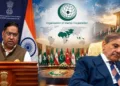
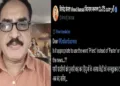
In the vibrant democracy that is Bharat, the freedom of speech—especially within academic spaces—is sacred, but not sacrosanct. Yet, it must also be grounded in responsibility, especially when such speech threatens the ethos and honor of the very nation that guarantees it. The recent controversy surrounding Ali Khan Mahmudabad, a professor at Ashoka University, is not merely a passing headline—it is a microcosm of the deep-rooted ideological battle that has been festering within Bharat’s academia. His disparaging remarks on the spokespersons in respect to “Operation Sindoor,” have ignited a national debate. And this debate is not only timely—it is necessary.
The Insidious Undermining of Women in Uniform
Operation Sindoor was not just a military operation. It was a symbolic assertion of Nari Shakti—the rising feminine power that has always been revered in Bharatiya tradition, from the battlefield to the boardroom. Colonel Sofiya and Wing Commander Vyomika represented more than their ranks; they represented the collective aspirations of countless Indian daughters who dream of serving their nation in uniform. Their dignified and commanding presence at the press conference was a watershed moment in Bharat’s defense narrative.
Yet, in an astonishing act of academic condescension, Professor Mahmudabad labeled their participation as mere “optics” and dismissed the entire event as “hypocrisy.” Such comments, if made, are not only demeaning—they reflect a certain ideological discomfort with India’s cultural and national resurgence. The ridicule was not aimed at two officers alone; it was directed at the idea of a proud, confident, resurgent Bharat that honors its women, traditions, and armed forces alike.
What must be questioned is the mindset that finds empowered Indian women in military fatigues to be a problem. Why does showcasing our shakti offend the sensibilities of some in elite academic circles? Why is it so hard for them to accept that patriotism, pride, and power can coexist within the Indian woman? Are we witnessing a broader pattern wherein voices rooted in civilisational pride are systematically undermined under the guise of critical inquiry?
Partition Shadows and Ideological Continuities
The controversy took a darker turn when the Haryana Women’s Commission revealed facts about Mahmudabad’s family legacy. According to the Commission, Professor Mahmudabad’s grandfather may have been a significant financial contributor to the Muslim League, the political formation at the center of Bharat’s tragic Partition. The Commission further claimed that he allegedly held Pakistani citizenship until 1957 and continued to offer support to the League even post-Independence.
While these assertions remain to be independently verified, they raise important questions: Does a legacy of such political affiliations bear relevance in the academic and ideological posturing of descendants? Should we not question whether inherited ideological worldviews continue to shape present academic narratives, particularly when these narratives so often clash with national sentiment?
It is not about guilt by association, but about intellectual transparency. If such a background exists, it becomes essential to reflect on whether such a legacy influences the lens through which Bharat and its institutions are viewed and critiqued. Are our institutions doing enough to ensure that historical biases do not become contemporary dogmas?
The Cloak of Intellectualism and the Shield of Solidarity
Within days of the Haryana Commission’s notice, a familiar pattern emerged. Over 1,200 individuals—many from elite academic and cultural circles—signed a petition supporting Professor Mahmudabad and demanding that the summons be withdrawn. Among them were historian Romila Thapar and academic Malvika Maheshwari. The petition, cloaked in lofty language about “academic freedom” and “freedom of expression,” curiously made no mention of the sentiments of Bharat’s armed forces or the offensiveness of the professor’s comments.
This response compels us to ask: Is this solidarity rooted in principle, or is it an automatic defense mechanism triggered whenever one of their ideological peers is questioned? Are we looking at a closely-knit group that prefers mutual protection over self-reflection?
Time and again, sections of the intellectual establishment appear to rush to the defense of their ideological peers—raising the question: is this driven more by shared worldviews than by objective principles of justice? Why is it that when a professor undermines national heroes or sacred symbols, he is protected in the name of free speech—but when a nationalist voice calls for civilisational pride, it is immediately demonized as fascist?
This dichotomy between freedom for dissent and disdain for national pride must be addressed. Are we creating intellectual spaces where only one worldview is allowed to thrive while all others are suffocated?
Ashoka University Must Choose Its Dharma
Ashoka University, which describes itself as a bastion of liberal education, now stands at a moral and ideological crossroads. The question is simple yet profound: will it allow its platform to be misused by individuals who openly question the legitimacy and dignity of Bharat’s armed forces? Or will it rise to the occasion and foster a truly inclusive academic culture—one where nationalism is not vilified, where tradition is not mocked, and where the values of Bharatiyata are accorded due respect?
Academic institutions must guard against becoming echo chambers—where the freedom to question Bharat’s identity and institutions is protected, but pride in those same institutions is viewed with suspicion. The intellectual vigor of an institution is reflected not in how well it tolerates anti-establishment views alone, but in how respectfully it accommodates civilisational pride and nationalist thought.
Ashoka must decide whether it will be a breeding ground for ideological radicalism or a sanctuary of balanced, rooted, and responsible thought.
Drawing the Red Line: Bharat’s Patience Has Limits
The Haryana Women’s Commission has been unequivocal in its response. Its intervention is not an act of political vendetta—it is a long-awaited assertion of the principle that no citizen, no professor, and no intellectual is above national respect and honor. Especially when it comes to the guardians of our sovereignty—the Indian armed forces—there must be no room for veiled insults or ideological mockery.
Bharat is awakening. A new generation, grounded in civilisational pride and confident in its future, is reclaiming its narrative. From the corridors of power to the classrooms of universities, there is a rising awareness that for too long, our national discourse has been dominated by those who see Bharat through a lens of guilt, shame, and inferiority. That time is over.
To call Nari Shakti, the Sainika (women bravehearts) “optics” is to betray the sacrifices of thousands of daughters, sisters, and mothers who serve without expecting applause. To reduce their service to a spectacle is to commit an unforgivable insult—an insult not only to them, but to the nation itself.
This episode is more than a controversy. It is a mirror. A mirror that reflects the deep ideological fissures within our educational institutions. A mirror that forces us to ask uncomfortable but essential questions. And a mirror that, if we dare to look into it deeply, will show us the path we must take as a nation committed to Dharma, to Rashtra, and to Satya.