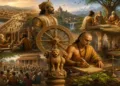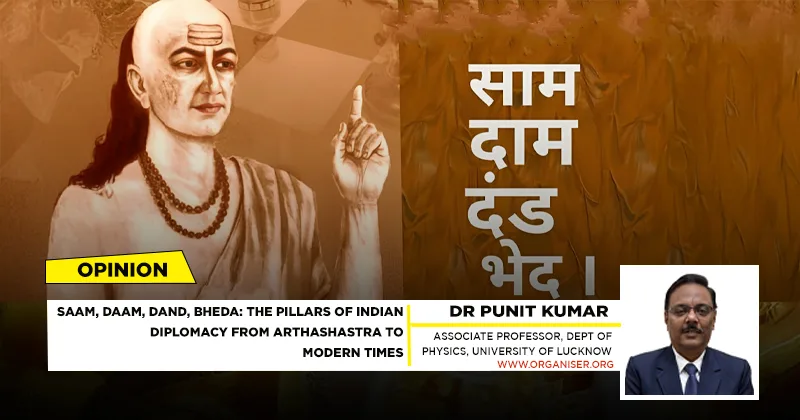
Indian political philosophy is one of the oldest in the world, and among its most influential texts is the Arthashastra, composed by Kautilya (Chanakya) in the 4th century BCE. A master strategist, economist, and teacher at Takshashila University, Kautilya crafted a comprehensive treatise on statecraft, governance, economy, and diplomacy. Among its many profound teachings is the doctrine of ‘Saam, Daam, Dand, Bheda’, a fourfold strategy for negotiation and conflict resolution.
These four principles, still relevant today, provide a practical and flexible framework for diplomacy, conflict management, and national interest. Rooted in realism and guided by ethical pragmatism, this approach has significantly influenced India’s ancient and modern foreign policy decisions.
Understanding Saam, Daam, Dand, Bheda
Let us first unpack these concepts as elaborated in the Arthashastra, particularly in Books VI and VII, which deal with Mandala theory, diplomacy, and warfare.
1. Saam (साम) – Persuasive Diplomacy
Saam refers to using dialogue, reason, and diplomacy to resolve conflict or gain support. It involves soft power, appeals to common interests, and building trust. According to Kautilya:
“सामनाम्ना संधिः” (Using persuasive language and harmony, peace is established.)
Saam is the first and most preferred method in diplomacy. It aims at avoiding war through mutual understanding, negotiation, and compromise.
India’s commitment to dialogue, non-alignment, and multilateralism is rooted in Saam. From the Panchsheel doctrine to India’s leadership in the Non-Aligned Movement (NAM), India has historically prioritised negotiation over confrontation.
In recent times, India’s active role in the United Nations, BRICS, G-20, and South Asian Association for Regional Cooperation (SAARC) reflects this principle. India’s efforts to mediate regional peace, whether in Sri Lanka or the Middle East, rely heavily on persuasion and soft power.
India’s public diplomacy, through cultural exchange (e.g., yoga diplomacy), diaspora engagement, and humanitarian aid, also aligns with Saam. The International Day of Yoga, celebrated globally, is a subtle yet powerful example of Indian soft power at play.
2. Daam (दाम) – Economic Diplomacy
Daam implies using material inducements, money, position, privileges, trade, or bribes to influence behaviour or secure cooperation. It is not bribery in a pejorative sense, but strategic investment in peace or alliance.
“दानेन मित्रं लभते” (One gains allies through gifts.)
This is akin to economic diplomacy today, where trade agreements, aid, and incentives are tools to win favour or compliance.
India uses trade, investment, development aid, and technology transfers as tools of diplomacy. Its ‘Neighbourhood First’ and ‘Act East’ policies often involve infrastructure assistance, energy cooperation, and preferential trade to maintain regional stability.
Projects like the Kaladan Multimodal Transit with Myanmar, Chabahar Port in Iran, or development grants to the Maldives, Nepal, and Bhutan showcase Daam, building alliances through economic strength.
India’s strategic use of energy diplomacy, free trade agreements, and foreign direct investment (FDI) also reflects this principle. Vaccine Maitri (vaccine diplomacy during COVID-19) is another perfect case of Daam in humanitarian garb.
3. Dand (दण्ड) – Strategic Deterrence and Defence
Dand is the application of military or legal force when persuasion and rewards fail. It includes deterrence, sanctions, or war. Kautilya viewed Dand as essential for maintaining law and sovereignty:
“दण्डः शास्ति प्रजाः सर्वाः”(Force governs all subjects.)
Kautilya emphasised that the threat of force is often enough to keep adversaries in check.
While India is fundamentally peace-loving, it has used Dand when provoked. The 1971 war with Pakistan, leading to the creation of Bangladesh, was a decisive application of force after all diplomatic options failed.
India’s nuclear doctrine, particularly the concept of ‘No First Use’ combined with credible minimum deterrence, reflects Kautilya’s idea that the threat of Dand can ensure peace. More recently, the surgical strikes in 2016, the Balakot airstrike in 2019 and the operation ‘Sindoor’ are demonstrations of calibrated use of force. India’s growing defence capabilities, including indigenous weapon development under ‘Make in India’, also aim at strengthening deterrence.
4. Bheda (भेद) – Strategic Alliances and Psychological Tools
Bheda involves creating divisions in enemy ranks, sowing dissent, or exploiting internal weaknesses. It can mean psychological warfare, misinformation, or diplomacy aimed at isolating or weakening opponents.
“भेदेन जयति शत्रून्” (By division, one defeats enemies.)
This subtle strategy is akin to modern intelligence, psychological operations, or coalition diplomacy that weakens an adversary from within.
Modern Bheda is seen in coalition building, diplomatic isolation of adversaries, and intelligence operations. India’s efforts to isolate Pakistan internationally on the issue of cross-border terrorism, especially after attacks in Uri and Pulwama, reflect the use of Bheda.
India’s strengthening of ties with Quad countries (USA, Japan, Australia) can also be seen as a counterbalance to China’s rise in a subtle form of diplomatic Bheda through alignment.
At the cyber and psychological level, India invests in information warfare, media influence, and track-II diplomacy to shape perceptions. The use of digital platforms and direct engagement with foreign media reflects the strategic communication dimension of Bheda.
Together, these four methods represent a hierarchy of approaches, from peaceful to forceful, providing flexibility to rulers based on circumstances.
Application in Ancient India
Kautilya’s Arthashastra is not merely theoretical. It was applied with stunning effectiveness by Chandragupta Maurya in unifying India after the fall of the Nanda dynasty. Saam was used to win over allies and regions diplomatically, Daam to buy out rival leaders or gain loyalty, Dand against the Greek invaders and other hostile kings, and Bheda to divide enemy alliances.
“युक्तियुक्तं च नयस्य प्रभावः, राष्ट्रस्य रक्षणे च सूत्रम्।”(A well-reasoned policy is the thread that secures the state) — Arthashastra
The ancient science of statecraft, embedded in India’s civilisational memory, has found renewed relevance in safeguarding the nation from modern threats. India, while deeply rooted in its moral and cultural values, remains grounded in the realpolitik enshrined in the Arthashastra. In the volatile global order marked by shifting alliances, economic pressures, and security threats, the timeless framework of Saam, Daam, Dand, Bheda helps India balance idealism with pragmatism.
As Kautilya wisely advised:
“सर्वे गुणाः कण्ठे बध्नीयुः। शत्रुं निबध्नाति यो नीत्या।” (Tie all virtues around your neck, but bind your enemies with strategy) — Arthashastra, Book VII
India’s enduring success in diplomacy lies in its ability to follow this wisdom, not through dominance, but through strategic, layered, and value-based statecraft.
Similarly, King Ashoka, though remembered for his post Kalinga pacifism, used all four methods during his conquests. Even the great epics like the Mahabharata depict these principles, Krishna’s efforts before the war being classic examples of Saam (peace appeal), Daam (offering kingdoms), Dand (war), and Bheda (sowing doubt among Kauravas).