Nalanda: How It Changed the World by Abhay K. is a fascinating exploration of one of history’s most enigmatic centres of learning. The book delves into the many unanswered questions surrounding Nalanda, its origins, founders, the scholars who studied and taught there, and the vast array of subjects it offered. The author does a remarkable job of peeling back the layers of mystery that have long surrounded this ancient institution, taking readers on a journey through its rise, golden age, and eventual decline. Through meticulous research, Abhay K. uncovers Nalanda’s significant contributions to fields such as Science, Mathematics, Philosophy, Art, Architecture and Poetry. The book is divided into eight chapters along with a long introduction, bibliography and index into a total of 224 pages.
Abhay K., a diplomat and accomplished poet, served as Bharat’s Ambassador to Madagascar and Comoros. He currently serves as the Deputy Director General of the Indian Council for Cultural Relations (ICCR) in New Delhi. Abhay K. joined the Indian Foreign Service in 2003 and has held key diplomatic roles, including as Deputy Ambassador to Brazil. Alongside his diplomatic career, Abhay K. is a prolific poet, with numerous poetry collections and translations, earning recognition such as the SAARC Literary Award 2013, the Kalinga Literature Festival Award 2022 and Bharat Shiksha Samman 2025. He is also a translator and artist.
The book highlights the intellectual giants who made Nalanda renowned as the epicentre of knowledge in the ancient world, shedding light on both Bharatiya and foreign scholars who were drawn to this extraordinary institution. While exploring many facets of Nalanda, Abhay K. also raises thought-provoking questions about whether it could truly be considered a university in the modern sense, given its unique structure and intellectual scope. The narrative not only covers Nalanda’s unparalleled achievements but also examines the circumstances that led to its tragic downfall. Through this thorough analysis, Nalanda: How It Changed the World paints a vivid picture of an institution that, despite its eventual destruction, continues to inspire awe and admiration across the world. This book is a must-read for anyone interested in the history of education, philosophy, or the cultural heritage of Bharat. The book is a compelling and meticulously researched exploration of one of history’s most distinguished centers of learning, the Nalanda Mahavihara. Through an engaging and poetic narrative, Abhay K. not only recounts the rich history of this ancient institution but also highlights its profound influence on global education, philosophy and cross-cultural exchange. This work offers a refreshing perspective on Nalanda’s evolution and legacy, underscoring its relevance in shaping intellectual pursuits across the world.
The destruction of Nalanda’s library, which is said to have burned for months, serves as a poignant reminder of the catastrophic loss of knowledge during this period
The book opens with a detailed introduction that traces the origins and development of Nalanda, beginning with its roots in the era of King Bimbisara of the Haryanka dynasty and continuing through the periods of the Gupta and Pala dynasties. Abhay K. highlights the significant contributions of various kings and patrons who supported Nalanda, as well as the vibrant Buddhist activities that took place in the region, including the translation of key Buddhist texts like the Prajnaparamitahrdaya Sutra. The author’s own poetic insights are woven throughout, offering a unique blend of scholarship and creative expression to evoke the rise and decline of Nalanda.
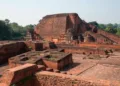
The book further delves into Nalanda’s geographical and historical context, emphasising its location near Rajagriha, the first capital of Magadha, and its role as a hub for scholarly and spiritual debates. Abhay K. explores how Nalanda became a beacon for intellectuals from across Asia, with a particular focus on legendary figures such as Shariputra and Maudgalyayana, two revered disciples of Gautama Buddha. Their contributions to Buddhist teachings set the foundation for Nalanda’s academic tradition, and the author connects their influence to the broader intellectual and spiritual landscape of ancient Bharat.
The author paints a vivid picture of the rise of Nalanda Mahavihara, detailing its establishment by Emperor Kumaragupta-I during the Gupta period. The book elaborates on Nalanda’s comprehensive curriculum, which ranged from Buddhist philosophy and astronomy to medicine and the arts. The rigorous academic standards and the diverse intellectual environment at Nalanda are portrayed in depth, illustrating how it became a beacon of learning not only for Bharat but for scholars from around the world.
One of the most fascinating aspects of Nalanda: How It Changed the World is its exploration of the institution’s intellectual luminaries. Scholars such as Nagarjuna, Aryabhata and Dharmakirti are discussed in detail, showcasing their groundbreaking contributions to philosophy, science, and mathematics. This section reveals how Nalanda was a crucible for the development of ideas that would later shape global intellectual thought.
Foreign scholars from across Asia, China, Korea, Tibet, and Central Asia, were drawn to Nalanda, and their accounts enrich the narrative. Abhay K explores the writings of figures like Faxian, Xuanzang and Yijing, who chronicled their experiences at Nalanda, providing invaluable insights into the academic excellence and daily life at the university. Other visitors, including Hyecho, Shih-Pien and Bodhidharma, also left behind records that highlight the profound impact of Nalanda’s teachings on diverse cultures.
The author does not shy away from addressing the decline of Nalanda. He delves into the political and social factors that contributed to the institution’s downfall, including the decline of Buddhism in Bharat and the devastating invasion by Bakhtiyar Khilji by the end of 12th century. The destruction of Nalanda’s library, which is said to have burned for months, serves as a poignant reminder of the catastrophic loss of knowledge during this period.
In the final chapters, Abhay K. examines Nalanda’s enduring legacy. He argues that the institution’s interdisciplinary approach to education laid the groundwork for modern universities. The global impact of Nalanda is underscored by the establishment of several institutions named after it, including Nalanda Gedige in Sri Lanka and the Nalanda Institute in countries such as the United States, Brazil, and Singapore. The recent revival of Nalanda University is presented as a testament to the lasting influence of this remarkable institution.
The book concludes with a powerful reflection on Nalanda’s contributions to global education and its role in shaping the intellectual landscape of the ancient world. Abhay K. captures the essence of Nalanda’s spirit, encapsulating its significance in a quote from the Buddhist mantra: Gate Gate Paragate Parasamgate Bodhi Svaha (Gone, Gone, Gone Beyond, Beyond All, Enlightened).
Abhay K. combines scholarly rigour with poetic insight to craft a narrative that is both accessible and deeply enriching. His personal connection to Nalanda, having grown up near its ruins, infuses the book with an authentic passion and reverence for this historical gem. His narrative is a poignant tribute to Nalanda’s legacy, reminding us of its vital role in shaping the intellectual and spiritual pursuits of humanity.