In a groundbreaking discovery that could rewrite the ancient cultural history of eastern Bharat, the Archaeological Survey of India (ASI) has officially identified a sacred mound in Mangarh village, Hazaribagh district, as a 2,500 to 3,000-year-old Buddhist stupa. Long revered by locals as a spiritual site, this massive mound has now been confirmed as a significant religious structure dating back to a forgotten civilisation, highlighting the region’s deep-rooted Buddhist heritage.
The ASI’s extensive excavation operations in Chouparan block, covering villages like Daihar, Sohra, Mangarh, and Hathindar, have brought to light traces of an ancient civilisation spread across the Hazaribagh region. Among the most notable finds are samples of Northern Black Polished Ware (NBPW)—a signature black-glazed pottery dated between 300 to 100 BC. This rare ceramic evidence indicates the area’s historic importance as a thriving cultural and trade hub.
However, the most significant revelation has been the identification of the Buddhist stupa in Mangarh. Previously considered a sacred hill by villagers, the mound is now confirmed to be a religious structure built approximately 2,500 to 3,000 years ago. ASI officials stated that further investigation into its architectural design, religious function, and cultural connections with other Buddhist sites is underway.
Clues Emerge of Buddhist Learning Site
Archaeologists suggest the stupa in Mangarh points to the area being a vital center of Buddhist worship and learning in ancient India. As excavations continue, experts are optimistic about uncovering more details regarding its ritualistic use, structural composition, and possibly even monastic settlements in the surrounding regions.
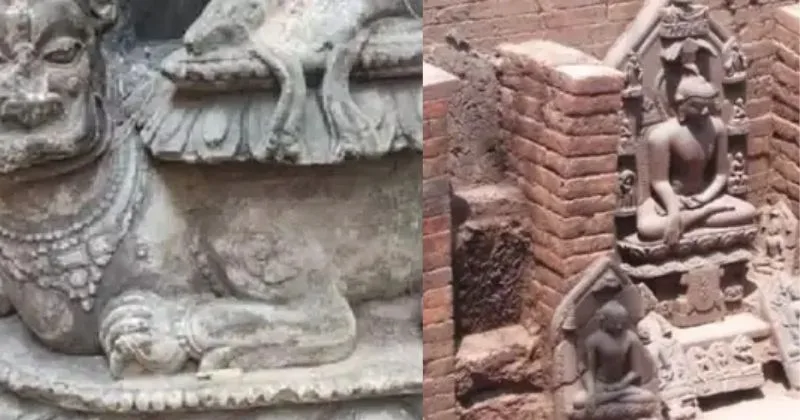
Adding further depth to the discovery, several stone sculptures and artefacts have been found in the area over the decades during routine agricultural activities such as pond digging and well construction. These include statues of Gautam Buddha, Tara, and Avalokiteshvara, reflecting the prevalence of Mahayana Buddhist traditions. Interestingly, Hindu deities such as Brahma, Vishnu, and Ganesha have also been unearthed, suggesting a long-standing coexistence of multiple faiths in this region.
In Hathindar village, archaeologists recently unearthed a Sati stone, used historically to commemorate the self-immolation of a widow following her husband’s death. Alongside it, a terracotta ring well, likely used for water storage or ritual purposes, was discovered. These artefacts provide a rare glimpse into the social customs, religious beliefs, and daily lives of the communities that once flourished here.
The archaeological narrative doesn’t end in Jharkhand. Parallel excavations in Nachna village, Panna district of Madhya Pradesh, have uncovered a stone-built Shiv temple and residential structures, providing insight into the architectural ingenuity of the time. Built with stone blocks and mud mortar, the temple reflects advanced construction methods, while a nearby brick structure likely dates back to the Kushana period, further underlining the depth of India’s ancient heritage.
This discovery marks a major milestone for the ASI, which continues to unearth the forgotten chapters of India’s civilisational history. From buried stupas and temples to ancient domestic structures, each excavation is a silent storyteller of the subcontinent’s spiritual, architectural, and social evolution.
As researchers delve deeper into Mangarh and neighbouring sites, this once-obscure region of Jharkhand could soon take its place on the map of India’s most historically significant Buddhist sites.