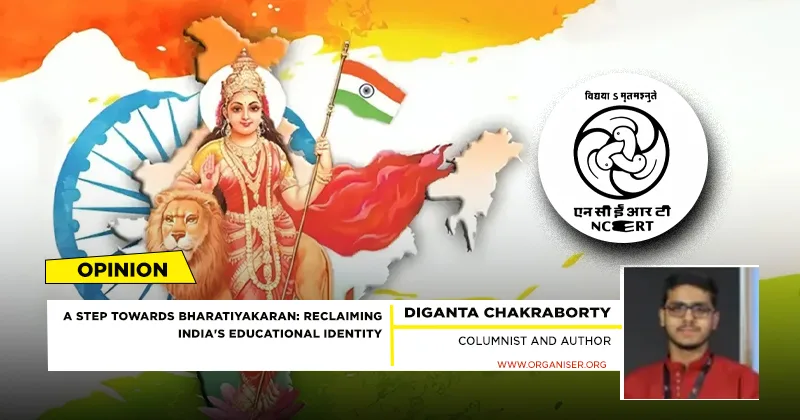
In a recent move, The National Council of Educational Research and Training (NCERT) has announced a significant revision to its Class 7 Social Science textbooks for the 2025–26 academic session, removing chapters on the Delhi Sultanate and the Mughals. In their place, new sections highlighting ancient Indian dynasties, Mahakumbh, pilgrimage sites, and cultural traditions have been introduced. While this has drawn criticism from some quarters, labelling it as the saffronisation of Education, a closer and more honest look reveals it as a step forward in the Bharatiyakaran of our education system—a process long overdue.
To understand the significance of this change, one must revisit the roots of modern Indian Education. The foundation of our contemporary system was laid down by Lord Thomas Babington Macaulay, whose infamous Minute on Indian Education in 1835 expressed the colonial goal of creating “a class of persons, Indian in blood and colour, but English in taste, in opinions, in morals, and intellect.” In other words, a class of literate clerks—not educated, critical thinkers. But in Bharatiya, “Education is the manifestation of perfection already in man”, as told by Swami Vivekananda.
Macaulay’s system was never designed to empower Indians with self-respect or cultural pride. It was a strategic move in the colonial playbook: conquer the mind to rule the body. Generations were taught to admire Western history, literature, and values, while their heritage was dismissed as backward or irrelevant. The consequences of this mental colonisation are visible even today. We still recite the names of Babar, Akbar, and Aurangzeb with admiration, while the names of our ancestors—like the descendants of Lord Ram—remain forgotten.
As a result, a nation that once led the world in science, philosophy, astronomy, medicine, and statecraft was made to feel like it had no glorious past. This intellectual enslavement is perhaps more damaging than physical colonisation because it breeds generations who doubt their worth. Even in widely respected books like ‘The Discovery of India’ by Jawaharlal Nehru, there is a subtle tendency to interpret India’s ancient past with a tone of scepticism or condescension. While Nehru admired aspects of Indian civilisation, his overall narrative often echoed the colonial lens that downplayed Indigenous achievements.
Expert says that if you want to break a civilisation, you don’t necessarily need to wage war—you only need to distort its past, its culture. And this is precisely what was done to India. A country with thousands of years of history and rich culture was made to believe that its true story began only with foreign invasions.
Is it not strange that we studied the invaders who plundered India in detail but barely touched upon civilisational marvels like Nalanda, Takshashila, the Gupta period’s scientific advancements, or the spiritual wisdom of the Vedas and Upanishads? Is it not concerning that the emphasis on Mughal rulers came at the cost of knowing about the Cholas, Pandyas, Ahoms, or the valour of Rajput kings? India is the land of Bharata, Chanakya, Patanjali, Panini, Kalidasa, and Bhaskaracharya—men whose genius rivalled or surpassed their Western counterparts. But these names find little space in our textbooks.
Including the Mahakumbh in the curriculum is a refreshing and necessary course correction. Far from being a mere religious gathering, the Mahakumbh represents a living civilisational tradition over 5000 years old. It is a convergence of spiritual seekers, scholars, saints, scientists, and artists. It showcases the democratic and pluralistic ethos of India, where ideas are exchanged, not imposed. More importantly, teaching about the Mahakumbh connects young Indians to their cultural roots and allows them to appreciate the continuity of Indian civilisation.
Predictably, sections of the media have criticised this shift, branding it as the “saffronisation” of Education. One prominent Bengali newspaper went so far as to publish a front-page report decrying the move. Such reactions are not just unfortunate; they are deeply symptomatic of the colonial hangover that still clouds the judgment of our intellectual elite. To view every attempt at restoring Indian culture through the lens of communalism is not only misleading but intellectually dishonest. Is it communal to teach about the Kumbh Mela, a UNESCO-recognized Intangible Cultural Heritage of Humanity? Is it communal to introduce students to India’s spiritual and philosophical heritage, which has inspired generations worldwide—from Emerson and Thoreau to Schopenhauer and Einstein? The question we must ask is this: Why is teaching Western civilisation considered Education, but teaching Indian civilisation is considered indoctrination?
The narrative that Bharat was a land of ignorance before foreign invasions is simply false. The works of historians and researchers like Dharampal, particularly in books like ‘The Beautiful Tree’, provide detailed evidence—collected from British records themselves—that pre-colonial India had an extensive and decentralised education system. In the early 19th century, British surveys found that almost every village in Bengal and Madras had schools. Subjects included grammar, logic, mathematics, astronomy, and philosophy. His works demonstrate that Bharat, until at least the 18th century, was thriving in Education, manufacturing, trade, and social organisation, making it one of the most prosperous civilisations of the time. To point to the widespread presence of Schools in Indian Villages, Dharampal quotes Sir Thomas Munro, the Governor of Madras: ‘Every village had a school’. Dharampal’s research, based on British surveys from the early 19th century, reveals a robust network of indigenous educational institutions across India. For instance, the Madras Presidency Indigenous Education Survey (1822–25) reported 11,575 schools with 188,650 students. Similarly, William Adam’s reports from Bengal and Bihar (1835–38) estimated approximately 100,000 village schools, averaging about one school per village. These findings suggest that Indigenous Education was more widespread in India than in contemporary England during the same period.
The path to making Bharat a global power does not lie in imitating the West but in rediscovering and reclaiming our civilisational identity. The recent initiative by the NCERT should be viewed as part of a larger mission—the decolonisation of the Indian mind. Every individual can reclaim and reinterpret their history through a decolonised lens. As Walter D. Mignolo and Catherine E. Walsh assert in their work On Decoloniality: Concepts, Analytics, Praxis, every society possesses the right to define both coloniality and decoloniality by its unique historical experiences and cultural context.
By reintroducing civilisational themes, cultural practices, and Indigenous knowledge systems into school curricula, we are not just rewriting history—we are rewriting self-worth. Let our upcoming generations know about Aryabhatta, who calculated the value of pi; about Sushruta, the father of surgery; about Gargi and Maitreyi, female philosophers who debated in ancient assemblies; about the Bhakti and Sant traditions that upheld social harmony long before modern secularism.