
Either the judiciary reforms itself or it risks becoming obsolete
June 7, 2026
  • Read Ecopy
  • Circulation
  • Advertise
  • Careers
  • About Us
  • Contact Us
Android AppiPhone AppArattai
Organiser
  • ‌
  • Bharat
    • Assam
    • Bihar
    • Chhattisgarh
    • Jharkhand
    • Maharashtra
    • View All States
  • World
    • Asia
    • Europe
    • North America
    • South America
    • Africa
    • Australia
  • Editorial
  • International
  • Opinion
  • RSS @ 100
  • More
    • Op Sindoor
    • Analysis
    • Sports
    • Defence
    • Politics
    • Business
    • Economy
    • Culture
    • Special Report
    • Sci & Tech
    • Entertainment
    • G20
    • Azadi Ka Amrit Mahotsav
    • Vocal4Local
    • Web Stories
    • Education
    • Employment
    • Books
    • Interviews
    • Travel
    • Law
    • Health
    • Obituary
  • Subscribe
    • Subscribe Print Edition
    • Subscribe Ecopy
    • Read Ecopy
  • ‌
  • Bharat
    • Assam
    • Bihar
    • Chhattisgarh
    • Jharkhand
    • Maharashtra
    • View All States
  • World
    • Asia
    • Europe
    • North America
    • South America
    • Africa
    • Australia
  • Editorial
  • International
  • Opinion
  • RSS @ 100
  • More
    • Op Sindoor
    • Analysis
    • Sports
    • Defence
    • Politics
    • Business
    • Economy
    • Culture
    • Special Report
    • Sci & Tech
    • Entertainment
    • G20
    • Azadi Ka Amrit Mahotsav
    • Vocal4Local
    • Web Stories
    • Education
    • Employment
    • Books
    • Interviews
    • Travel
    • Law
    • Health
    • Obituary
  • Subscribe
    • Subscribe Print Edition
    • Subscribe Ecopy
    • Read Ecopy
Organiser
  • Home
  • Bharat
  • World
  • Operation Sindoor
  • Editorial
  • Analysis
  • Opinion
  • Culture
  • Defence
  • International Edition
  • RSS @ 100
  • Magazine
  • Read Ecopy
Home Bharat

Either the judiciary reforms itself or it risks becoming obsolete: Former Chief Justice of India, Ranjan Gogoi

Prafulla KetkarPrafulla Ketkar
Apr 21, 2025, 07:00 pm IST
in Bharat, Law, Interviews
Follow on Google News
FacebookTwitterWhatsAppTelegramEmail

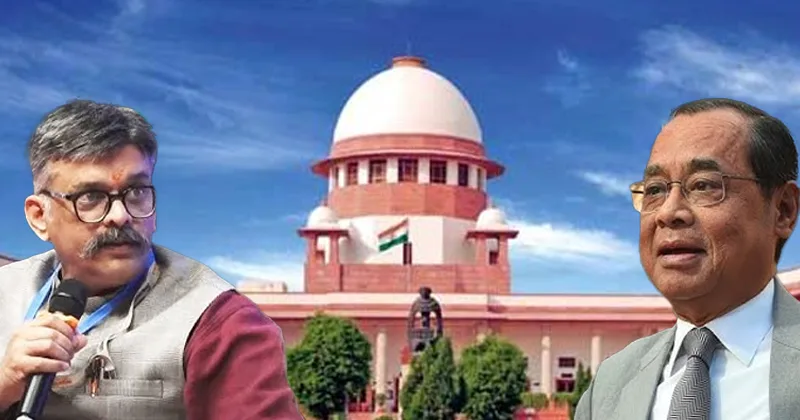
Former Chief Justice of India, Ranjan Gogoi, engages in an insightful discussion with Prafulla Ketkar, Editor Organiser, in Surat Literature festival organised from January 17 to January 19, 2025. Justice Gogoi shares his views on critical issues such as judicial reforms, the backlog of cases, the Uniform Civil Code (UCC), and the role of the judiciary in shaping India’s future. He offers a candid assessment of the challenges facing the Indian legal system and the necessary steps required to ensure efficiency and fairness. Excerpts:

You mentioned judicial reforms. If you could suggest three key reforms, what would they be?

You don’t need three reforms—just one. Get good people to become judges. If you have good people in the judiciary, the rest will fall into place.

Judges currently enter the system by passing an examination and undergoing a short interview. However, there is no assessment of their character, compassion, or sense of justice. This needs to change. Increase the number of judges from 24,000 to 1,00,000 and ensure that they are selected based on merit and integrity.

Beyond good people, do we also need better laws?

Laws alone won’t solve the problem. Even a bad law can work if implemented by good people, whereas even the best laws fail under bad administration. The recent amendments to the Indian Penal Code, Criminal Procedure Code, and Evidence Act include positive steps such as community service for minor offenses and DNA-based evidence collection. These reforms are promising, but their success depends on those who implement them.

There are more than 3.5 crore pending cases in the Courts. If we are to move forward, what would be your recommendation as former Chief Justice of India to address this backlog and restore common people’s confidence in the judiciary?

That is a critical issue. When I demitted office in 2019, the pending cases were around three crore. Today, it stands at five crore. No Chief Justice before me has entered public life post-retirement. I consciously chose to do so because I believe engagement with the system is necessary. The backlog is solvable, but it requires serious intent. Many cases remain pending due to technicalities or lack of interest from litigants. A significant portion of the backlog consists of criminal cases. For example, in the Allahabad High Court, judges are still hearing 40-year-old criminal appeals. This means that if a person was convicted at the age of 30, they are now around 75 to 80 years old and still waiting for justice.

A systematic review is required to identify cases that remain relevant and those that have lost significance due to time. A large portion of the backlog consists of dead cases, which can be closed. I have suggested that the Chief Justice of India take the initiative to address this problem.

What steps can be taken in the next 25 years so that by 2047, the Indian judicial system is more efficient?

If the system continues as it is, there will be serious difficulties. Either the judiciary reforms itself or it risks becoming obsolete. The legislature must consider a framework to close cases that have been pending for decades with no progress. Some Roman emperors burned all law books and rewrote them. While I am not suggesting something as extreme, we must be willing to take bold steps. High courts and the Supreme Court should authorize the closure of cases that cannot be meaningfully adjudicated.

“The recent amendments to the Indian Penal Code, Criminal Procedure Code, and Evidence Act include positive steps such as community service for minor offenses and DNA-based evidence collection”
— Ranjan Gogoi, Former Chief Justice of India

Criminal trials must be completed within three to four years, at most. Today, in states like Uttar Pradesh, appeals remain stuck for decades. A person convicted by the trial court may wait 20 years before the high court even hears the appeal. If the high court later finds them innocent, what compensation can be given for those lost years?

The Uniform Civil Code (UCC) has been a long-debated topic. How do you see its implementation?

The Uniform Civil Code (UCC) is a very progressive piece of legislation that aims to replace diverse customary practices that have evolved into law. There is no dispute that it is a constitutional goal. It is mentioned in Article 44 of the Indian Constitution, and one day, we must achieve it.

I see the UCC as an important step towards national integration, ensuring social justice and gender justice. However, it does not conflict with Article 25 and 26, which guarantee the right to freedom of religion. As you yourself pointed out, the UCC will govern civil matters such as adoption, marriage, divorce, and inheritance—it has nothing to do with religious practices. The UCC has worked wonderfully in Goa, where the Portuguese Civil Code is in place, and there is no controversy. This shows that a uniform law is both practical and beneficial.

However, implementation must be done thoughtfully. My suggestion is that the government and lawmakers should focus on consensus-building. There is a lot of misinformation about the UCC, with some groups portraying it as a threat to religious freedoms. This is simply not true. The Supreme Court has repeatedly raised the issue of the UCC in multiple cases, starting from Shah Bano to more recent judgments. The highest court of this land has consistently stated that India must move towards implementing a Uniform Civil Code.

A nation cannot afford to have fragmented laws governing civil matters. It complicates legal proceedings and adds to the judicial backlog. Additionally, it affects the fundamental rights of individuals, particularly in matters of gender justice. The only way forward is for Parliament to take gradual steps toward its implementation while ensuring proper education and sensitization of the public.

That being said, I urge lawmakers to take their time and not rush into it. The focus should be on building consensus and dispelling misconceptions. While some sections of society may always resist change, the majority will support it if they are properly informed.

Coming to a sensitive issue—you are from Assam, a state that has faced significant challenges with illegal migration. What are your thoughts on how India should handle this issue?

Sitting judges do not discuss pending cases in public forums, and retired judges should not comment on their own judgments. I authored the NRC judgment and supervised the case for seven years, passing over 700 orders. Given this, I will refrain from commenting further on the issue. However, I hope those in charge take inspiration from the efforts made to address illegal migration.


Topics: Uniform Civil CodeUCCFormer Chief Justice India Ranjan GogoiJudicial Reforms
Prafulla Ketkar
Prafulla Ketkar
Prafulla Ketkar, is the Editor, Organiser (Weekly) since 2013. He has a experience of over 20 years in the fields of research, media and academics. He is also Advisory Committee School of Journalism, Delhi University. He has been writing on issues related to International politics and foreign policy, with special reference to China and Democracy, Hindutva, and Bharatiya Civilisation. He was also a member of the Editorial team of the recently published Complete Works of Pt Deendayal Ji in 15 Volumes. He has 2 books, 29 academic articles, 2 entries in Encyclopedia of India and numerous articles to his credit. [Read more]
Share2TweetSendShareSend
✮ Subscribe Organiser YouTube Channel. ✮
✮ Join Organiser's WhatsApp channel for Nationalist views beyond the news. ✮
Previous News

Indian ethos & the distinctive importance of number six

Next News

Kerala: Higher studies in mother tongue will empower students, says NAAC chairman Dr Anil Sahasrabudhe

Related News

The Uniform Civil Code debate in Assam has reignited questions around equality, cultural identity and constitutional reform in India

Equality Without Assimilation: Why Assam’s UCC debate goes beyond legal uniformity

Assam CM Himanta Biswa Sarma

Assam Passes UCC: Congress party’s proposed amendment over second wife rejected

New Delhi, May 24 (ANI): Union Home Minister Amit Shah speaks during Janjatiya Sanskriti Samagam, at Red Fort, in New Delhi on Sunday. (ANI Photo/Naveen Sharma)

Janjati Sanskritik Samagam | “No need to fear UCC”: Amit Shah reassures tribals, pre-empts conspiracy narrative

UCC Bill 2026 tabled in Assam Assembly

Assam Govt introduces UCC in assembly: Bill aims to curb polygamy, requires registration of all live-in relationship

Assam cabinet clears UCC bill

Assam: Himanta Biswa’s first cabinet clears UCC bill, adopts BJP Sankalpa Patra as government’s guiding framework

First Halala Case Under UCC Filed in Uttarakhand, Husband and In-Laws Booked (This image is generated by AI)

Uttarakhand Police registers India’s first Halala FIR under UCC by Shahin against her husband, Mohammad Danish

Load More

Latest News

(Left) Victorious Indian Men-s hockey team who who won Gold in U-18 Asia Cup (Right) U-18 Women's hockey team who won bronze medal in the Asia Cup

U18 Asia Cup 2026: Indian Men’s hockey wins gold, women secure bronze medal; PM Modi & Amit Shah hail the teams

India’s semiconductor roadmap shifts from import dependence to silicon sovereignty, aiming for a self-reliant ecosystem by Viksit Bharat 2047

From Import Dependence to Silicon Sovereignty: India’s bold semiconductor roadmap for Viksit Bharat 2047

Keralam Chief Minister V.D. Satheeshan

Jamaat-e-Islami Hind Team Meets CM Satheeshan, Senior Ministers, fuel debate over influence in UDF government

Singapore acts against China-linked posts targeting Indian community, cites threat to social harmony

Singapore Invokes OCHA: Facebook, YouTube and X ordered to block anti-Indian content originating from China

Editors of the HAF Wikipedia page run propaganda and disinformation campaign against the organisation, India and Hindu cultural ethos

Wikipedia fuels propaganda against Hindu American Foundation: How anonymous writers demonise Hindu rights group?

Israel to Install Statue of Chhatrapati Shivaji Maharaj; Israel’s Consul General in Mumbai, Yaniv Revach, met Maharashtra Chief Minister Devendra Fadnavis and sough his support in this regard

Chhatrapati Shivaji Maharaj’s legacy to reach Israel; Statue to be installed as symbol of India-Israel friendship

IIGH Public Policy Seminar: Women’s dignity, safety & equal opportunity discussed

Representative Image

Decoding Hezbollah: How the terror group built a massive arsenal against Israel

Representative Image

Plastic, Traffic and Landslides: How rising tourist footfall is posing threat to the mountainous region

The Green Realignment: Why the US-India trade pact is a battle for climate and supply chain security

Load More
  • Privacy
  • Terms
  • Cookie Policy
  • Refund and Cancellation
  • Delivery and Shipping

© Bharat Prakashan (Delhi) Limited.
Tech-enabled by Ananthapuri Technologies

  • Home
  • Search Organiser
  • Bharat
    • Assam
    • Bihar
    • Chhattisgarh
    • Jharkhand
    • Maharashtra
    • View All States
  • World
    • Asia
    • Africa
    • North America
    • South America
    • Europe
    • Australia
  • Editorial
  • Operation Sindoor
  • Opinion
  • Analysis
  • Defence
  • Culture
  • Sports
  • Business
  • RSS @ 100
  • Entertainment
  • More ..
    • Sci & Tech
    • Vocal4Local
    • Special Report
    • Education
    • Employment
    • Books
    • Interviews
    • Travel
    • Health
    • Politics
    • Law
    • Economy
    • Obituary
  • Subscribe Magazine
  • Read Ecopy
  • Advertise
  • Circulation
  • Careers
  • About Us
  • Contact Us
  • Policies & Terms
    • Privacy Policy
    • Cookie Policy
    • Refund and Cancellation
    • Terms of Use

© Bharat Prakashan (Delhi) Limited.
Tech-enabled by Ananthapuri Technologies