Hezbollah should wake up to new realities
June 24, 2026
  • Read Ecopy
  • Circulation
  • Advertise
  • Careers
  • About Us
  • Contact Us
Android AppiPhone AppArattai
Organiser
  • ‌
  • Bharat
    • Assam
    • Bihar
    • Chhattisgarh
    • Jharkhand
    • Maharashtra
    • View All States
  • World
    • Asia
    • Europe
    • North America
    • South America
    • Africa
    • Australia
  • Editorial
  • International
  • Opinion
  • RSS @ 100
  • More
    • Op Sindoor
    • Analysis
    • Sports
    • Defence
    • Politics
    • Business
    • Economy
    • Culture
    • Special Report
    • Sci & Tech
    • Entertainment
    • G20
    • Azadi Ka Amrit Mahotsav
    • Vocal4Local
    • Web Stories
    • Education
    • Employment
    • Books
    • Interviews
    • Travel
    • Law
    • Health
    • Obituary
  • Subscribe
    • Subscribe Print Edition
    • Subscribe Ecopy
    • Read Ecopy
  • ‌
  • Bharat
    • Assam
    • Bihar
    • Chhattisgarh
    • Jharkhand
    • Maharashtra
    • View All States
  • World
    • Asia
    • Europe
    • North America
    • South America
    • Africa
    • Australia
  • Editorial
  • International
  • Opinion
  • RSS @ 100
  • More
    • Op Sindoor
    • Analysis
    • Sports
    • Defence
    • Politics
    • Business
    • Economy
    • Culture
    • Special Report
    • Sci & Tech
    • Entertainment
    • G20
    • Azadi Ka Amrit Mahotsav
    • Vocal4Local
    • Web Stories
    • Education
    • Employment
    • Books
    • Interviews
    • Travel
    • Law
    • Health
    • Obituary
  • Subscribe
    • Subscribe Print Edition
    • Subscribe Ecopy
    • Read Ecopy
Organiser
  • Home
  • Bharat
  • World
  • Operation Sindoor
  • Editorial
  • Analysis
  • Opinion
  • Culture
  • Defence
  • International Edition
  • RSS @ 100
  • Magazine
  • Read Ecopy
Home World

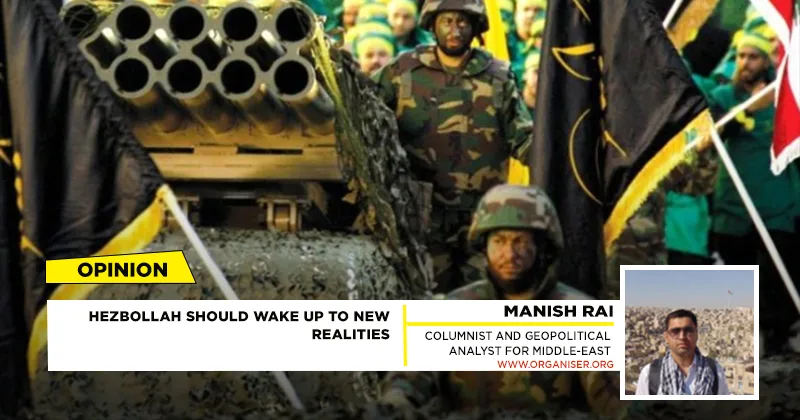
Hezbollah Should Wake Up to New Realities

As regional dynamics shift rapidly in the Middle East, Hezbollah finds itself at a critical crossroads. Mounting international pressure, changing equations in the Israel-Iran conflict, and growing domestic discontent in Lebanon are reshaping the strategic landscape in which the militant group has long operated

Manish RaiManish Rai
Apr 13, 2025, 08:00 pm IST
in World, Opinion, International Edition
Follow on Google News
FacebookTwitterWhatsAppTelegramEmail

US Deputy Envoy to the Middle East Morgan Ortagus, recently visited Lebanon. During an interview with the LBCI news outlet, Ortagus stressed the importance of disarming Hezbollah. This statement from a senior US diplomat has sparked a new debate about the disarmament of Hezbollah, which has been demanded for a long time. In January this year, the Lebanese parliament elected a new president, former army chief Joseph Aoun. New President in his inaugural speech, clearly said that he wanted the state to have the monopoly of force. He wanted the state to be the one with the weapons. It should be remembered that Hezbollah was the only Lebanese armed group that refused to surrender its weapons following a 1975-1990 civil war, arguing that its arms were necessary to fight against occupying Israeli troops in south Lebanon.

The international community, through the UN Security Council, has demanded multiple times that Hezbollah should disarm. Instead, Hezbollah has continually ignored these demands. They ignored UN Resolution 1701, which called for a zone free of armed personnel besides the army of Lebanon. They ignored UN Resolution 1559 and the Lebanese Taif Agreement, which ended the Lebanese Civil War and called for the disbanding and disarmament of all Lebanese and non-Lebanese militias. Hezbollah in the past has clearly shown it has no intention of ever laying down its arms.

But now the time has changed, with the group weakened militarily and economically, critics see this as a unique opportunity to disarm it. More than a year of fighting with Israel has left the Iran-backed Shia group, once renowned as the world’s strongest non-state actor, reeling. The group’s near-total dominance of the Lebanese state for the past two decades has been weakened by the losses it has suffered in the past year of war. Most of Hezbollah’s senior leadership was killed in the fighting, along with thousands of its fighters, and many of its weapon caches were destroyed. Hezbollah has also lost control of key assets such as the Beirut airport and smuggling routes along the Syrian border, both historically key for its cash flow. They no longer have a territorial link between Lebanon, Syria, Iraq, and Iran, which was crucial for getting arms supplies from Iran. This also hinders their logistics about obtaining weapons, which were stored in Syrian underground tunnels. Moreover, the main backer of Hezbollah, the Iranians, are themselves under immense pressure from the United States right now, and they are not in a position to provide any major assistance to Hezbollah.

As a condition of the ceasefire with Israel, which was agreed in November last year. Hezbollah has withdrawn its weaponry from its historical heartland south of the Litani River, about 18 miles from the Israeli border. The Lebanese army has been active in enforcing the terms of the ceasefire deal. It has been dismantling military assets belonging to the group in south Lebanon and conducting raids in the southern suburbs of Beirut, something unthinkable just six months earlier.

Hezbollah is assessing the ground realities, that’s why the group is in “wait and see mode”, as it recovers from the war and adjusts to a new political reality in Lebanon and the wider region. Many analysts believe that at present, Hezbollah is internally split into two factions. One faction acknowledges the group’s defeat by Israel and is willing to turn their weapons over and integrate into Lebanon as a political party. On the other hand, another faction believes Hezbollah’s sole legitimacy lies in fighting Israel, and that if they stop doing so, they have no right to exist as a movement. But this group, which has been running a state within a state for decades, must realise that it can no longer unilaterally drag Lebanon into foreign conflicts and can’t blackmail the Lebanese state through its large arsenal. But any effort to disarm Hezbollah forcefully can prompt a new conflict in Lebanon. To avoid this kind of situation, the Lebanese top leadership must convince Hezbollah to give up arms and solely be a political force. Any negotiations about Hezbollah’s disarmament are likely to be difficult and long. The central objective should be convincing Hezbollah that disarmament need not amount to the party’s complete demise. One of the options that can be put forward for Hezbollah’s consideration is that its arsenal, believed to still include long-range missiles, be put under the control of the state, while its fighters, estimated to be several thousand, could be integrated into the Lebanese army. Alternatively, a new defense strategy can also be negotiated under which Hezbollah fighters would join a paramilitary force within the Lebanese Army.

Hezbollah will remain an important player in Lebanese politics, but not a hegemon. The old order marked by Iranian influence and Shia ascendancy has crumbled. Lebanon now stands at a crossroads: the chance to reclaim sovereignty and pluralistic politics or the risk of another descent into fragmentation and chaos. Lebanon can sink further into chaos or use Hezbollah’s defeat as a catalyst for change. Hezbollah’s disarmament can also open doors for long-overdue political and economic reforms in Lebanon.




Topics: IranHezbollahIsraeil
Manish Rai
Manish Rai
The writer is a Political Analyst for West Asia and Af-Pak Region. [Read more]
Share21TweetSendShareSend
✮ Subscribe Organiser YouTube Channel. ✮
✮ Join Organiser's WhatsApp channel for Nationalist views beyond the news. ✮
Previous News

The state of harmony, strength and righteousness is Param Vaibhav: Dattatreya Hosabale, Sarkaryavah of RSS

Next News

Historic Indo-Sri Lanka Defence Cooperation Agreement: Timely response to Chinese designs in the IOR

Related News

Lebanon must get out of the clutches of Hezbollah

Representative image

West Asia Conflict: Donald Trump announces landmark US-Iran agreement, raises hopes for peace

Iran-themed World Cup flexes in Narath, Kannur, featuring Ayatollah Khamenei and 'Free Palestine' messaging, have sparked debate over the intersection of football, religion and politics in Keralam

Keralam’s football world cup frenzy takes a religious turn with Iran, Khamenei and free Palestine flexes

America’s Friend, Pakistan’s Burden: The hidden cost of Washington’s Iran strategy

Representative Image

The Labyrinth of War: Easy to enter; Difficult to exit

West Asia Conflict: India issues advisory to citizens in Iran & Israel; Urges to avoid tarvel & exercise utmost caution

Load More

Latest News

Suhail arrested for plotting terror attack on Ayodhya Ram Mandir

Karnataka: Terror plot targeting Ayodhya Ram Mandir unearthed after arrest of suspected terrorist Suhail

Ketan Vishal Agarwal’s 400-foot fall exposes alleged plot by Siya Goyal and Chetan Chaudhary

Pune Fort Murder: Ketan Agarwal thrown off Lohagad Fort; Fiancee Siya & lover Chetan arrested for plotting the killing

Bangladeshi infiltrators arrested by Assam Police

Assam Police arrests 10 Bangladeshi infiltrators from Guwahati lodge; 33 arrested in two weeks 

Punjab CM Bhagwat Mann

Bhagwant Mann Video Row: Gurugram police claim Punjab officers paid Rs 10 lakh to tailor forensic report

France’s annual music festival turns into night of fear amid alleged syringe attacks, sexual assaults & street violence

France Music Festival Violence: Women stabbed, drugged and sexually assaulted; 243 arrests made

Can Karnataka bypass SIR rules? Residence certificate move sparks citizenship debate

Karnataka SIR Controversy: Residence certificate plan unlikely to pass ECI’s voter verification test

The US Ambassador to India Sergio Gor and Tamil Nadu Chief Minister Joseph Vijay; The tweet of BJP Tamil Nadu State Secretary Ashvathaman.

BJP Tamil Nadu urges Jaishankar to intervene over US Ambassador’s ‘two nations’ remark after meeting CM Joseph Vijay

Puri Rath Yatra 2026: Authorities finalise crowd management plan

Puri Rath Yatra 2026 in Odisha: Massive security, healthcare and transport arrangements finalised

Karnataka's Gruha Lakshmi scheme faces scrutiny after CAG flags 19,000 beneficiaries linked to one account

Karnataka: Gruha Lakshmi scheme under scanner; CAG flags 19,000 beneficiaries linked to same bank account

Pesticides linked to cancer and environmental harm remain in use on Indian farms, sparking fresh concerns about food safety

Toxic Harvest? Why cancer-linked pesticides continue to be used across Indian farms despite global concerns

Load More
  • Privacy
  • Terms
  • Cookie Policy
  • Refund and Cancellation
  • Delivery and Shipping

© Bharat Prakashan (Delhi) Limited.
Tech-enabled by Ananthapuri Technologies

  • Home
  • Search Organiser
  • Bharat
    • Assam
    • Bihar
    • Chhattisgarh
    • Jharkhand
    • Maharashtra
    • View All States
  • World
    • Asia
    • Africa
    • North America
    • South America
    • Europe
    • Australia
  • Editorial
  • Operation Sindoor
  • Opinion
  • Analysis
  • Defence
  • Culture
  • Sports
  • Business
  • RSS @ 100
  • Entertainment
  • More ..
    • Sci & Tech
    • Vocal4Local
    • Special Report
    • Education
    • Employment
    • Books
    • Interviews
    • Travel
    • Health
    • Politics
    • Law
    • Economy
    • Obituary
  • Subscribe Magazine
  • Read Ecopy
  • Advertise
  • Circulation
  • Careers
  • About Us
  • Contact Us
  • Policies & Terms
    • Privacy Policy
    • Cookie Policy
    • Refund and Cancellation
    • Terms of Use

© Bharat Prakashan (Delhi) Limited.
Tech-enabled by Ananthapuri Technologies