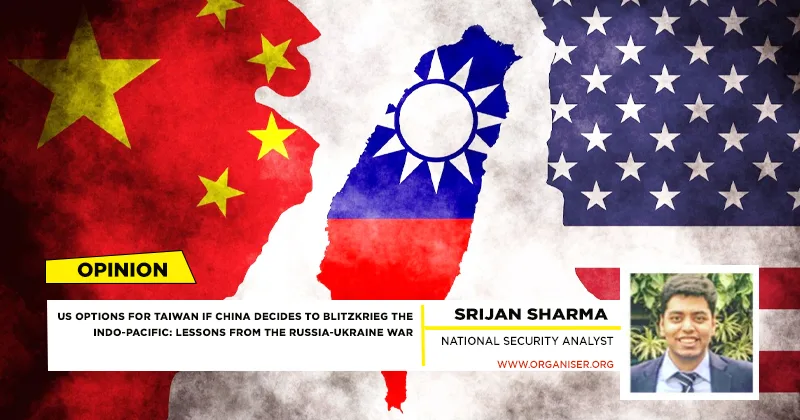
China has once again upped the ante of the security dilemma and fueled security anxiety in the Indo-Pacific region by demonstrating a possible plan of invasion and blockage of Taiwan. As the Trump Administration sets the stage to confront China in a more aggressive manner unlike the Biden Administration, the possibilities of simmering tensions in the Indo Pacific region are more likely in the coming days. If China’s show off tactics against Taiwan take some serious shape in the future, it would not only complicate US’s options but can fragment maritime peace in the Indo-Pacific region for long, inviting more dangerous consequences for global order than the Russia- Ukraine War. The Indo-Pacific region accounts for one-third of global economic activity and is emerging as a key geoeconomic hub.
Flash In Indo Pacific
If China moves away from its strategic ambiguity and translates its show-off tactics to real warfare with Taiwan, as it aims to do by 2027 as per the recent development. Then, it would be interesting to see how the US’s security and strategic community will respond. A possible strategic lesson can be drawn from the US’s response to the Russia- Ukraine war, which could serve as an effective security option in case a conflict breaks out in the Indo-Pacific region. This approach not only helps deter China but also safeguards Taiwan from an immediate wave of Chinese attack.
The Lesson
During the Russia- Ukraine war, it was surprising that Ukraine managed to hold ground for two years in the battlefield despite having an asymmetrical war capability compared to the Russians. However, it now becomes an open truth that the US’s Nixon doctrine is at play, which has backed and increased Ukraine’s survival chances. These events are not new to the geopolitical landscape; during the Cold War era, the world witnessed countries fighting in a proxy style to balance asymmetries. There were countries, such as Vietnam, that had displayed exemplary courage in asymmetrical warfare by leveraging the support of key figures to upgrade their firepower and mitigate some of the asymmetries, thereby sustaining and prolonging their presence on the battlefield. The same courage in fighting asymmetrical warfare is currently evident in the Russia- Ukraine war.
Understanding Strategies and Counter-Strategies
Russia, to some extent, had employed the blitzkrieg strategy to achieve strategic paralysis. It was aimed to strategically paralyse Ukraine by targeting their military and strategic installation. Perhaps Russia believed that this line of action was desirable for achieving a swift victory over Ukraine. However, little did they know that a 7–10-day job would now become an endless job of fighting. Ukraine has countered the Russian offensive with a porcupine strategy backed by the West, which has so far proved to be an effective strategy in fighting asymmetrical warfare. Russia’s retort to this strategy was the attrition strategy- a strategy to wear and tear/exhaust the moral and resources of Ukraine to force them to surrender or comply with Russian demands. However, the question arises as to why Russians are still unable to exhaust Ukrainian forces despite having expanded the area of their attrition strategy. This demands an investigation which leads us to the following:
The Porcupine Strategy: A License to Fight Asymmetrical Warfare
The ‘porcupine doctrine,’ proposed in 2008 by US Naval War College research professor William S. Murray, is a strategy of asymmetric warfare. It focuses on fortifying a weak state’s defenses to exploit the enemy’s weaknesses rather than engaging in direct combat. This ensures that the weak state can survive and sustain itself, making it difficult for the enemy to gain the upper hand quickly. The defensive layers surrounding the weak state or the fortifying work make it difficult for an invading state to gain the upper hand over the weak state quickly. The fortifying work also helps the weak state buy some time for planning and reorganizing its arsenals, assets, and other resources for the war. A brief discussion of the working of this strategy is discussed below:
The Working of Porcupine Strategy
According to King’s College London, three defensive layers are formed, where the outer layer is given to the Intelligence apparatus of the weak state, backed by a strong state, so that they can alert the defence forces. Upon receiving the alert, the defence forces can be adequately prepared. The US Intelligence Agency (CIA) must have already established an adequate presence to sense, report, and coordinate with the Ukrainian Intelligence Agency so that Ukraine’s defence forces are prepared to face the Russian offensive. The second layer is fighting a guerrilla or internal war with sophisticated support from a big state against the enemy or invading state. The Ukraine government’s decision to establish the International Legion and encourage civilian communities to support Ukraine’s forces is indicative towards the intent of setting the stage for guerrilla warfare. The guerilla method would provide logistical and ground support to Ukraine’s conventional forces. The third layer takes advantage of what you already have or are blessed with, i.e., your geographical setting or terrain. In the present case, Ukraine is blessed with a significant and complicated urban terrain, and its advantage is currently being utilized by the Ukrainian forces against the Russian forces.
The Ogaden War(1977-78); Breaking the perception
There is a common perception among many that if a strong state backs a weak state, the weak state is more likely to prevail. However, there is an urgent need to dispel these preconceived notions and gain a clearer understanding of the strategic picture. The success of the porcupine strategy rests on two pillars: 1) the receptivity or assimilation of a weak state and 2) the firm will or determination of a weak state. Simply securing the support of bigwigs and high-tech weapons is not enough to win the war. If that had been the case, then Somalia would have won the Ogaden War against Ethiopia (backed by the USSR) in 1977-78, where Somalia still suffered a humiliating defeat despite having US backing. The reason for the defeat was that the Somalians failed to assimilate, understand and operate the US’s cache of arms supplies. Therefore, to achieve success, the weak state must go the extra mile with the big state to balance the efforts.
The Ukrainian Response
Ukrainians are very receptive to the sophisticated weapons and systems provided to them by the US. According to retired U.S. Army Lt. Gen. Ben Hodges, the U.S. provided radar equipment that detected incoming Russian artillery fire. Hodges expressed his surprise over the radar functioning-“radar is better than I realised,” he said. The Ukrainians took it and were able to utilise it in ways that I had not known were possible. And it’s not just the technical aspect, but also the tactical, in how they employed it. Hodges said. He further said that the Ukrainian military is trying to create drones with the technology supplied to them by the US. Ukrainians have also demonstrated brilliance in not letting Russians dominate their airspace, using shoulder-held Stinger missiles to take down low-flying helicopters and the S-300 surface-to-air missile system to target higher-flying aircraft. This has constrained Russians to fire their missiles long distance from the skies over Russia or the Black Sea rather than entering into Ukrainian air space. At the information warfare front, Russia is also getting a tough response from Ukraine. Ever since the war began, the Ukraine leadership was quick and smart to leverage all the important international forum to wield anti Russian narrative which had a severe impact on the Russian image at the abroad and world forums- ouster from SWIFT, sanctions and anti Russian sentiments are some key repercussions that Russia is today facing. The majority of the people across the globe have built a negative perception of Russia, leaving a handful of people who understand Russia’s necessity. At every front of the war, the way the Ukrainian forces are tapping into technologies and learning them at a fast pace shows their grit and sound mind in extreme crises. The response of Ukrainian forces helps strengthen the second and third layers of defence, which keep the Russians on their toes and push them back. The failure to siege and capture Kyiv, as well as the withdrawal from Snake Island, are examples. Thus, it is evident that Ukraine’s porcupine strategy, backed up by the West, is frustrating Russians, humiliating them, and counter-exhausting them. Now, the same strategy is being implemented with Taiwan; it would be interesting to see how much success this strategy yields in the event of a Chinese invasion.