Water is a fundamental necessity for life, and access to clean drinking water is a basic human right. However, for decades, millions of Indians, particularly those in rural areas, have struggled with the availability of safe drinking water. Recognising this dire need, the Government of India led by the Bharatiya Janata Party (BJP) launched the Jal Jeevan Mission (JJM) on August 15, 2019. This ambitious initiative, implemented by the Ministry of Jal Shakti, aims to provide functional household tap connections (FHTCs) to every rural household by 2024. The mission envisions sustainable and equitable access to drinking water while emphasising community participation and water conservation.
Background and need for the Jal Jeevan Mission
India, home to over 1.4 billion people, faces severe water stress. According to a 2018 NITI Aayog report, 600 million Indians experience high to extreme water stress, and approximately 200,000 people die annually due to inadequate access to safe drinking water. Rural areas, where over 65 per cent of India’s population resides, are the most affected. Women and children, traditionally responsible for fetching water, often travel several kilometers daily, exposing themselves to physical strain and potential dangers. Moreover, waterborne diseases due to contaminated sources continue to be a significant public health concern, contributing to 20 per cent of all disease burdens in the country.
Recognising these challenges, the Jal Jeevan Mission was conceived as a comprehensive solution. Unlike previous water supply schemes, which primarily focused on infrastructure development without ensuring long-term sustainability, JJM integrates water conservation, community ownership, and decentralised governance to create a lasting impact.
Objectives of the Jal Jeevan Mission
The primary goal of the Jal Jeevan Mission is to provide piped drinking water to every rural household. However, the initiative extends beyond mere infrastructure and incorporates several key objectives:
1. Universal Coverage: Ensure 100 per cent Functional Household Tap Connections (FHTCs) in all rural households by 2024.
2. Quality Assurance: Provide safe drinking water that meets the prescribed quality standards, reducing dependency on untreated groundwater.
3. Sustainability and Conservation: Promote water source sustainability through rainwater harvesting, groundwater recharge, and reuse of greywater.
4. Community Participation: Encourage local governance through Gram Panchayats, Village Water & Sanitation Committees (VWSCs), and Self-Help Groups (SHGs) to ensure maintenance and equitable distribution.
5. Capacity Building and Awareness: Train village-level functionaries, sensitise communities on water management, and promote water literacy.
Implementation Strategy
The success of the Jal Jeevan Mission relies on a bottom-up approach involving state governments, local bodies, and communities. The mission follows a structured four-tier approach:
1. Planning at the Village Level: Each village prepares a Village Action Plan (VAP), identifying water sources, supply infrastructure, and conservation measures.
2. Infrastructure Development: The program funds the installation of piped water supply networks, groundwater recharge structures, and water treatment plants.
3. Community Ownership: The mission mandates at least 10 per cent contribution from the community in cash or labor, ensuring local ownership and responsibility.
4. Monitoring and Assessment: Water quality is regularly tested using Field Testing Kits (FTKs), while digital dashboards track progress in real-time.
To ensure equitable distribution, priority is given to water-stressed districts, tribal areas, and villages affected by water contamination due to fluoride, arsenic, or iron. Special provisions are also made for schools, anganwadi centers, and healthcare institutions, ensuring adequate access for vulnerable populations.
State-Wise Implementation
So far, 11 States and UTs have reported 100 per cent tap water connectivity in rural households. These include Arunachal Pradesh, Goa, Gujarat, Haryana, Himachal Pradesh, Mizoram, Punjab, Telangana, Andaman & Nicobar Islands, Dadra & Nagar Haveli & Daman Diu, and Puducherry. Other states are actively working towards achieving full coverage, with varying degrees of progress.
Performance of Key States: Madhya Pradesh and Maharashtra
Two major states, Madhya Pradesh and Maharashtra, have made significant strides under JJM. Their financial allocation, fund utilisation, and coverage progress are outlined below:
Madhya Pradesh
Since the inception of JJM, the Government of India has allocated substantial funds to Madhya Pradesh to enhance water connectivity. A total of Rs 26,952.10 crore has been allocated, out of which Rs 16,232.04 crore has been drawn. The reported expenditure under the state share stands at Rs 18,674.80 crore, demonstrating a robust commitment towards rural water supply infrastructure. As of March 2025, 76.52 lakh rural households (68.44 per cent) in Madhya Pradesh have access to tap water connections.
Maharashtra
Maharashtra, being one of India’s largest states, has also demonstrated a strong commitment to JJM. With a total fund allocation of Rs 44,391.36 crore, Rs 15,434.91 crore has been drawn, and Rs 15,222.28 crore has been utilised under the state share. The state has successfully provided tap water to 130.81 lakh rural households (89.11 per cent), bringing clean drinking water to a vast population.
Dadra and Nagar Haveli & Daman and Diu
Unlike Madhya Pradesh and Maharashtra, Dadra and Nagar Haveli & Daman and Diu has not drawn any central funds under JJM but has still managed to achieve 100 per cent tap water coverage in its rural areas.
Achievements and Progress
Since its launch, Jal Jeevan Mission has made remarkable progress. As of March 2024, over 13 crore rural households have been provided with functional tap water connections, increasing the national coverage from 17 per cent in 2019 to over 70 per cent. Several states, including Goa, Haryana, Telangana, and Puducherry, have already achieved 100 per cent coverage.
In addition to household connections, JJM has successfully ensured water availability in over 8 lakh schools and anganwadi centers, benefitting millions of children. The program has also led to a significant reduction in waterborne diseases, improved sanitation, and enhanced gender empowerment by reducing the time and effort women spend fetching water.
Moreover, JJM has integrated digital tools like the Jal Jeevan Mission App and Water Quality Monitoring Dashboard, enabling transparency and accountability. The sensor-based IoT technology installed in several villages helps monitor water supply in real-time, ensuring efficient resource management.
On-Ground Impact: A Transformation in Bundelkhand
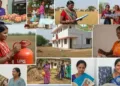
In a comprehensive ground report published by Organiser on June 2, 2024, a visit was made to the historically water-scarce Bundelkhand region, an area infamous for its prolonged droughts and acute water crisis. For decades, women in the region bore the brunt of this struggle, walking miles each day to fetch water, often sacrificing education, work, and household responsibilities. However, with the implementation of the Jal Jeevan Mission (JJM), life in these villages has undergone a revolutionary transformation—one that has restored dignity, ease, and hope to its residents.
Mahoba’s Unprecedented Achievement
One of the most remarkable success stories of JJM is Mahoba district, where out of 132,710 households, an astonishing 132,207 now have functional tap water connections. This 99.62% coverage rate marks a watershed moment for the district, reflecting the life-changing impact of the initiative.
The report captures a striking image of the transformation—what was once a region plagued by water shortages and manual water-fetching hardships is now a thriving settlement with paved roads, electricity, and modern homes equipped with piped water connections.
As the correspondent moved through the village, he met Babita Yadav, a resident sitting outside her house. With a beaming smile, she eagerly pointed towards a tap installed in her courtyard and said, “I no longer need to stand in line for hours under the burning sun. Water comes straight to my home.” To demonstrate, she twisted the tap handle, allowing clear, filtered water to flow effortlessly.
She then walked towards her indoor washroom, a facility that had been unimaginable just a few years ago. Filling a bucket effortlessly, she poured a glass of water and offered it to the correspondent. “Drinking brackish water is a thing of the past. Today, I have tap water, a gas connection, and a washroom—all of this because of Modi. I will vote for him only,” she said with conviction.
Deepshika Nigam, another resident, was busy with household chores, filling buckets and tubs with tap water. As the water flowed effortlessly from a piped opening connected directly to the water line, she invited the correspondent to sit while several other families gathered around, eager to share their stories.
With evident relief, the villagers recounted how life had changed in the past decade, expressing particular appreciation for Uttar Pradesh’s Chief Minister Yogi Adityanath, whom they credited for the state’s effective implementation of JJM.
One of the elderly residents, Prem Singh, reflected on the struggles of the past. “Summers were the worst. The water table would drop so low that the hand pumps ran dry. We had no choice but to walk to distant wells or ponds to collect water,” he recalled.
Outside Deepshika’s house, two abandoned wells stood as relics of the past, now rendered obsolete by the steady and reliable tap water supply. “Earlier, these wells were our only hope. Now, we don’t even need to use them anymore,” she remarked.
For the younger generation, this shift from scarcity to sufficiency has been nothing short of life-altering. Sourabhi Singh, a bright-eyed young girl, shared how the lack of accessible water had deeply affected her family.
“Before taps were installed in our village, we had to walk all the way to the school or the hand pump outside the village to fetch water. My elder sisters had to drop out of school because of this. They had to help my mother with household chores instead,” she said, her voice tinged with the painful memory of lost opportunities.
However, with tap water now readily available, her future looks much brighter. Smiling, she added, “Now, whether at school or at home, there’s ample water. I won’t have to drop out of school like my sisters did.”
The success of Jal Jeevan Mission in Bundelkhand represents far more than just infrastructure development—it symbolises a fundamental shift in rural living standards, particularly for women and children.
Challenges and Roadblocks
Despite its success, the Jal Jeevan Mission faces several challenges that require continuous efforts to overcome:
1. Water Source Sustainability: With groundwater levels depleting rapidly, ensuring a reliable water source remains a significant challenge. Over-extraction, pollution, and climate change-induced variations exacerbate the problem.
2. Quality Concerns: Many rural areas suffer from fluoride, arsenic, and iron contamination, making water purification essential. However, treatment infrastructure is still inadequate in several regions.
3. Financial and Technical Constraints: While the mission has a substantial budget, implementing projects in remote and hilly terrains remains expensive and logistically challenging.
4. Behavioral Changes: Encouraging communities to adopt water conservation practices and participate in the maintenance of infrastructure is crucial but often difficult due to ingrained habits and lack of awareness.
5. Coordination Among Stakeholders: Effective implementation requires seamless coordination between central and state governments, NGOs, private sector partners, and local bodies. Any bureaucratic delays or mismanagement can hinder progress.
The Jal Jeevan Mission is a transformational initiative that has the potential to significantly improve the quality of life for millions of rural Indians. By ensuring universal access to clean and safe drinking water, the mission directly contributes to public health, economic growth, and gender empowerment. While challenges remain, the commitment of the government, the involvement of communities, and technological advancements provide a strong foundation for success.
The commitment of both the central and state governments, coupled with efficient fund utilisation and community participation, is crucial for achieving universal tap water coverage. As India moves forward, continued investment in water sustainability, infrastructure, and governance will be key to making clean drinking water a reality for every rural household.