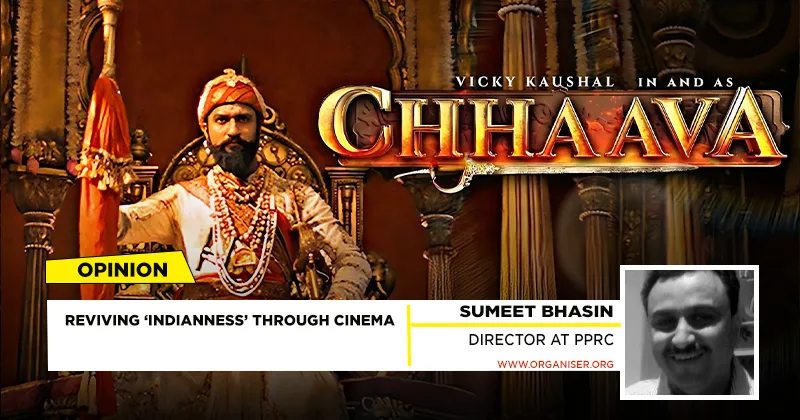
Recently, I had the good fortune of watching Chaava, meaning ‘lion’s cub’ in Marathi. The movie is a cinematic portrayal of the life and sacrifices of Chhatrapati Sambhaji Maharaj, the son of the legendary Maratha king, Chhatrapati Shivaji Maharaj. The film emphasises the unflinching courage and indomitable spirit of Sambhaji Maharaj as he fought against Mughal imperialism and struggled for Swaraj (self-rule). The narrative is deeply tied to the idea of resistance against imperialism and the refusal to yield under foreign oppression, showcasing how even in the face of unimaginable hardships, the desire for self-governance and pride in one’s heritage remain unbroken.
One of the most powerful moments in the film, for me, was when a poem is recited to honor Sambhaji’s bravery. The lines, “Haathi, ghode, top, talwaare / Fauj teri saari hai / Par zanjeeron mein jakde mere raje / Aaj bhi sab pe bhaari hai,” which translate to “Elephants, horses, cannons, and swords / Your entire army is great / But my king, who is shackled in chains / Still stands taller than all of you,” evoked thunderous applause from the crowd and gave me goosebumps. These words, combined with the film’s dramatic portrayal of Sambhaji’s sacrifice, resonated deeply with the audience – primarily youths. This led me to wonder about the wider trends in India’s cultural landscape and its evolution over the years.
The history of Indian art and culture has been extremely rich and glorious. In Indian culture, art was not solely a means of entertainment. It was created for the benefit of mankind. In the early history of Indian cinema, the main purpose of films was to depict the richness of our society and the ideals of Indian culture.
Films like Raja Harishchandra (1913), India’s first silent film, or Mohini Bhasmasur and Krishna Janma promoted religious and moral values. But over time, Indian cinema underwent a shift. Attempts were made to portray Hinduism, Indian traditions, and culture in a negative light. This change began especially soon after Indian Independence, when under the Congress ecosystem, Hindu symbols and religious beliefs were often distorted or mocked in films.
In contrast to this trend, a significant transformation in Indian cinema has taken place in recent years, particularly after the coming of Prime Minister Narendra Modi’s government. This change has been evident in the emergence of films that celebrate India’s rich cultural heritage, nationalism, and resilience. A prime example of this new wave is the film Chhaava.
This film is more than just entertainment; it represents a larger cultural awakening that has swept through India in recent years. Under Prime Minister Modi’s leadership, there has been a conscious effort to revive the nation’s pride in its heritage, history, and cultural identity. Films like Chhaava are a reflection of this shift in the overton window, as they align with the Prime Minister’s vision of self-reliance and national pride.
There was a time when we were taught that the Mughal era was the golden period of our country’s history and that the Mughals respected freedom of expression. However, this film has revealed how undemocratic and ruthless the Mughal rulers truly were. It has exposed the manufactured and untrue knowledge system propagated for decades by the leftist ecosystem.
During the post-Independence years, Indian cinema portrayed Hinduism and its traditions in a negative light. For decades, the narratives under Congress leaders sidelined Hindu contributions to India’s identity. Hinduism, Indian traditions, and values were often either ignored or ridiculed. The portrayal of India’s independence struggle and national heroes also suffered, with films often distorting or underplaying their contributions.
Note that Saif Ali Khan was awarded the National Award in 2005 for the film ‘Hum Tum’ during the UPA regime, while the story of this film was only a common love story. Director Ketan Mehta’s patriotic film ‘Mangal Pandey’ was released during the same time, based on the life of Mangal Pandey, the hero of the country’s first freedom struggle against British oppression in 1857. Unfortunately, this film was not given any award, due to which movie directors also shied away from making such films at the time.
The scenario began to change when Prime Minister Narendra Modi’s government took office, ushering in a new era of cultural resurgence. Today, Indian youth are increasingly proud of their language, culture, and heritage. The country is witnessing a resurgence of nationalist and patriotic cinema, where films reflect the values of self-respect, independence, and pride in one’s roots. Films like Uri: The Surgical Strike, Kesari, Tanhaji, Samrat Prithviraj, The Kashmir Files, Article 370, etc. reflect the growing enthusiasm for narratives that not only celebrate India’s past but also promote the ideals of Swaraj and nationalism.
The success of Chhaava reflects this phenomenon. The film crossed Rs. 200 crore at the box office in just six days, highlighting the growing interest among the audiences from all corners of the country for films that celebrate their culture and valorise historical figures who fought for their rights.
This cultural resurgence has not remained limited to Indian cinema. Prime Minister Narendra Modi has played a pivotal role in encouraging this shift by linking India’s cultural heritage with development, foreign policy, and national pride. His initiatives, such as the Kashi Tamil Sangamam and Saurashtra Tamil Sangamam, have demonstrated how cultural diversity strengthens the unity of the nation. Through these efforts, Modi Ji has helped build bridges of equality across different communities, while also encouraging a return to India’s ancient values of unity and resilience.
Moreover, Modi Ji’s initiatives have led to symbolic and practical changes that break free from the colonial mindset. The renaming of roads and government buildings that were previously named after colonial figures, the installation of Netaji Subhash Chandra Bose’s statue at India Gate, and the unveiling of the new Parliament House – imbued with the idea of Indianness, in which Sengol was installed as part of the legacy of India’s great civilisation – reflect the government’s commitment to celebrating Indian culture and history. These actions, alongside the promotion of the National Education Policy, which aims to make education more inclusive and accessible in local languages, have contributed to this awakening of national pride.
The revival of patriotic cinema since 2014 is not just a coincidence. It aligns with a broader cultural movement, one that seeks to reframe India’s historical narrative and celebrate its true heroes. Films like Chhaava and The Kashmir Files are part of this resurgence, confronting historical distortions and presenting stories that empower the nation. These films encourage the youth to take pride in their heritage and find inspiration in the struggles of their ancestors.
As we look back at the years of colonial influence and the subsequent distortion of India’s history, it is clear that the country is in the midst of a cultural revival. Chhaava serves as a powerful reminder of India’s glorious past and the ongoing fight for self-governance. It symbolises the resurgence of values that have defined Indian civilisation for millennia. This shift in Indian cinema, exemplified by films that celebrate nationalism and pride in one’s heritage, is a reflection of the broader transformation happening in the country today.
As a person who grew up amidst narratives that often sidelined India’s cultural contributions and rich history, watching Chhaava was an emotional experience for me. The bravery of Sambhaji Maharaj, his sacrifices for the cause of Swaraj, and his resistance to foreign rule all struck a chord with me. The film serves as an inspiration to future generations, encouraging them to find role models in their own history rather than in foreign figures. It reminds us that our rich heritage deserves recognition and that this century belongs to a resurgent Hinduism that celebrates ethics, values, and cultural pride.
As India marches forward on the path of progress and development, let us celebrate these films that honor our history and inspire us to uphold the values that have defined our civilisation for millennia. I appeal to my readers to take some time out of their busy lives to witness the true essence of Chaava. Know your history, and let this powerful film remind you of the sacrifices that shaped our present.