India has been a hub of international trade for millennia, with its spices, textiles, and precious gems sought after across continents. Ancient texts like the Vedas and the Arthashastra reflect a sophisticated understanding of commerce and trade. The Vedas, particularly the Rigveda, mention maritime trade and the exchange of goods, highlighting the interconnectedness of societies. The Arthashastra by Kautilya (Chanakya) provides a detailed framework for economic policies, taxation, and the regulation of markets. These ancient scriptures emphasise dharma (moral duty) in trade practices, advocating fairness, transparency, and the welfare of all stakeholders.
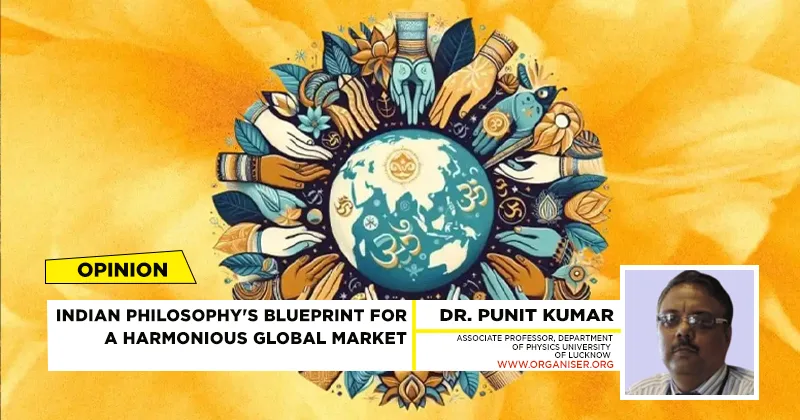
The ‘Vasudhaiva Kutumbakam’, meaning ‘the world is one family’, from the Maha Upanishad, encapsulates the Indian philosophical approach to globalisation. This idea emphasises universal interconnectedness and mutual respect, forming a moral basis for global trade that prioritises collective well-being over individual greed.
Indian philosophy provides an ethical framework for economic activity, rooted in principles such as ahimsa (non-violence), Satya (truth), and aparigraha (non-possessiveness). These principles offer a counter-narrative to global markets’ exploitative tendencies. Ahimsa, or non-violence, emphasises avoiding harm to others, whether consumers, workers, or the environment. This principle aligns closely with modern concepts of corporate social responsibility (CSR) and sustainable practices, encouraging businesses to minimise their environmental footprint and prioritise the welfare of all stakeholders. Satya, or truth, stresses transparency and honesty in business dealings, fostering trust and long-term relationships. By adhering to truthful practices, businesses can maintain ethical standards and build reputational capital in the global market. Aparigraha, or non-possessiveness, as advocated in the Bhagavad Gita, encourages detachment from excessive materialism. This principle inspires businesses to focus on sustainability and equitable wealth distribution rather than unchecked profit accumulation. Together, these values form a robust ethical foundation prioritising the collective good and promoting a sustainable, inclusive approach to global commerce.
The principle of Vasudhaiva Kutumbakam, emphasising global unity and collective welfare, offers a philosophical foundation for a global market based on cooperation and mutual benefit. It encourages nations and corporations to view economic activities as opportunities to uplift humanity rather than merely maximise profits. In practical terms, this philosophy calls for ensuring fair trade practices by providing equitable opportunities and fair wages to all participants across the global supply chain. Sustainability is another cornerstone, urging businesses and governments to adopt environmentally responsible practices that safeguard the planet for future generations. Further, the philosophy advocates for inclusive growth by addressing disparities between developed and developing nations. This can be achieved by facilitating knowledge transfer, sharing advanced technologies, and building capacity in underprivileged regions. Such an approach not only fosters economic equity but also enhances global stability. Aligning with contemporary movements advocating for ethical globalisation, this vision ensures that economic activities prioritise human dignity, environmental sustainability, and collective well-being over mere profit maximisation. It presents a transformative pathway to a harmonious and sustainable global economy.
While Indian philosophical principles offer profound insights, their application in the modern global market is not without challenges. The competitive nature of globalisation often prioritises short-term gains over long-term sustainability and ethics. Corruption, exploitation, and environmental degradation are persistent issues that hinder the realisation of ethical commerce. Moreover, aligning diverse cultural, political, and economic systems with the values of Vasudhaiva Kutumbakam requires significant effort. Differences in regulatory frameworks, labour standards, and environmental policies across nations create barriers to implementing a unified ethical framework.
Indian philosophy offers profound insights that enrich modern economic theories, fostering sustainable and inclusive development. The stakeholder theory, central to global markets today, resonates with the Indian concept of dharma, which advocates ethical responsibility towards all stakeholders – employees, customers, suppliers, and the environment. This holistic perspective encourages businesses to move beyond profit maximisation, embracing practices that balance economic growth with societal well-being. Similarly, the principle of aparigraha aligns closely with the circular economy concept, which prioritises minimising waste, reusing resources, and creating closed-loop systems. By emphasising minimalism and sustainability, Indian philosophy provides a framework for businesses to adopt environmentally conscious practices that support long-term ecological balance. Further, the ethical foundations of Indian thought deeply resonate with the objectives of social entrepreneurship, which seeks to address social and environmental challenges while ensuring financial sustainability. By promoting values such as compassion, service, and collective welfare, Indian philosophy inspires entrepreneurs to integrate ethical considerations into their ventures, creating solutions that benefit society and the economy. Thus, Indian philosophical principles offer valuable guidance for shaping a more equitable and sustainable global economy.
Technology is a vital bridge between Indian philosophical principles and their practical application in the global market, fostering ethical and sustainable practices. Blockchain technology, by ensuring transparency and accountability in supply chains, embodies the principle of satya (truth). Artificial intelligence enhances resource management and promotes sustainability, aligning with ahimsa (non-violence) and aparigraha (non-possessiveness) values. Meanwhile, e-commerce platforms empower small-scale producers and artisans by connecting them to global markets, echoing the inclusive philosophy of Vasudhaiva Kutumbakam (the world is one family). By integrating these technologies, businesses can uphold ethical standards, reduce inefficiencies, and contribute to equitable global development.
To create a harmonious global market, it is essential to integrate Indian philosophical values into policy-making, corporate governance, and individual behaviour. Governments, businesses, and consumers must work collaboratively to prioritise ethical practices and sustainability over profit maximisation.
Education and awareness campaigns can play a pivotal role in promoting these values. Incorporating ethical principles into business curricula and encouraging dialogue between cultures can help create a shared vision for a sustainable global economy.
The concept of a global market in Indian philosophy is deeply rooted in values of interconnectedness, ethical conduct, and sustainability. Principles such as Vasudhaiva Kutumbakam, ahimsa, and aparigraha provide a timeless framework for addressing the challenges of globalisation while fostering a more equitable and sustainable world.
By embracing these principles, the global market can evolve into a force for collective well-being, reflecting the spirit of Indian philosophical wisdom in action. With continued efforts to integrate these values into modern economic systems, the dream of a harmonious and sustainable global economy is well within reach.