Modi’s vision for a self-reliant tech future & India’s semiconductor revolution to create around 3 lakh jobs by 2027
June 9, 2026
  • Read Ecopy
  • Circulation
  • Advertise
  • Careers
  • About Us
  • Contact Us
Android AppiPhone AppArattai
Organiser
  • ‌
  • Bharat
    • Assam
    • Bihar
    • Chhattisgarh
    • Jharkhand
    • Maharashtra
    • View All States
  • World
    • Asia
    • Europe
    • North America
    • South America
    • Africa
    • Australia
  • Editorial
  • International
  • Opinion
  • RSS @ 100
  • More
    • Op Sindoor
    • Analysis
    • Sports
    • Defence
    • Politics
    • Business
    • Economy
    • Culture
    • Special Report
    • Sci & Tech
    • Entertainment
    • G20
    • Azadi Ka Amrit Mahotsav
    • Vocal4Local
    • Web Stories
    • Education
    • Employment
    • Books
    • Interviews
    • Travel
    • Law
    • Health
    • Obituary
  • Subscribe
    • Subscribe Print Edition
    • Subscribe Ecopy
    • Read Ecopy
  • ‌
  • Bharat
    • Assam
    • Bihar
    • Chhattisgarh
    • Jharkhand
    • Maharashtra
    • View All States
  • World
    • Asia
    • Europe
    • North America
    • South America
    • Africa
    • Australia
  • Editorial
  • International
  • Opinion
  • RSS @ 100
  • More
    • Op Sindoor
    • Analysis
    • Sports
    • Defence
    • Politics
    • Business
    • Economy
    • Culture
    • Special Report
    • Sci & Tech
    • Entertainment
    • G20
    • Azadi Ka Amrit Mahotsav
    • Vocal4Local
    • Web Stories
    • Education
    • Employment
    • Books
    • Interviews
    • Travel
    • Law
    • Health
    • Obituary
  • Subscribe
    • Subscribe Print Edition
    • Subscribe Ecopy
    • Read Ecopy
Organiser
  • Home
  • Bharat
  • World
  • Operation Sindoor
  • Editorial
  • Analysis
  • Opinion
  • Culture
  • Defence
  • International Edition
  • RSS @ 100
  • Magazine
  • Read Ecopy
Home International Edition Technology

Modi’s vision for a self-reliant tech future & India’s semiconductor revolution to create around 3 lakh jobs by 2027

The Modi government is aggressively developing India’s semiconductor industry to boost self-reliance, economic growth, and technological leadership under initiatives like the India Semiconductor Mission and PLI scheme

WEBDESKWEBDESK
Jan 30, 2025, 09:00 pm IST
in Technology, Sci & Tech
Follow on Google News
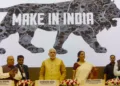
PM Modi bats for making Bharat hub for semiconductors

PM Modi bats for making Bharat hub for semiconductors

FacebookTwitterWhatsAppTelegramEmail

India’s semiconductor industry is at the center of the Modi government’s ambitious vision of making the country a global manufacturing hub. Recognising the strategic importance of semiconductors in driving technological advancement and economic growth, the government is taking bold steps to develop a self-reliant semiconductor ecosystem. However, the industry’s rapid growth presents a critical challenge: a massive demand for skilled professionals, estimated at around 300,000 by 2027. Addressing this gap is not just an industry imperative but also a key to achieving India’s broader economic goals under Prime Minister Narendra Modi’s leadership.

Semiconductors, often referred to as the “brains” behind modern electronics, are essential for critical industries like telecommunications, defense, healthcare, and renewable energy. With the increasing adoption of technologies like artificial intelligence (AI), the Internet of Things (IoT), 5G, and electric vehicles, the demand for semiconductors is soaring globally.

The Modi government has consistently emphasised the need for self-reliance in critical technologies under the “Atma Nirbhar Bharat” (Self-Reliant India) initiative. Semiconductors have emerged as a cornerstone of this policy. By reducing dependency on imports, the government aims to enhance national security, boost local manufacturing, and position India as a global leader in high-tech industries.

Government Initiatives to Promote the Semiconductor Industry

To turn this vision into reality, the Modi government has introduced several targeted initiatives. Among them, the India Semiconductor Mission (ISM) stands out as a comprehensive program aimed at establishing a robust semiconductor ecosystem. The ISM, launched in December 2021, offers financial support to companies investing in semiconductor manufacturing, design, and research.

The Production Linked Incentive (PLI) scheme, specifically tailored for the electronics and semiconductor sector, is another flagship initiative. With an allocation of $1.7 billion, the scheme incentivizes companies to establish semiconductor manufacturing units in India. This policy aligns with Modi’s larger “Make in India” campaign, which seeks to transform India into a global manufacturing powerhouse.

Under Modi’s leadership, India has become a magnet for global semiconductor investments. Several multinational corporations have announced significant projects in the country:

Micron Technology is setting up a state-of-the-art Assembly, Test, Marking, and Packaging (ATMP) facility, with an investment of $2.75 billion.

Tata Group, a prominent Indian conglomerate, is establishing its own semiconductor and chip manufacturing plant, further solidifying India’s position in this strategic sector.

Israel’s Tower Semiconductor, in collaboration with the Adani Group, has pledged $10 billion to build a semiconductor manufacturing facility in Maharashtra.

These developments underscore the Modi government’s success in creating a favorable business environment through policy clarity, ease of doing business reforms, and significant financial incentives.

While the policy framework and investments are in place, the lack of a skilled workforce poses a significant hurdle. Industry experts estimate that the semiconductor sector will require nearly 300,000 skilled professionals by 2027, spanning areas like research and development, chip design, manufacturing, and advanced packaging.

This gap has its roots in several systemic issues, including outdated curricula in technical institutions, insufficient industry-academia collaboration, and a lack of focus on hands-on training. Addressing this talent gap is critical for the success of the Modi government’s semiconductor ambitions.

Recognising the urgency of the skills issue, the Modi government has launched a multi-pronged strategy to develop talent in the semiconductor industry. Key initiatives include:

Strengthening Educational Institutions: Over 300 colleges across India are now offering specialized courses in semiconductor technology, supported by updated curricula and industry partnerships.
National Apprenticeship Promotion Scheme (NAPS): The Electronics Sector Skill Council (ESSC) has introduced more than 35 apprenticeship programs to train entry-level workers for the semiconductor industry.
Collaboration with Private Players: Programs like TeamLease Degree Apprenticeships are bridging the gap between academic learning and industry needs by providing practical training in semiconductor technologies.

These initiatives align with Modi’s broader vision for skill development under the Skill India Mission, which seeks to equip the workforce with the competencies needed for emerging industries.

Beyond economic considerations, the Modi government’s semiconductor push has a strong geopolitical dimension. In the context of global supply chain disruptions and the U.S.-China trade tensions, countries worldwide are looking to diversify their semiconductor supply chains. India, with its strategic location, large talent pool, and favourable policy framework, is emerging as a key player in this global realignment.

Prime Minister Modi’s engagements with global leaders have further strengthened India’s semiconductor ambitions. High-profile partnerships with countries like the United States, Japan, and South Korea have paved the way for technology transfers, joint ventures, and investments in India’s semiconductor ecosystem.

The semiconductor industry also plays a critical role in advancing India’s technological sovereignty. As the country aspires to become a leader in futuristic technologies like AI and IoT, semiconductors will serve as the backbone of innovation. By fostering domestic semiconductor manufacturing, the Modi government is ensuring that India has control over critical technologies, reducing its reliance on foreign imports.

The Modi government’s efforts to build a thriving semiconductor industry are both ambitious and necessary. With the right mix of policy support, industry participation, and skill development, India is well-positioned to become a global semiconductor hub. Addressing the workforce challenge will be the key to unlocking this potential.

By aligning the semiconductor mission with broader national goals like “Aatmanirbhar Bharat,” “Make in India,” and “Digital India,” the Modi government is laying the foundation for a technology-driven, self-reliant future. The semiconductor sector’s success will not only contribute to India’s economic growth but also enhance its standing as a global technology leader.

In the coming years, India’s ability to bridge the skills gap, foster innovation, and attract investments will determine whether it can fully realize the opportunities in the semiconductor space. Under Prime Minister Modi’s leadership, the country has the vision and momentum to achieve this transformative goal.


Topics: India Semiconductor MissionIsrael’s Tower SemiconductorMake In IndiaAatmanirbhar BharatDigital Indiaadani group
ShareTweetSendShareSend
✮ Subscribe Organiser YouTube Channel. ✮
✮ Join Organiser's WhatsApp channel for Nationalist views beyond the news. ✮
Previous News

Politicians are working with groups that wanted to split the state: Manipur CM Biren Singh

Next News

AAP’s Delhi education model exposed; Know the reality vs claims made by Aam Aadmi Party 

Related News

India’s semiconductor roadmap shifts from import dependence to silicon sovereignty, aiming for a self-reliant ecosystem by Viksit Bharat 2047

From Import Dependence to Silicon Sovereignty: India’s bold semiconductor roadmap for Viksit Bharat 2047

DRDO, IAF successfully flight-test indigenous RudraM-II air-to-surface missile

DRDO, IAF conduct successful RudraM-II Missile trials under extreme conditions, boosting India’s defence self-reliance

PM-WANI has crossed 3.91 lakh hotspots and 2.45 crore users, offering a licence-free public Wi-Fi model

India Public Wi-Fi Connectivity: How PM-WANI outpaces the American and Chinese models

Bharat Taxi emerges as World's largest mobility cooperative with over 35 lakh users, 6 lakh drivers

How Bharat Taxi is transforming India’s ride-hailing sector with a zero-commission cooperative model for drivers

A representative image

Ayushman Bharat Crosses 90 Cr ABHA Accounts: How Modi govt is building the world’s largest digital health ecosystem

Bihar-made combat boots are powering international defence supply chains, including Russia, and redefining “Made in India”

From Combat Boots to BrahMos missile: How Bihar’s Hajipur factory entered Russia’s military supply chain

Load More

Latest News

Uttar Pradesh launches major crackdown on coaching mafia and exam fraud networks

Uttar Pradesh: Paper leak syndicates, solver gangs and fake coaching centres face crackdown by Yogi government in UP

Banda Singh Bahadur

Banda Singh Bahadur Martyrdom Day: Betrayal of Guru Gobind Singh Ji by Mughals and the rise of Madho Das

12 years of Modi Govt: Meaningful philosophy or manufactured phenomenon; Bharat’s tryst with democracy

Prime Minister Narendra Modi during an overseas visit, greeting members of the Indian diplomatic and community delegation upon arrival. (File Photo)

Trade, Defence and Diaspora: PM Modi eyes Indo-Pacific reset with three-nation tour

Accused Nida Khan reportedly admits taking victim for religious instruction, teaching Islamic rituals

Nashik TCS Corporate Jihad: ‘I taught her how to do namaz,’ says Nida Khan; victim pressured to observe 30 ramzan roza

Germany: Sri Ganesha temple opens in Berlin: Europe’s largest Hindu Mandir reflects India’s cultural & dharmic spirit

Rajasthn | RSS centenary journey embodies dedication to nation-building: Dr Ramesh Agrawal

Decades of illegal infiltration from Bangladesh have driven profound demographic shifts in Assam, fundamentally altering its religious, linguistic, and political landscape

Unnatural demographic change: The termite threat

The Rs 200-crore MAHA Water Mission seeks to boost water security and democratise research funding in India

From Rigveda to Research Labs: How ANRF’s Rs 200 crore water mission is securing India’s future

(Right) Prakhar Shrivastava, Senior Consulting Editor and Anchor at Delhi Doordarshan Kendra at a Narada Jayanti programme in Guwahati (Left) Prakahar Srivastava addressing the gathering

Narada Jayanti by VSK Assam: “Half-truths more dangerous than lies,” says senior journalist Prakhar Shrivastava

Load More
  • Privacy
  • Terms
  • Cookie Policy
  • Refund and Cancellation
  • Delivery and Shipping

© Bharat Prakashan (Delhi) Limited.
Tech-enabled by Ananthapuri Technologies

  • Home
  • Search Organiser
  • Bharat
    • Assam
    • Bihar
    • Chhattisgarh
    • Jharkhand
    • Maharashtra
    • View All States
  • World
    • Asia
    • Africa
    • North America
    • South America
    • Europe
    • Australia
  • Editorial
  • Operation Sindoor
  • Opinion
  • Analysis
  • Defence
  • Culture
  • Sports
  • Business
  • RSS @ 100
  • Entertainment
  • More ..
    • Sci & Tech
    • Vocal4Local
    • Special Report
    • Education
    • Employment
    • Books
    • Interviews
    • Travel
    • Health
    • Politics
    • Law
    • Economy
    • Obituary
  • Subscribe Magazine
  • Read Ecopy
  • Advertise
  • Circulation
  • Careers
  • About Us
  • Contact Us
  • Policies & Terms
    • Privacy Policy
    • Cookie Policy
    • Refund and Cancellation
    • Terms of Use

© Bharat Prakashan (Delhi) Limited.
Tech-enabled by Ananthapuri Technologies