India’s semiconductor industry is at the center of the Modi government’s ambitious vision of making the country a global manufacturing hub. Recognising the strategic importance of semiconductors in driving technological advancement and economic growth, the government is taking bold steps to develop a self-reliant semiconductor ecosystem. However, the industry’s rapid growth presents a critical challenge: a massive demand for skilled professionals, estimated at around 300,000 by 2027. Addressing this gap is not just an industry imperative but also a key to achieving India’s broader economic goals under Prime Minister Narendra Modi’s leadership.
Semiconductors, often referred to as the “brains” behind modern electronics, are essential for critical industries like telecommunications, defense, healthcare, and renewable energy. With the increasing adoption of technologies like artificial intelligence (AI), the Internet of Things (IoT), 5G, and electric vehicles, the demand for semiconductors is soaring globally.
The Modi government has consistently emphasised the need for self-reliance in critical technologies under the “Atma Nirbhar Bharat” (Self-Reliant India) initiative. Semiconductors have emerged as a cornerstone of this policy. By reducing dependency on imports, the government aims to enhance national security, boost local manufacturing, and position India as a global leader in high-tech industries.
Government Initiatives to Promote the Semiconductor Industry
To turn this vision into reality, the Modi government has introduced several targeted initiatives. Among them, the India Semiconductor Mission (ISM) stands out as a comprehensive program aimed at establishing a robust semiconductor ecosystem. The ISM, launched in December 2021, offers financial support to companies investing in semiconductor manufacturing, design, and research.
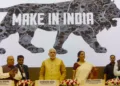
The Production Linked Incentive (PLI) scheme, specifically tailored for the electronics and semiconductor sector, is another flagship initiative. With an allocation of $1.7 billion, the scheme incentivizes companies to establish semiconductor manufacturing units in India. This policy aligns with Modi’s larger “Make in India” campaign, which seeks to transform India into a global manufacturing powerhouse.
Under Modi’s leadership, India has become a magnet for global semiconductor investments. Several multinational corporations have announced significant projects in the country:
Micron Technology is setting up a state-of-the-art Assembly, Test, Marking, and Packaging (ATMP) facility, with an investment of $2.75 billion.
Tata Group, a prominent Indian conglomerate, is establishing its own semiconductor and chip manufacturing plant, further solidifying India’s position in this strategic sector.
Israel’s Tower Semiconductor, in collaboration with the Adani Group, has pledged $10 billion to build a semiconductor manufacturing facility in Maharashtra.
These developments underscore the Modi government’s success in creating a favorable business environment through policy clarity, ease of doing business reforms, and significant financial incentives.
While the policy framework and investments are in place, the lack of a skilled workforce poses a significant hurdle. Industry experts estimate that the semiconductor sector will require nearly 300,000 skilled professionals by 2027, spanning areas like research and development, chip design, manufacturing, and advanced packaging.
This gap has its roots in several systemic issues, including outdated curricula in technical institutions, insufficient industry-academia collaboration, and a lack of focus on hands-on training. Addressing this talent gap is critical for the success of the Modi government’s semiconductor ambitions.
Recognising the urgency of the skills issue, the Modi government has launched a multi-pronged strategy to develop talent in the semiconductor industry. Key initiatives include:
Strengthening Educational Institutions: Over 300 colleges across India are now offering specialized courses in semiconductor technology, supported by updated curricula and industry partnerships.
National Apprenticeship Promotion Scheme (NAPS): The Electronics Sector Skill Council (ESSC) has introduced more than 35 apprenticeship programs to train entry-level workers for the semiconductor industry.
Collaboration with Private Players: Programs like TeamLease Degree Apprenticeships are bridging the gap between academic learning and industry needs by providing practical training in semiconductor technologies.
These initiatives align with Modi’s broader vision for skill development under the Skill India Mission, which seeks to equip the workforce with the competencies needed for emerging industries.
Beyond economic considerations, the Modi government’s semiconductor push has a strong geopolitical dimension. In the context of global supply chain disruptions and the U.S.-China trade tensions, countries worldwide are looking to diversify their semiconductor supply chains. India, with its strategic location, large talent pool, and favourable policy framework, is emerging as a key player in this global realignment.
Prime Minister Modi’s engagements with global leaders have further strengthened India’s semiconductor ambitions. High-profile partnerships with countries like the United States, Japan, and South Korea have paved the way for technology transfers, joint ventures, and investments in India’s semiconductor ecosystem.
The semiconductor industry also plays a critical role in advancing India’s technological sovereignty. As the country aspires to become a leader in futuristic technologies like AI and IoT, semiconductors will serve as the backbone of innovation. By fostering domestic semiconductor manufacturing, the Modi government is ensuring that India has control over critical technologies, reducing its reliance on foreign imports.
The Modi government’s efforts to build a thriving semiconductor industry are both ambitious and necessary. With the right mix of policy support, industry participation, and skill development, India is well-positioned to become a global semiconductor hub. Addressing the workforce challenge will be the key to unlocking this potential.
By aligning the semiconductor mission with broader national goals like “Aatmanirbhar Bharat,” “Make in India,” and “Digital India,” the Modi government is laying the foundation for a technology-driven, self-reliant future. The semiconductor sector’s success will not only contribute to India’s economic growth but also enhance its standing as a global technology leader.
In the coming years, India’s ability to bridge the skills gap, foster innovation, and attract investments will determine whether it can fully realize the opportunities in the semiconductor space. Under Prime Minister Modi’s leadership, the country has the vision and momentum to achieve this transformative goal.