
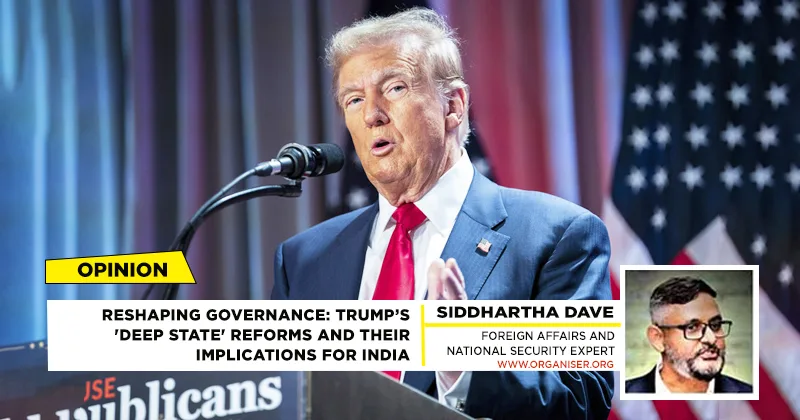
Reshaping Governance: Trump’s 'Deep State' reforms and their implications for India
June 24, 2026
  • Read Ecopy
  • Circulation
  • Advertise
  • Careers
  • About Us
  • Contact Us
Android AppiPhone AppArattai
Organiser
  • ‌
  • Bharat
    • Assam
    • Bihar
    • Chhattisgarh
    • Jharkhand
    • Maharashtra
    • View All States
  • World
    • Asia
    • Europe
    • North America
    • South America
    • Africa
    • Australia
  • Editorial
  • International
  • Opinion
  • RSS @ 100
  • More
    • Op Sindoor
    • Analysis
    • Sports
    • Defence
    • Politics
    • Business
    • Economy
    • Culture
    • Special Report
    • Sci & Tech
    • Entertainment
    • G20
    • Azadi Ka Amrit Mahotsav
    • Vocal4Local
    • Web Stories
    • Education
    • Employment
    • Books
    • Interviews
    • Travel
    • Law
    • Health
    • Obituary
  • Subscribe
    • Subscribe Print Edition
    • Subscribe Ecopy
    • Read Ecopy
  • ‌
  • Bharat
    • Assam
    • Bihar
    • Chhattisgarh
    • Jharkhand
    • Maharashtra
    • View All States
  • World
    • Asia
    • Europe
    • North America
    • South America
    • Africa
    • Australia
  • Editorial
  • International
  • Opinion
  • RSS @ 100
  • More
    • Op Sindoor
    • Analysis
    • Sports
    • Defence
    • Politics
    • Business
    • Economy
    • Culture
    • Special Report
    • Sci & Tech
    • Entertainment
    • G20
    • Azadi Ka Amrit Mahotsav
    • Vocal4Local
    • Web Stories
    • Education
    • Employment
    • Books
    • Interviews
    • Travel
    • Law
    • Health
    • Obituary
  • Subscribe
    • Subscribe Print Edition
    • Subscribe Ecopy
    • Read Ecopy
Organiser
  • Home
  • Bharat
  • World
  • Operation Sindoor
  • Editorial
  • Analysis
  • Opinion
  • Culture
  • Defence
  • International Edition
  • RSS @ 100
  • Magazine
  • Read Ecopy
Home Bharat

Reshaping Governance: Trump’s ‘Deep State’ reforms and their implications for India

As Donald Trump prepares to assume office in 2025, his plan to dismantle the "deep state" and reshape the US federal government is setting the stage for significant political change. This bold strategy has far-reaching implications, not only for American governance but also for India’s approach to bureaucracy and its geopolitical positioning

Siddhartha DaveSiddhartha Dave
Jan 20, 2025, 05:30 pm IST
in Bharat, Opinion
Follow on Google News
FacebookTwitterWhatsAppTelegramEmail

Donald Trump, set to assume office on January 20, 2025, is preparing to take bold steps to dismantle the “deep state” and cement control over the federal government.

President Donald Trump’s ongoing efforts to exert unparalleled control over the US federal government represent a dramatic recalibration of governance dynamics. Central to this initiative is his controversial plan to dismantle the so-called “deep state,” a term his administration uses to describe entrenched bureaucratic elements perceived as resistant to his agenda. This ambitious undertaking marks one of the most significant overhauls in the history of US federal governance, with far-reaching implications domestically and internationally.

Redefining Federal Governance: Trump’s Strategy

A cornerstone of Trump’s plan involves the rapid implementation of an executive order aimed at eliminating job protections for approximately 50,000 career federal employees. This measure would pave the way for replacing them with appointees loyal to Trump’s vision, thus embedding his influence within the federal bureaucracy. To accelerate this process, the administration is poised to expedite thousands of political appointments across federal agencies, solidifying its control over policymaking.

This overhaul extends beyond symbolic gestures. The Trump team has signalled its intentions by requesting the resignation of senior career diplomats at the US State Department and proposing “Schedule F,” a framework to reclassify career positions as political appointments. This reclassification empowers agency officials to dismiss career employees without cause, replacing them with individuals aligned with the administration’s ideological goals. Architects of this approach, such as Russell Vought and James Sherk, underscore its necessity, arguing that policymaking roles must be occupied by individuals who fully support the president’s agenda. Sherk’s reports highlight alleged instances of bureaucratic resistance that hindered Trump’s policies during his first term, further justifying this sweeping reform.

Targeting Bureaucratic Resistance

Key appointments for Trump’s prospective second term, including figures like Pam Bondi as Attorney General and Kash Patel as FBI Director, are expected to spearhead efforts to neutralize perceived resistance within the federal government. The administration’s focus extends to departments such as Education, Justice, and the national security apparatus, where entrenched bureaucrats are accused of undermining key initiatives.

Critics challenge the validity of the “deep state” narrative, viewing it as a pretext for consolidating executive power. Workforce experts and union leaders caution that measures like Schedule F could erode trust, suppress constructive dissent, and lower morale within federal agencies. James Eisenmann, a prominent expert on federal workforce policies, warns that such initiatives risk creating a culture of compliance at the expense of innovation and effective governance.

Cultivating a Loyal Bureaucratic Network

The administration’s strategy also includes identifying and sidelining officials whose priorities diverge from Trump’s agenda. Conservative organizations, such as the Heritage Foundation-backed American Accountability Foundation, are actively compiling lists of “problematic” federal employees, targeting individuals focused on diversity initiatives or perceived as obstructive to border security policies. This ideological vetting has sparked opposition from outgoing officials, like Defense Secretary Lloyd Austin, who argue that diversity and inclusion are critical to representing America’s broader societal fabric.

Despite criticism, Trump’s team remains steadfast, emphasising the need to ensure that government employees align with the administration’s principles. Spokesperson Brian Hughes underscores that this effort aims to uphold American values and taxpayer interests, framing it as a corrective measure to align governance with electoral mandates.

Indian Perspectives: Lessons and Strategic Implications

For India, Trump’s bold approach to governance offers valuable lessons and potential opportunities. India, too, has grappled with the challenges posed by bureaucratic inertia, inefficiency, and entrenched interests within its administrative framework. Trump’s strategy, controversial as it may be, demonstrates the impact of decisive leadership in dismantling institutional resistance to reform.

Moreover, the elimination of “deep state” elements within the US bureaucracy could yield indirect benefits for India. Historically, factions within the US government have occasionally supported policies contrary to India’s interests—ranging from backing Pakistan-aligned narratives to fostering instability in South Asia. A streamlined and ideologically aligned US administration might adopt a more consistent and favourable stance toward India, particularly in areas such as counterterrorism, trade, and regional security.

This shift is particularly significant in the context of Bangladesh’s political transition. The new regime’s overtures toward closer alignment with India could be bolstered by a US administration that prioritizes stability in South Asia. By curtailing external influences inimical to regional stability, a reoriented US bureaucracy could enhance India’s efforts to strengthen its partnerships in the neighbourhood.

Navigating Opportunities and Risks

While Trump’s approach underscores the transformative potential of political will, it also highlights the risks associated with undermining institutional safeguards. For Indian policymakers, the challenge lies in striking a balance between pursuing administrative efficiency and preserving democratic principles. Lessons from the US experience suggest that reform efforts must be accompanied by robust oversight mechanisms to prevent the erosion of accountability and transparency.

Conclusion: Implications for India’s Governance

Trump’s efforts to reshape the US federal government serve as both a cautionary tale and a source of inspiration. For India, the implications extend beyond governance reforms, influencing its geopolitical calculus and bilateral relations with the U.S. By leveraging these developments, India can explore innovative strategies to address its own bureaucratic challenges while safeguarding its core democratic values.

As global dynamics continue to evolve, India must remain proactive in adapting to these shifts, ensuring that its national interests are advanced in an increasingly complex and interconnected world. Trump’s governance reforms, while polarizing, offer critical insights into the interplay between leadership, bureaucracy, and national policy, underscoring the enduring relevance of adaptability and resilience in statecraft.

 

Topics: Deep StateUS-India relationsTrump ReformsUS GovernanceDonald Trump
Siddhartha Dave
Siddhartha Dave
Siddhartha Dave is an alumnus of the United Nations University in Tokyo and a former Lok Sabha Research Fellow. He writes on foreign affairs and national security. [Read more]
ShareTweetSendShareSend
✮ Subscribe Organiser YouTube Channel. ✮
✮ Join Organiser's WhatsApp channel for Nationalist views beyond the news. ✮
Previous News

Karnataka: Amidst widening rift, Siddaramaiah’s supporters plan to file complaint against Randeep Surjewala

Next News

How illegal Bangladeshi immigrants dodge deportation and why cases are a boon for them

Related News

Prime Minister Narendra Modi with US President Donald Trump

A Handshake, Not a Hug: Why PM Modi must assert India’s strategic red lines in his crucial meeting with Trump

Prime Minister Narendra Modi with US President Donald Trump

Hormuz Disruptions: “Several Indian civilians lost lives,” says PM Modi & expresses concern in presence of Trump

U.S. Consulate General Hyderabad Office
(Inside box- Telangana CM Revanth Reddy)

BJP Telangana questions Congress and CM Revanth Reddy over renaming a road in Hyderabad as ‘Donald Trump Avenue’

Strait of Hormuz at the centre of global energy crisis as US-Iran tensions reshape West Asia

West Asia Crisis: Why opening the Strait of Hormuz could be the key to lasting peace between Iran & US

Trump administration praises New Delhi over Bengal election win while reviving fake mediation claim on Operation Sindoor

Trump’s Diplomatic Double Game: Congratulates PM Modi on Bengal, pushing Pakistan’s narrative on ‘Operation Sindoor’

US President Donald Trump, Iran's
Supreme Leader Mojtaba Khamenei,
Israeli Prime Minister Benjamin Netanyahu

US–Iran agree to two-week ceasefire amid rival victory claims; Israel backs pause, excludes Lebanon, tensions persist

Load More

Latest News

Bangladeshi infiltrators arrested by Assam Police

Assam Police arrests 10 Bangladeshi infiltrators from Guwahati lodge; 33 arrested in two weeks 

Punjab CM Bhagwat Mann

Bhagwant Mann Video Row: Gurugram police claim Punjab officers paid Rs 10 lakh to tailor forensic report

France’s annual music festival turns into night of fear amid alleged syringe attacks, sexual assaults & street violence

France Music Festival Violence: Women stabbed, drugged and sexually assaulted; 243 arrests made

Can Karnataka bypass SIR rules? Residence certificate move sparks citizenship debate

Karnataka SIR Controversy: Residence certificate plan unlikely to pass ECI’s voter verification test

The US Ambassador to India Sergio Gor and Tamil Nadu Chief Minister Joseph Vijay; The tweet of BJP Tamil Nadu State Secretary Ashvathaman.

BJP Tamil Nadu urges Jaishankar to intervene over US Ambassador’s ‘two nations’ remark after meeting CM Joseph Vijay

Puri Rath Yatra 2026: Authorities finalise crowd management plan

Puri Rath Yatra 2026 in Odisha: Massive security, healthcare and transport arrangements finalised

Karnataka's Gruha Lakshmi scheme faces scrutiny after CAG flags 19,000 beneficiaries linked to one account

Karnataka: Gruha Lakshmi scheme under scanner; CAG flags 19,000 beneficiaries linked to same bank account

Pesticides linked to cancer and environmental harm remain in use on Indian farms, sparking fresh concerns about food safety

Toxic Harvest? Why cancer-linked pesticides continue to be used across Indian farms despite global concerns

Gem-quality diamonds found during exploration in Chhattisgarh's Mahasamund

From Panna to Mahasamund: Could Chhattisgarh be India’s next diamond frontier?

External Affairs Minister S Jaishankar

Kanishka Bombing Anniversary: Jaishankar reaffirms India’s commitment to combat terrorism in all its forms

Load More
  • Privacy
  • Terms
  • Cookie Policy
  • Refund and Cancellation
  • Delivery and Shipping

© Bharat Prakashan (Delhi) Limited.
Tech-enabled by Ananthapuri Technologies

  • Home
  • Search Organiser
  • Bharat
    • Assam
    • Bihar
    • Chhattisgarh
    • Jharkhand
    • Maharashtra
    • View All States
  • World
    • Asia
    • Africa
    • North America
    • South America
    • Europe
    • Australia
  • Editorial
  • Operation Sindoor
  • Opinion
  • Analysis
  • Defence
  • Culture
  • Sports
  • Business
  • RSS @ 100
  • Entertainment
  • More ..
    • Sci & Tech
    • Vocal4Local
    • Special Report
    • Education
    • Employment
    • Books
    • Interviews
    • Travel
    • Health
    • Politics
    • Law
    • Economy
    • Obituary
  • Subscribe Magazine
  • Read Ecopy
  • Advertise
  • Circulation
  • Careers
  • About Us
  • Contact Us
  • Policies & Terms
    • Privacy Policy
    • Cookie Policy
    • Refund and Cancellation
    • Terms of Use

© Bharat Prakashan (Delhi) Limited.
Tech-enabled by Ananthapuri Technologies