
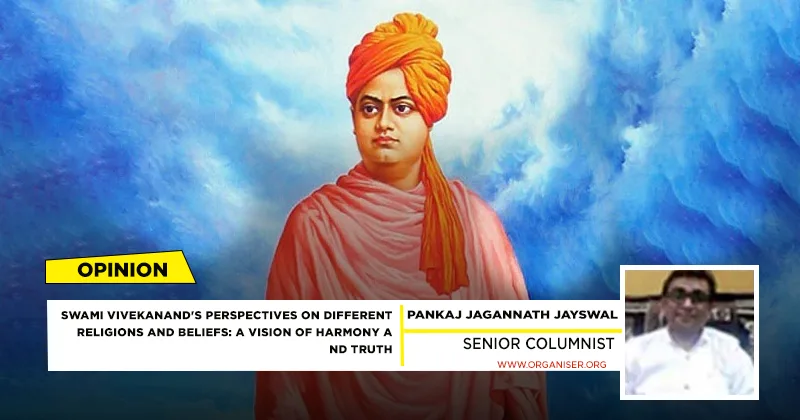
Swami Vivekanand, a monk with a strong aura that no one could penetrate, had the mental energy and charismatic personality to keep people of all religions united with him even after his straightforward discourse on many religions’ perspectives, particularly Christianity and Islam. His in-depth insight and knowledge of all religions made him an accepted spiritual leader around the world. Let’s look at some of his talks on his birth anniversary to gain a sense of his profound understanding of religions and Vedanta philosophy.
Swamiji plainly speaks on the religious perspectives of different faiths.
Delivered in Minneapolis on November 26, 1893: Reported in the Minneapolis Journal
Swamiji began with a narrative: “I’ll tell you the story of five blind guys. There was a procession in a village in India, and everyone came to watch it. They were overjoyed, and as the five blind people touched the elephant, they became acquainted with its form. They were given the privilege, and after the procession, they returned home with the rest of the people, where they began to discuss the elephant. ‘It was exactly like a wall,’ one remarked. ‘No,’ responded another, ‘it was just a piece of rope. You are mistaken, remarked a third, ‘I felt him and it was only a serpent. The discussion heated up, and the fourth declared that the elephant was like a cushion. The conversation quickly turned into more heated expressions, and the five blind guys began to fight. A man with two eyes approached and asked, ‘My friends, what is the matter?’ The dispute was recounted, and the newcomer remarked, “Men, you are all right; the problem is that you touched the elephant at separate spots. The wall represented the side, the rope the tail, and the serpent the trunk. The toes were the pillow. Stop arguing; you’re fine; you just have different perspectives on the elephant. ” Religion, Swamiji claimed, had been embroiled in such a conflict. People in the West believed they possessed the only religion of God, and people in the East shared this belief. Both were mistaken; God existed in all religions.
There were many insightful critiques of Western thinking. The Christians were described as having a “shopkeeping religion”. They were continuously pleading with God: “O God, give me this and that; O God, do this and that.” The Hindu couldn’t comprehend this. He thought it was improper to be petitioning God. Rather than beg, the holy man should offer. The Hindu believed in giving to God and his fellows rather than expecting God to give to them. They had noticed that many people in the West thought a lot about God as long as everything went well, but when things went wrong, God was forgotten; not so with Hindus.
Hindus and other religions
(A lecture delivered at Detroit on February 21, 1894, and reported in the Detroit Free Press)
Hindus have an inclination to harmonize rather than destroy. If a new concept enters India, we do not oppose it, but rather endeavor to incorporate it and harmonise it, as this way was first taught by our Bhagwan, God incarnate on earth, Shri Krishna. This Incarnation of God preached himself first: “I am the God Incarnate, the inspirer of all books, the inspirer of all religions”. As a result, we have no rejections.
There is one significant difference between us and Christians, which we never taught. That is the concept of redemption via Jesus’ blood, or deaning with any man’s blood. We had our sacrifice, just as the Jews did. Our sacrifices are basically this: here is some food I’m going to consume, and it’s wrong unless some of it is dedicated to God, therefore I offer it. This is the simplest idea. However, the Jew believes that his sin should be transferred to the lamb, and that the lamb should be slain while he remains unharmed. We never had this wonderful concept in India, and I’m glad we didn’t. Such a doctrine, in my opinion, would not lead to salvation. If anybody came and said, “Be saved by my blood,” I would tell him, “My brother, leave; I will go to hell; I am not a coward to take innocent blood to go to heaven; I am ready for hell.”
Why Sanatan Dharma or Vedanta is true religion?
When Swamiji returned to India following his first visit to the West, he was greeted as a national hero everywhere he went. In response to the positive reception, he conducted several inspiring talks throughout the country, seeking to raise religious awareness and instill pride in one’s cultural heritage. These are referred to as his “Lectures from Colombo to Almora”.
The lecture in Kumbakonam was one of them. He utilized dramatic, impassioned comments to instill pride in the people of India, waking them up from their slumber and recognizing the magnificence of their own faith. He believed he could speak his mind among his own people. He discovered that each of the other religions claimed to be the one true one, but provided no supporting evidence for their claim. It’s like someone saying, “My mother is the best cook in the world.”
” It is a subjective expression indicating personal allegiance, not factual. However, Swamiji clearly set out the foundation, or at least part of them, for declaring Vedanta as the “only true religion.” From that perspective, he is correct, as no other religion has similar beliefs. Swamiji, on the other hand, became quite particular and outlined certain qualities of Hindu Dharma, or more accurately, Vedanta, to explain why it “is the only true religion.” In response to the address congratulating him at Kumbakonam in February 1897, Swamiji lectured on the “Mission of the Vedanta” and stated: Ours is the only true religion since, according to it, this small sense-world of three days is not to be the end and aim of all, nor is it to be our major goal. This small terrestrial horizon of a few feet does not limit the scope of our religion. Ours is far beyond, and yet farther beyond; beyond the senses, beyond space, and beyond time, until nothing of this world remains and the universe becomes a drop in the transcendent ocean of the splendor of the soul.
Our religion is true because it teaches that God alone is true, that this world is deceptive and ephemeral, that all your gold is but dust, that all your strength is finite, and that life itself is frequently evil; thus, our religion is true. Ours is the true religion because, above all, it teaches renunciation and stands up with the wisdom of ages to tell and declare to nations who are mere children of yesterday in comparison to us Hindus—who own the hoary antiquity of the wisdom discovered by our ancestors here in India—to tell them in plain words:
“Children, you are prisoners of the senses; there is only finiteness in the senses, only ruination in the senses; the three short days of pleasure here will ultimately lead to ruin. Give it all up, forsake the love of the senses and the world; this is the path of religion.”
That, in my opinion, is the reason why our religion is truer than any other religion: it has never conquered, has never shed blood, and has always spoken words of blessing, peace, love, and sympathy to everyone. Toleration was originally preached here and nowhere else. Toleration and sympathy have only become realistic in this country; in every other country, they remain theoretical.
The objective is not to portray any religion negatively, but rather to highlight the charisma of a monk whose words must be thoroughly researched and analyzed in order to make the world a better place for all living beings. His unbiased commitment to communicating the truth should be a guiding principle for all people, regardless of religion or beliefs. Celebrate this wonderful spiritual master’s birth anniversary.