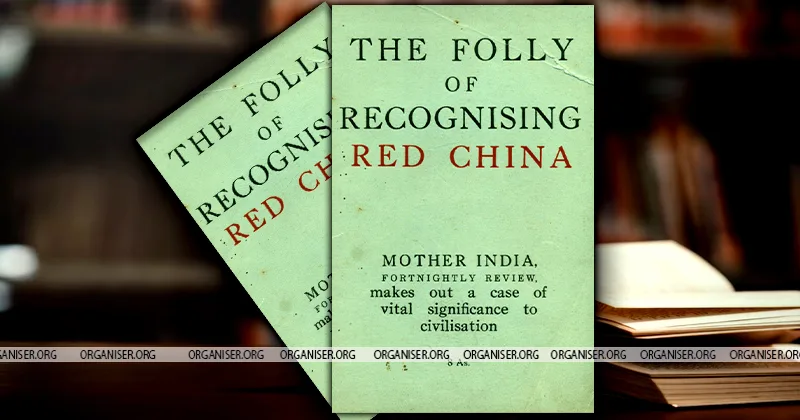
Book Review: The Folly of Recognising Red China by KD Sethna: A Prophetic Warning Ignored
October 2, 2026
  • Read Ecopy
  • Circulation
  • Advertise
  • Careers
  • About Us
  • Contact Us
Android AppiPhone AppArattai
Organiser
  • ‌
  • Bharat
    • Assam
    • Bihar
    • Chhattisgarh
    • Jharkhand
    • Maharashtra
    • View All States
  • World
    • Asia
    • Europe
    • North America
    • South America
    • Africa
    • Australia
  • Editorial
  • International
  • Opinion
  • RSS @ 100
  • More
    • World Hindu Congress 2026
    • Op Sindoor
    • Analysis
    • Sports
    • Defence
    • Politics
    • Business
    • Economy
    • Culture
    • Special Report
    • Sci & Tech
    • Entertainment
    • G20
    • Azadi Ka Amrit Mahotsav
    • Vocal4Local
    • Web Stories
    • Education
    • Employment
    • Books
    • Interviews
    • Travel
    • Law
    • Health
    • Obituary
  • Subscribe
    • Subscribe Print Edition
    • Subscribe Ecopy
    • Read Ecopy
  • ‌
  • Bharat
    • Assam
    • Bihar
    • Chhattisgarh
    • Jharkhand
    • Maharashtra
    • View All States
  • World
    • Asia
    • Europe
    • North America
    • South America
    • Africa
    • Australia
  • Editorial
  • International
  • Opinion
  • RSS @ 100
  • More
    • World Hindu Congress 2026
    • Op Sindoor
    • Analysis
    • Sports
    • Defence
    • Politics
    • Business
    • Economy
    • Culture
    • Special Report
    • Sci & Tech
    • Entertainment
    • G20
    • Azadi Ka Amrit Mahotsav
    • Vocal4Local
    • Web Stories
    • Education
    • Employment
    • Books
    • Interviews
    • Travel
    • Law
    • Health
    • Obituary
  • Subscribe
    • Subscribe Print Edition
    • Subscribe Ecopy
    • Read Ecopy
Organiser
  • Home
  • Bharat
  • World
  • Operation Sindoor
  • Editorial
  • Analysis
  • Opinion
  • Culture
  • Defence
  • International Edition
  • RSS @ 100
  • Magazine
  • Read Ecopy
Home Bharat

Book Review: The Folly of Recognising Red China by KD Sethna: A Prophetic Warning Ignored

The Folly of Recognising Red China by KD Sethna is a compelling critique of India's diplomatic approach toward China, offering a prophetic warning that went largely unheeded. Written with incisive clarity, the book examines the political and ideological underpinnings of China's rise and its implications for India

WEBDESKWEBDESK
Dec 29, 2024, 01:30 pm IST
inBharat, Books
Follow on Google News
Facebook
Twitter
WhatsAppTelegramEmail

KD Sethna’s The Folly of Recognising Red China is not merely a political commentary but a prophetic critique that foresaw the dire consequences of legitimising Mao Zedong’s regime. First published in 1950 as a series of editorials in Mother India, the text demonstrated remarkable foresight, and understanding of geopolitics, and commitment to India’s spiritual and cultural ideals. Sethna stands far ahead of his time, dissecting the geopolitical chessboard with surgical precision and a vision that history has since vindicated.

In 1950, India’s recognition of Communist China was celebrated by some as a bold assertion of its independent foreign policy. Sethna, however, denounced it as an egregious mistake, an act of political myopia that betrayed India’s spiritual ethos and jeopardised global democratic values. His warnings, dismissed as reactionary at the time, have been realising themselves repeatedly in the decades since as China’s rise and its ideological exportation have come to dominate international discourse.

Written during the Cold War’s early days, Sethna’s critique emerged from Mother India, with the motto “Great is Truth and it shall prevail,” the publication often ventured into political and cultural debates from a perspective deeply rooted in Indian spiritual thought. Sethna’s association with Sri Aurobindo Ashram imbued his analysis with Sri Aurobindo’s lens of integral philosophy, the evolution of human consciousness and the spiritual destiny of nations.

Sethna’s critique revolved around several interlocking themes, each substantiated by his insights and grasp of ideological warfare. His arguments are striking not only for their clarity but also for their relevance to subsequent developments.

Sethna condemns the recognition of Mao’s regime as a moral and legal betrayal. He argues that Chiang Kai-shek’s Nationalist government, though flawed, remained the legitimate representative of China. Mao’s regime, by contrast, was a product of Soviet-engineered rebellion, devoid of popular will. Sethna anticipated the centralization of power and the brutal suppression of dissent that became evident in Mao’s rule itself. He drew parallels to Stalin’s puppet regimes in Eastern Europe, warning that recognizing Red China would lend international legitimacy to a dictatorship built on coercion and ideological subversion.

“You are either a Communist or a corpse,” Sethna starkly notes, highlighting Mao’s ruthless elimination of opposition. This prescient observation was tragically confirmed in the Cultural Revolution, where millions were purged in Mao’s quest for ideological purity.

Sethna lambasted the Indian government for failing to recognize the strategic implications of its decision. He predicts that Mao’s alignment with Stalin would solidify a Communist bloc capable of challenging global democracy. The subsequent decades saw exactly this: the Sino-Soviet partnership strengthened Communist insurgencies worldwide, from Southeast Asia to Africa.

His specific warnings about Red China’s destabilising influence in India’s neighborhood—Tibet, Nepal, and Southeast Asia—were starkly realized. China’s annexation of Tibet in 1951 and its military provocations along the Indian border culminated in the 1962 Sino-Indian War. “More than any other country, India has to be vigilant against Red China,” he warned, a call that resonates today in the face of ongoing territorial disputes and China’s assertive foreign policy.

For Sethna, the recognition of Mao’s China was not merely a diplomatic error but a cultural betrayal of India’s spiritual identity. He contrasts India’s millennia-old quest for the Divine with the materialism and authoritarianism of Communism. He viewed Mao’s regime as a direct threat to India’s civilizational ethos, arguing that legitimizing such a regime undermined India’s moral leadership in the world.  “India would be untrue to her whole history and betray her future,” Sethna writes, as a dire warning about the cultural erosion that can accompany ideological capitulation.

Then he derides the economic arguments for recognizing Red China as dangerously short-sighted. While Britain and the U.S. hesitated to engage with Mao, fearing the ideological and strategic costs, India’s decision to prioritize trade and diplomatic recognition was, in Sethna’s eyes, a capitulation to “low realism.” He foresaw how China’s economic pragmatism would be wielded to advance its ideological agenda, a reality visible today in China’s use of economic leverage through initiatives like the Belt and Road and Debt Traps.

History has vindicated many of Sethna’s dire predictions

● China’s Expansionism: From Tibet to the South China Sea, Sethna’s warnings about Mao’s territorial ambitions have been borne out. The annexation of Tibet and the subsequent military aggression against India reflect the very scenarios he feared.

● The Communist Bloc’s Influence: Sethna’s prediction of Red China as a major ally of Soviet Russia in ideological warfare was realized, particularly during the Korean War and Vietnam War.

● The Cultural Revolution and Internal Repression: Sethna’s characterization of Mao’s regime as a dictatorship devoid of popular will was confirmed during the Cultural Revolution’s devastation.

Sethna’s critique of India’s failure to align with democracies like the US also anticipated the long-term consequences of India’s initial reluctance to fully integrate with democratic alliances. “Authentic realism,” Sethna writes, “can mean for India nothing else save a constant sense of the basic and perfect reality that is the Divine.”

The Folly of Recognising Red China was not merely a historical critique but a manifesto for civilizations grappling with materialism and ideological subversion. Sethna’s analysis, far ahead of its time, remains a crucial text for understanding the interplay between geopolitics, culture, and spirituality. His warnings, ignored in 1950, have become realities that continue to challenge democratic nations. For India, Sethna’s work is a reminder of the costs of abandoning its civilizational mission and a call to reclaim its moral and spiritual leadership in a world still wrestling with the shadows he so clearly foresaw.


Topics: cold warThe Folly of Recognising Red China1962 Sino-Indian WarKD Sethna
Share
Tweet
SendShareSend
✮ Subscribe Organiser YouTube Channel. ✮
✮ Join Organiser's WhatsApp channel for Nationalist views beyond the news. ✮
Previous News

Patna Mahavir Mandir Trust Secretary Kishore Kunal passes away due to cardiac arrest

Next News

Khalistani Pannun of banned terrorist organisation Sikhs For Justice issues threats to disrupt Mahakumbh 2025 

Related News

Bharatiya soldiers celebrating victory during Kargil War

Kargil Vijay Diwas: Revisiting the terror flashpoint

(Left) Russian President Vladimir Putin (Right) Prime Minister Narendra Modi (Image Credit: ANI)

Russia Day 2026: The ancient civilisational bond between India and Moscow

Representative Image

The 21st-Century Arthashastra: Bharat’s Chanakya doctrine in the decade of wars

Representative Image

A Partnership Forged in History: The enduring strength of India–Russia Relations

Representative Image

Dead Hand during the Cold War and Skyfall now: Russian deterrence keeps US on tenterhooks

Representative image

US Ready to Risk All for Venezuela: Why the Trump gunboat gamble may fail

Load More

Latest News

Hindu Hate Watch: 49 Reported Cases in a Week

Hindu Hate Watch-A Weekly tracker: 49 reported cases of attacks, threats, conversion and targeting

Burial service for Christian youth leader Filibus Usman Kuje on Aug. 10, 2026 in Amaha village, Kokona County, Nasarawa state, Nigeria

Nigeria: Islamic terrorists kill one Christian every 86 minutes; Report reveals 4,216 deaths between January-September

BAPS Gets Clean Chit in Eiffel Tower Row

BAPS Gets Clean Chit in Eiffel Tower Row: No request to exclude women staff; Director to resign over operational lapse

Cocroach Abhijit Dipke

CJP wants the Election Commission to answer tough questions, but who will answer questions about CJP’s funding?

Russian President Vladimir Putin and PM Modi(File Photo)

“PM Modi has very good ideas to end Russia-Ukraine conflict”; President Putin thanks PM Modi for peace efforts

RSS shakha in Aravanchal in Cherupuzha Khand of Payyannoor Sangh zilla, Kannur, Keralam

Keralam: Swayamsevaks respond to CPM attack with increased attendance from 15 to 50 at RSS shakha in Kannur

Flydubai Attack: “Hanuman Chalisa gave me strength”, Smit Machchhar tells PM Modi as Indian pilot’s bravery saved lives

Delhi SIR exercise (A representative image)

Delhi SIR exposes voter list anomalies: 6.4 percent notices for siblings less than 9 months gap – But that’s not all

Indian Express Investigation vs Official Verification: Will the newspaper apologise?

Goa Chief Election Officer fact-checks ‘97 valid voters’ claim by Indian Express; 3 among 97 had Portuguese passports

PM Modi speaks to Captain Smit Machchhar; Wishes speedy recovery

PM Modi speaks to Smit Machchhar, Indian pilot hails PM as “biggest idol”; Footage reveals 9/11-style crash attempt

Load More
  • Privacy
  • Terms
  • Cookie Policy
  • Refund and Cancellation
  • Delivery and Shipping

© Bharat Prakashan (Delhi) Limited.
Tech-enabled by Ananthapuri Technologies

  • Home
  • Search Organiser
  • Bharat
    • Assam
    • Bihar
    • Chhattisgarh
    • Jharkhand
    • Maharashtra
    • View All States
  • World
    • Asia
    • Africa
    • North America
    • South America
    • Europe
    • Australia
  • Editorial
  • Operation Sindoor
  • Opinion
  • Analysis
  • Defence
  • Culture
  • Sports
  • Business
  • RSS @ 100
  • Entertainment
  • More ..
    • Sci & Tech
    • Vocal4Local
    • Special Report
    • Education
    • Employment
    • Books
    • Interviews
    • Travel
    • Health
    • Politics
    • Law
    • Economy
    • Obituary
  • Subscribe Magazine
  • Read Ecopy
  • Advertise
  • Circulation
  • Careers
  • About Us
  • Contact Us
  • Policies & Terms
    • Privacy Policy
    • Cookie Policy
    • Refund and Cancellation
    • Terms of Use

© Bharat Prakashan (Delhi) Limited.
Tech-enabled by Ananthapuri Technologies