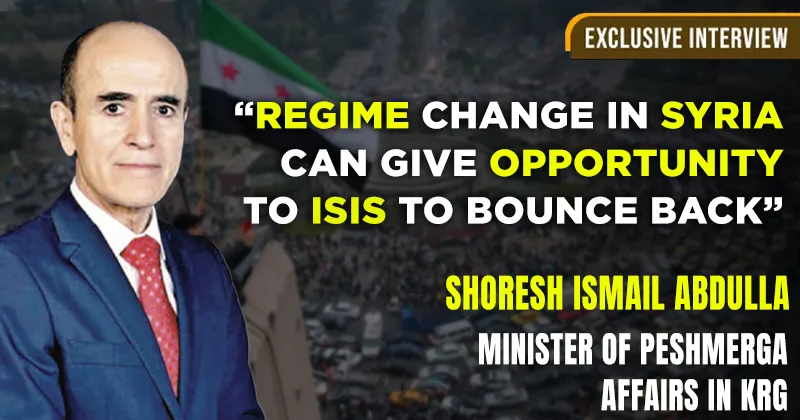
After the Assad regime’s collapse, the security situation in Syria continues to be grim and unpredictable with armed conflict throughout the country. To worsen matters for the locals as well as for the people of West Asia, the threat posed by The Islamic State (ISIS) is far from over. This extremist group remains the most prominent threat to the stability and peace of the region. Fortunately, the Peshmerga are the military forces of the Kurdistan Regional Government (KRG) and one of the most capable forces in the region, which pushed back ISIS from its stronghold. Currently, Peshmerga is also playing a vital role in counter-terror operations against ISIS. In an exclusive interview with Manish Rai, Geopolitical Analyst for West Asia, at the Ministry of Peshmerga Affairs in Erbil, Iraqi Kurdistan, Shoresh Ismail Abdulla, Minister of Peshmerga Affairs in the Kurdistan Regional Government (KRG), spoke about the re-emergence of ISIS in the context of developments in Syria. The comprehensive interview also covered planned reforms of Peshmerga and expectations from the incoming United States administration of President-elect Donald Trump. Excerpts:
What role Peshmerga forces are playing in countering the menace of ISIS? Is the threat of ISIS still imminent?
To understand the role played by the Peshmerga in countering terrorism, we have to dig into the past of this force. Historically, Peshmerga fought against the brutal Baathist regime of Saddam Hussein and other terror groups to save the people and the region. So, when ISIS emerged as a significant threat in 2014, we already had the expertise to deal with this kind of force. We confronted ISIS with all our strength, and while doing that, we also made a lot of sacrifices. For example, we had more than 10,000 injured and 2,000 martyrs in the fight against ISIS. But combined with our experience and determination, we were able to defeat ISIS and stop this terror group’s expansion. Yes, the threat posed by ISIS is far from over, and this extremist group remains the most prominent threat to the stability and peace of the region.
“When ISIS emerged as a significant threat in 2014, we (Peshmerga) already had the expertise to deal with this kind of force. We confronted ISIS with all our strength, and while doing that, we also made a lot of sacrifices. For example, we had more than 10,000 injured and 2,000 martyrs in the fight against ISIS”
Do you think that ISIS still has the potential to capture large territories?
Their fighting tactics have changed. Islamic State is still carrying out its operations through its cells very frequently, and even after losing the large territory it once controlled, we are observing very high military activities from ISIS. As the ideology of ISIS is still very much present, it has the potential to re-emerge as a significant threat. The recent developments in Syria will provide favorable conditions for ISIS to strengthen themselves.
Still, many units (Unit 70 forces are linked with the PUK, and the KDP controls Unit 80 forces) of Peshmerga are affiliated with the political parties of Kurdistan. Will all the units be unified under the Ministry of Peshmerga Affairs anytime soon? What is the biggest hindrance to this unification?
There is no hindrance as such. The process of unifying all the Peshmerga units is underway. We are receiving support for this effort from the coalition forces led by the United States. There is a Memorandum of Understanding (MOU) between the two biggest parties of Kurdistan, KDP and PUK, to unify the Peshmerga forces by the end of 2026.
How is the Peshmerga’s modernisation process progressing? It is often stated that Peshmerga forces lack heavy weaponry and air power. Is there any plan in place to address these issues?
We have taken these reforms very seriously. A separate Directorate was established under the Ministry of Peshmerga Affairs, which oversees 35 points of planned reforms. Some critical areas, such as establishing a transparent chain of command, training, and logistics, are prioritised in the modernisation process. We are receiving continuous support from the US and other coalition forces. The Federal Government in Baghdad is preventing us from procuring heavy and advanced weapons. Baghdad is not even providing ammunition for the armaments we already possess. This behaviour of the Federal Government of Iraq is strange as Peshmerga forces have also fought against any threat Iraq faces. Our forces have defended the Kurdistan region and Iraq, and we expect more cooperation from
Iraqi authorities.
Recently, Peshmerga forces received some artillery pieces (105mm M119 howitzers) from the United States. However, Baghdad has opposed this kind of weapons transfer by the US, arguing that the Iraqi national Army should only possess heavy weapons.
We already possess some heavy weapons, and in the past, the Iraqi Government didn’t oppose it. Recently, some people have objected to weapons being transferred to Peshmerga forces by the United States. Prejudices and narrow thought processes drive these objections. There is a misinformation campaign being run that possession of heavy weapons by Peshmerga forces can be a threat to the Iraqi Army. But the matter is that Peshmerga has never been a threat to anyone. Also, it should be remembered that when the Iraqi National Army was not able to fight ISIS and fled, we were the only force that defended Iraqi territory and saved the innocents from ISIS. Hence, I would say that strong Peshmerga forces are also in Iraq’s interest.
What assistance should the international community provide you in the fight against terrorism?
We expect that each country that is part of the international coalition against terrorism should enter into bilateral agreements with the Iraqi federal Government, and we should also be included in such agreements. We are playing an essential role in the fight against terrorism in this region. I am not saying that we should be included as a third party in these bilateral engagements. However, it should be considered that the Kurdistan Regional Government (KRG), as per the Iraqi constitution, is an autonomous region of Iraq. Hence, we should be part of every agreement about counter-terror efforts.
Do you think the policies of US President-elect Donald Trump’s administration will affect the region differently, especially Kurdistan?
We can’t say with certainty whether the policies of the new US administration will change or not. But the officials chosen to serve in the new administration—almost all of them—have had positive views about the Kurdistan region and the Peshmerga in the past. We believe that policies in the United States are decided at an institutional level after considering the ground realities.