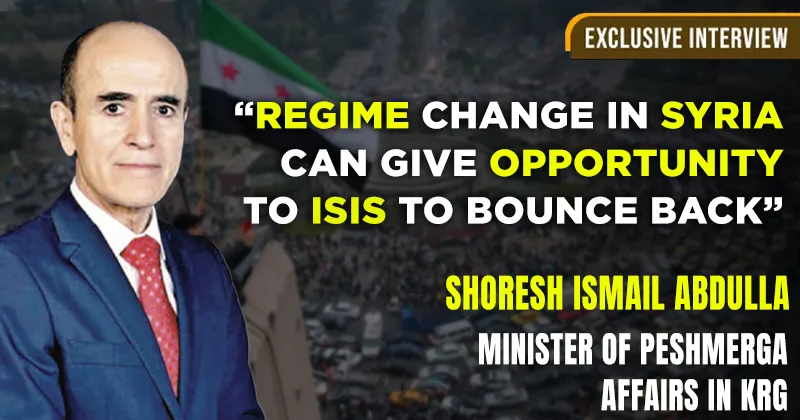
Regime change in Syria can give opportunity to ISIS to bounce back: Shoresh Ismail Abdulla
July 18, 2026
  • Read Ecopy
  • Circulation
  • Advertise
  • Careers
  • About Us
  • Contact Us
Android AppiPhone AppArattai
Organiser
  • ‌
  • Bharat
    • Assam
    • Bihar
    • Chhattisgarh
    • Jharkhand
    • Maharashtra
    • View All States
  • World
    • Asia
    • Europe
    • North America
    • South America
    • Africa
    • Australia
  • Editorial
  • International
  • Opinion
  • RSS @ 100
  • More
    • Op Sindoor
    • Analysis
    • Sports
    • Defence
    • Politics
    • Business
    • Economy
    • Culture
    • Special Report
    • Sci & Tech
    • Entertainment
    • G20
    • Azadi Ka Amrit Mahotsav
    • Vocal4Local
    • Web Stories
    • Education
    • Employment
    • Books
    • Interviews
    • Travel
    • Law
    • Health
    • Obituary
  • Subscribe
    • Subscribe Print Edition
    • Subscribe Ecopy
    • Read Ecopy
  • ‌
  • Bharat
    • Assam
    • Bihar
    • Chhattisgarh
    • Jharkhand
    • Maharashtra
    • View All States
  • World
    • Asia
    • Europe
    • North America
    • South America
    • Africa
    • Australia
  • Editorial
  • International
  • Opinion
  • RSS @ 100
  • More
    • Op Sindoor
    • Analysis
    • Sports
    • Defence
    • Politics
    • Business
    • Economy
    • Culture
    • Special Report
    • Sci & Tech
    • Entertainment
    • G20
    • Azadi Ka Amrit Mahotsav
    • Vocal4Local
    • Web Stories
    • Education
    • Employment
    • Books
    • Interviews
    • Travel
    • Law
    • Health
    • Obituary
  • Subscribe
    • Subscribe Print Edition
    • Subscribe Ecopy
    • Read Ecopy
Organiser
  • Home
  • Bharat
  • World
  • Operation Sindoor
  • Editorial
  • Analysis
  • Opinion
  • Culture
  • Defence
  • International Edition
  • RSS @ 100
  • Magazine
  • Read Ecopy
Home Bharat

Regime change in Syria can give opportunity to ISIS to bounce back: Shoresh Ismail Abdulla

Manish RaiManish Rai
Dec 25, 2024, 07:30 pm IST
in Bharat, Interviews
Follow on Google News
FacebookTwitterWhatsAppTelegramEmail

After the Assad regime’s collapse, the security situation in Syria continues to be grim and unpredictable with armed conflict throughout the country. To worsen matters for the locals as well as for the people of West Asia, the threat posed by The Islamic State (ISIS) is far from over. This extremist group remains the most prominent threat to the stability and peace of the region. Fortunately, the Peshmerga are the military forces of the Kurdistan Regional Government (KRG) and one of the most capable forces in the region, which pushed back ISIS from its stronghold. Currently, Peshmerga is also playing a vital role in counter-terror operations against ISIS. In an exclusive interview with Manish Rai, Geopolitical Analyst for West Asia, at the Ministry of Peshmerga Affairs in Erbil, Iraqi Kurdistan, Shoresh Ismail Abdulla, Minister of Peshmerga Affairs in the Kurdistan Regional Government (KRG), spoke about the re-emergence of ISIS in the context of developments in Syria. The comprehensive interview also covered planned reforms of Peshmerga and expectations from the incoming United States administration of President-elect Donald Trump. Excerpts:

What role Peshmerga forces are playing in countering the menace of ISIS? Is the threat of ISIS still imminent?

To understand the role played by the Peshmerga in countering terrorism, we have to dig into the past of this force. Historically, Peshmerga fought against the brutal Baathist regime of Saddam Hussein and other terror groups to save the people and the region. So, when ISIS emerged as a significant threat in 2014, we already had the expertise to deal with this kind of force. We confronted ISIS with all our strength, and while doing that, we also made a lot of sacrifices. For example, we had more than 10,000 injured and 2,000 martyrs in the fight against ISIS. But combined with our experience and determination, we were able to defeat ISIS and stop this terror group’s expansion. Yes, the threat posed by ISIS is far from over, and this extremist group remains the most prominent threat to the stability and peace of the region.

“When ISIS emerged as a significant threat in 2014, we (Peshmerga) already had the expertise to deal with this kind of force. We confronted ISIS with all our strength, and while doing that, we also made a lot of sacrifices. For example, we had more than 10,000 injured and 2,000 martyrs in the fight against ISIS”


Do you think that ISIS still has the potential to capture large territories?

Their fighting tactics have changed. Islamic State is still carrying out its operations through its cells very frequently, and even after losing the large territory it once controlled, we are observing very high military activities from ISIS. As the ideology of ISIS is still very much present, it has the potential to re-emerge as a significant threat. The recent developments in Syria will provide favorable conditions for ISIS to strengthen themselves.

Still, many units (Unit 70 forces are linked with the PUK, and the KDP controls Unit 80 forces) of Peshmerga are affiliated with the political parties of Kurdistan. Will all the units be unified under the Ministry of Peshmerga Affairs anytime soon? What is the biggest hindrance to this unification?

There is no hindrance as such. The process of unifying all the Peshmerga units is underway. We are receiving support for this effort from the coalition forces led by the United States. There is a Memorandum of Understanding (MOU) between the two biggest parties of Kurdistan, KDP and PUK, to unify the Peshmerga forces by the end of 2026.

How is the Peshmerga’s modernisation process progressing? It is often stated that Peshmerga forces lack heavy weaponry and air power. Is there any plan in place to address these issues?

We have taken these reforms very seriously. A separate Directorate was established under the Ministry of Peshmerga Affairs, which oversees 35 points of planned reforms. Some critical areas, such as establishing a transparent chain of command, training, and logistics, are prioritised in the modernisation process. We are receiving continuous support from the US and other coalition forces. The Federal Government in Baghdad is preventing us from procuring heavy and advanced weapons. Baghdad is not even providing ammunition for the armaments we already possess. This behaviour of the Federal Government of Iraq is strange as Peshmerga forces have also fought against any threat Iraq faces. Our forces have defended the Kurdistan region and Iraq, and we expect more cooperation from
Iraqi authorities.

Recently, Peshmerga forces received some artillery pieces (105mm M119 howitzers) from the United States. However, Baghdad has opposed this kind of weapons transfer by the US, arguing that the Iraqi national Army should only possess heavy weapons.

We already possess some heavy weapons, and in the past, the Iraqi Government didn’t oppose it. Recently, some people have objected to weapons being transferred to Peshmerga forces by the United States. Prejudices and narrow thought processes drive these objections. There is a misinformation campaign being run that possession of heavy weapons by Peshmerga forces can be a threat to the Iraqi Army. But the matter is that Peshmerga has never been a threat to anyone. Also, it should be remembered that when the Iraqi National Army was not able to fight ISIS and fled, we were the only force that defended Iraqi territory and saved the innocents from ISIS. Hence, I would say that strong Peshmerga forces are also in Iraq’s interest.

What assistance should the international community provide you in the fight against terrorism?

We expect that each country that is part of the international coalition against terrorism should enter into bilateral agreements with the Iraqi federal Government, and we should also be included in such agreements. We are playing an essential role in the fight against terrorism in this region. I am not saying that we should be included as a third party in these bilateral engagements. However, it should be considered that the Kurdistan Regional Government (KRG), as per the Iraqi constitution, is an autonomous region of Iraq. Hence, we should be part of every agreement about counter-terror efforts.

Do you think the policies of US President-elect Donald Trump’s administration will affect the region differently, especially Kurdistan?

We can’t say with certainty whether the policies of the new US administration will change or not. But the officials chosen to serve in the new administration—almost all of them—have had positive views about the Kurdistan region and the Peshmerga in the past. We believe that policies in the United States are decided at an institutional level after considering the ground realities.


Topics: ISISUnited StatesKurdistan Regional GovernmentIraqi federal GovernmentSyria continues
Manish Rai
Manish Rai
The writer is a Political Analyst for West Asia and Af-Pak Region. [Read more]
ShareTweetSendShareSend
✮ Subscribe Organiser YouTube Channel. ✮
✮ Join Organiser's WhatsApp channel for Nationalist views beyond the news. ✮
Previous News

Veer Bal Diwas: Delhi’s Bal Mandir School to organise Gurumat Samagam to honour chaar sahibzaades

Next News

Delhi: Five Bangladeshi nationals, 6 others arrested in major operation for creating fake Aadhaar and voter cards

Related News

UP govt's crackdown on ISIS network; NIA court awards five years of sentence to Rakib Imam Ansari (This image is generated by AI)

Uttar Pradesh: UP tightens grip on ISIS ecosystem; NIA court convicts Rakib Imam Ansari

Al-Hind ISIS Module: NIA Secures First Conviction in 2020 Terror Case (This is an AI generated image)

Major NIA action against Al-Hind ISIS Module: Mohammad Hanif Khan sentenced to 7 years of rigorous imprisonment

NIA busts social media radicalisation network

Andhra Pradesh: NIA unmasks social media radicalisation network linked to ISIS and AQIS

The "China Plus One" strategy is reshaping the global manufacturing map

The China Plus One Era: Why global manufacturing is shifting from Beijing to new strategic hubs

Florida has witnessed a series of incidents involving extremist violence and debates over religiously exclusive economic networks

Islamists threaten Florida’s security and freedom with parallel economy and radical extremism

CoHNA explains of Hindu temples are repeatedly vandalised in the US as anti-Hindu hate soars

CoHNA Slams Yashica Dutt’s Anti-Hindu Propaganda: Upholds Georgia’s bill & Indian American unity against polarisation

Load More

Latest News

Rahibai Soma Popere, the seed mother of India

Rahibai Soma Popere: The Padma Shri Awardee protecting India’s forgotten seed varieties for future generations

India's "Waterman" Rajendra Singh has revived sacred temple ponds, blending faith with water conservation

Rajendra Singh: How India’s ‘Waterman’ is reviving Mandir ponds to restore heritage and fight the water crisis

Senior Journalist Alok Goswami

Senior Journalist and Former ‘Panchjanya’ Associate Editor Alok Goswami passes away in Delhi; Huge loss to Hindi media

Located in Karnataka, the Vijayanagara ruins at Hampi preserve the timeless legacy of medieval India's last great Hindu empire

The Vijayanagara Ruins: How Hampi preserves the legacy of India’s last great Hindu empire

Depiction of the sun's magnetic fields (Representative Image)

‘Magnetic Trees’ unlock a hidden solar highway: Indian scientists trace deep plasma flow in the sun

Security forces arrested Maoist leader Ajay Mahto in Jharkhand

Jharkhand: Top Maoist leader with Rs 25 lakh bounty nabbed, wanted by four states & central forces

Sonam Wangchuk’s 20-day fast ends in pre-dawn police operation; Shifted to Hospital from Jantar Mantar on HC orders

Defence Minister Rajnath Singh at launch of 'RSS@100' authored by Shyam Jaju and Anupam Trivedi

“RSS is a civilisational force that needs no certification or validation”: Defence Minister Rajnath Singh

Ladakh LG VK Saxena commissions India's first and deepest geothermal wells at Puga Valley

Ladakh: 14,000 feet above sea level, 1,000 meters below ground: India drills its deepest geothermal wells

The Indian Ocean remains the enduring foundation of the India-US strategic partnership, according to Italy's ISPI

China Isn’t the Real Driver: Indian Ocean keeps India-US strategic partnership strong, says report

Load More
  • Privacy
  • Terms
  • Cookie Policy
  • Refund and Cancellation
  • Delivery and Shipping

© Bharat Prakashan (Delhi) Limited.
Tech-enabled by Ananthapuri Technologies

  • Home
  • Search Organiser
  • Bharat
    • Assam
    • Bihar
    • Chhattisgarh
    • Jharkhand
    • Maharashtra
    • View All States
  • World
    • Asia
    • Africa
    • North America
    • South America
    • Europe
    • Australia
  • Editorial
  • Operation Sindoor
  • Opinion
  • Analysis
  • Defence
  • Culture
  • Sports
  • Business
  • RSS @ 100
  • Entertainment
  • More ..
    • Sci & Tech
    • Vocal4Local
    • Special Report
    • Education
    • Employment
    • Books
    • Interviews
    • Travel
    • Health
    • Politics
    • Law
    • Economy
    • Obituary
  • Subscribe Magazine
  • Read Ecopy
  • Advertise
  • Circulation
  • Careers
  • About Us
  • Contact Us
  • Policies & Terms
    • Privacy Policy
    • Cookie Policy
    • Refund and Cancellation
    • Terms of Use

© Bharat Prakashan (Delhi) Limited.
Tech-enabled by Ananthapuri Technologies