"Ambedkar has been dropped": Here's everything Nehru wrote in his letter to Edwina Mountbatten in 1952
June 5, 2026
  • Read Ecopy
  • Circulation
  • Advertise
  • Careers
  • About Us
  • Contact Us
Android AppiPhone AppArattai
Organiser
  • ‌
  • Bharat
    • Assam
    • Bihar
    • Chhattisgarh
    • Jharkhand
    • Maharashtra
    • View All States
  • World
    • Asia
    • Europe
    • North America
    • South America
    • Africa
    • Australia
  • Editorial
  • International
  • Opinion
  • RSS @ 100
  • More
    • Op Sindoor
    • Analysis
    • Sports
    • Defence
    • Politics
    • Business
    • Economy
    • Culture
    • Special Report
    • Sci & Tech
    • Entertainment
    • G20
    • Azadi Ka Amrit Mahotsav
    • Vocal4Local
    • Web Stories
    • Education
    • Employment
    • Books
    • Interviews
    • Travel
    • Law
    • Health
    • Obituary
  • Subscribe
    • Subscribe Print Edition
    • Subscribe Ecopy
    • Read Ecopy
  • ‌
  • Bharat
    • Assam
    • Bihar
    • Chhattisgarh
    • Jharkhand
    • Maharashtra
    • View All States
  • World
    • Asia
    • Europe
    • North America
    • South America
    • Africa
    • Australia
  • Editorial
  • International
  • Opinion
  • RSS @ 100
  • More
    • Op Sindoor
    • Analysis
    • Sports
    • Defence
    • Politics
    • Business
    • Economy
    • Culture
    • Special Report
    • Sci & Tech
    • Entertainment
    • G20
    • Azadi Ka Amrit Mahotsav
    • Vocal4Local
    • Web Stories
    • Education
    • Employment
    • Books
    • Interviews
    • Travel
    • Law
    • Health
    • Obituary
  • Subscribe
    • Subscribe Print Edition
    • Subscribe Ecopy
    • Read Ecopy
Organiser
  • Home
  • Bharat
  • World
  • Operation Sindoor
  • Editorial
  • Analysis
  • Opinion
  • Culture
  • Defence
  • International Edition
  • RSS @ 100
  • Magazine
  • Read Ecopy
Home Bharat

“Ambedkar has been dropped”: Here’s everything Nehru wrote in his letter to Edwina Mountbatten in 1952

In his letter to Edwina Mountbatten, Jawaharlal Nehru remarked that "Ambedkar has been dropped out" and accused him of having "combined with Hindu communalists," reveals Nehru's frequently critical perspective on Ambedkar's political choices. It also underscores the divisions within the socialist movement during the formative years of India's independence

WEBDESKWEBDESK
Dec 19, 2024, 07:30 pm IST
in Bharat
Follow on Google News
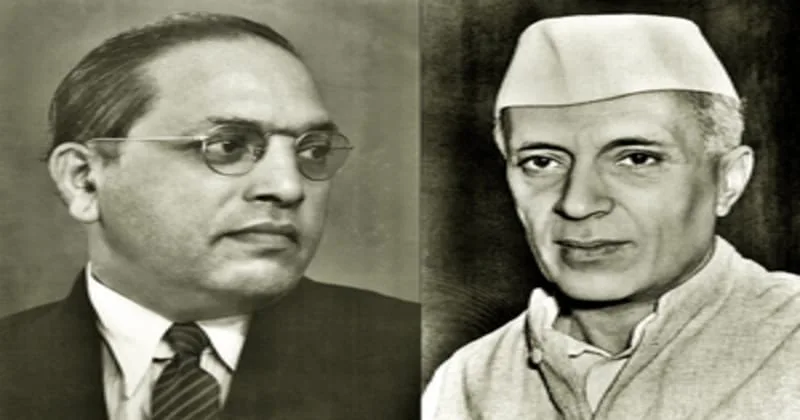
Dr B.R. Ambedkar (Left) and Jawaharlal Nehru (Right)

Dr B.R. Ambedkar (Left) and Jawaharlal Nehru (Right)

FacebookTwitterWhatsAppTelegramEmail

In a letter dated January 16, 1952, to Edwina Mountbatten, Jawaharlal Nehru, India’s first Prime Minister, revealed a striking political mindset that reflected his views on Dr B.R. Ambedkar, the leader of the Dalit community, and the complexities of India’s post-independence political landscape. Nehru’s sentiments, expressed in the letter, suggest a deepening rift between the Congress Party’s vision of social progress and Ambedkar’s growing influence among the lower castes and the marginalised.

The letter, in which Nehru stated that “Ambedkar has been dropped out” and “Ambedkar has combined with Hindu communalists,” sheds light on Nehru’s often critical stance towards Ambedkar’s political decisions, as well as the fracturing of the socialist movement in the early years of India’s independence.

Political Rivalries in Post-Independence India

The letter was written against the backdrop of a newly independent India grappling with its social, economic, and political realities. While the Congress Party, led by Nehru, held significant sway over the country’s trajectory, the early 1950s saw the emergence of various political groups that sought to influence the future course of India. Ambedkar, having served as the architect of the Indian Constitution, had become a key figure in advocating for the rights of the Dalits, whom he termed the “Scheduled Castes.” His dissatisfaction with the Congress Party’s policies, particularly its failure to fully address the social and economic needs of Dalits, led to the formation of his own political party, the Republican Party of India (RPI).

Around the same time, the Socialist Party, once a key ally of the Congress in the struggle for independence, had begun to diverge politically. The socialists, under leaders like Jayaprakash Narayan and Ram Manohar Lohia, had been increasingly critical of Nehru’s policies, particularly his emphasis on state-led industrialisation and the centralisation of power. Amidst these tensions, Ambedkar’s political movements, both as a leader of the Dalits and a critic of Nehru’s Congress, added another layer of complexity to India’s political environment.

Nehru’s Disappointment with Ambedkar: The Political Isolation

Nehru’s reference to Ambedkar as being “dropped out” in his letter to Edwina reflects his disillusionment with Ambedkar’s decision to part ways with Congress and form his own political path. At the time, Ambedkar was moving away from the Congress Party, which he had once been aligned with, due to what he saw as its failure to make meaningful strides for the upliftment of Dalits.

The rift between Nehru and Ambedkar was not just personal, but deeply ideological. Nehru, a firm believer in democratic socialism, had always emphasised the importance of the Congress Party in building a unified India. He viewed Ambedkar’s alliance with the Socialists, and later with other political factions, as a threat to the unity of the nation. Nehru’s words, “Ambedkar has combined with Hindu communalists,” reveal his view that Ambedkar’s political strategy, particularly his alliances, were detrimental to the broader project of social justice in India.

Nehru, an advocate for secularism, often expressed his skepticism about alliances that included elements of Hindu nationalism. The growing association between Ambedkar’s faction and groups aligned with the Hindu right wing, despite their supposed commitment to Dalit rights, was troubling to Nehru, who viewed it as a betrayal of the secular and inclusive values he championed. Nehru’s remark about Ambedkar’s “combination” with Hindu communalists underscores the friction between their political visions.

Ambedkar’s Growing Distance from Congress: A Necessary Struggle for Dalit Rights

Ambedkar’s decision to distance himself from the Congress Party was rooted in his frustration with the slow pace of social reforms, particularly concerning the rights of Dalits. His commitment to ending untouchability and achieving social equality for the marginalised was, in his view, inadequately addressed by Nehru’s government.

Ambedkar believed that the Congress Party, while progressive in its stance on political independence and nation-building, was too entrenched in traditional structures to bring about the necessary social transformations. This led him to seek alliances with other political forces that, despite their flaws, appeared more willing to address the pressing needs of Dalits.

Ambedkar’s move to align with the Hindu communalists, as Nehru described it, was not a seamless or ideological match. In fact, Ambedkar’s engagement with the Hindu Mahasabha and other conservative groups was, in many ways, a tactical maneuver, aimed at securing political leverage for the Dalit community. Ambedkar, a man of pragmatism, believed in using all available political avenues to achieve his goals, even if that meant forming uncomfortable alliances.

It is essential to understand that Ambedkar’s political journey was not solely about seeking power or creating divisions but was driven by his profound commitment to the social justice of India’s most oppressed communities. While Nehru may have seen these alliances as a political compromise, for Ambedkar, they were steps in his ongoing struggle to ensure the political empowerment of Dalits in a society that had long relegated them to the margins.

Nehru’s Virodhi Mindset: A Reflection of Power Dynamics

Nehru’s “Ambedkar Virodhi” (anti-Ambedkar) mindset can be understood within the larger context of post-independence power dynamics. Nehru, as a leader of Congress, wanted political democracy with a degree of centralisation and control. He saw the Congress Party as the custodian of India’s unity and secular identity, which he believed was essential for the survival of the nation. In this context, any political force that emerged as a challenge to Congress, particularly one led by Ambedkar, was viewed as a disruption to the national project.

On the other hand, Ambedkar did not conform to the prevailing political logic of unity at all costs. His commitment to social justice was paramount, and if that meant breaking away from Nehru’s Congress or aligning with forces that Nehru found distasteful, so be it. This divergence between Nehru’s centralising vision and Ambedkar’s fight for marginalized communities created an irreconcilable political tension.

The Complex Legacy of Nehru and Ambedkar

Nehru’s 1952 letter to Edwina Mountbatten reveals the deep ideological divide that existed between him and Ambedkar, particularly in the early years following India’s independence. While Nehru viewed Ambedkar’s decisions with skepticism and frustration, Ambedkar’s political choices reflected his unwavering commitment to the empowerment of Dalits and other marginalised communities.

The term “Ambedkar Virodhi” captures not only Nehru’s opposition to Ambedkar’s political shift but also highlights the broader tension between the Congress Party’s vision of a unified India and Ambedkar’s insistence on addressing the specific needs of Dalits, often at odds with mainstream politics.
Topics: Jawaharlal NehruDr B R AmbedkarDalit RightsNehru-Ambedkar ConflictSocialist Movement in India
ShareTweetSendShareSend
✮ Subscribe Organiser YouTube Channel. ✮
✮ Join Organiser's WhatsApp channel for Nationalist views beyond the news. ✮
Previous News

Kathmandu meeting, Naxal-linked groups, and Bharat Jodo Yatra: Fadnavis makes explosive claims in state assembly

Next News

Centre reinstated Protected Area Permit in Manipur; PAP reactivated in Nagaland and Mizoram to check influx

Related News

PM Modi to Overtake Nehru as India's Longest-Serving Elected Prime Minister on June 10

PM Modi set to surpass Nehru’s record, become India’s longest-serving elected Prime Minister

From Partition to the National Advisory Council in 2004, Congress-led decisions are seen as having lasting impacts on India’s territorial integrity

Dark Chapter of Congress: How partition, territorial concessions and political decisions shaped India’s troubled legacy

Akhil Bharatiya Adhivakta Parishad explores India’s early constitutional battles over free speech and judicial review

The First Amendment at 75: Revisiting Organiser’s historic free speech battle against the Nehru government

Why Nehru didn't want anything to do with Somnath temple rebuilding

When Nehru opposed reconstruction of Somnath Mandir and K.M. Munshi refused to back down

Somnath Mandir's Journey Through Bloodshed and Rebirth (This image is generated from AI)

Somnath Stands Tall: How Hindu civilisation survived repeated Islamic attacks

Nehru wrote 17 letters to oppose the reconstruction of Somnath Mandir (Image Source: Facebook)

Somnath Files: BJP reveals 17 letters of Nehru in which he opposed reconstruction of mandir

Load More

Latest News

RSS Sarsanghchalak Dr Mohan Bhagwat

The time of Bharat has arrived; we need to expedite our preparation: Dr Bhagwat at RSS Karyakarta Vikas Varg 2

Padma Bhushan awardee and noted industrialist Kumar Mangalam Birla Kumar Mangalam Birla addressing the Samapana Samaroh (Valedictory Function) of the Rashtriya Swayamsevak Sangh Karyakarta Vikas Varg – Dwitiya at Nagpur, on June 4, 2026

“RSS always stood by the society and nation”, Kumar Mangalam Birla at RSS Karyakarta Vikas Varg 2 in Nagpur

Arunachal Pradesh seals all 15 illegal Mosques; Bandh called off by APIYO

MK Stalin with Sonai Gandhi; MK Stalin with Rahul Gandhi (File Photos) (Left to Right)

Tamil Nadu: DMK says no to INDIA Alliance meet in Delhi, blames Congress for political backstabbing

Union Finance Minister Nirmala Sitharaman

Karnataka: All-Women team powers Yadgir’s groundnut revolution; Nirmala Sitharaman inaugurates NABARD Unit

Keralam: Jamaat-e-Islami event features Hamas and Muslim Brotherhood ideologues, raises concerns over Political Islam

Representative Image (This is an AI Generated image)

Uttar Pradesh CM Abhyudaya Scheme: Apply for free civil services, JEE and NEET coaching from June 5

House worth Rs 2 crore of drug peddler bulldozed in J&K

Anti-narcotics campaign in J&K: Police demolish Rs 2 crore residential property linked to drug peddler Sheikh Tasaduq

As fuel shortages rippled across Asia, New Delhi expanded supplies to its neighbours while Beijing sought to turn energy security into strategic influence.

The Hormuz Test: How India’s energy assistance outshines China’s conditional approach

Demographic changes in Bharat’s border districts have raised concerns about migration, security, and social cohesion

Demographic Shift in Border Areas of Bharat: The dangerous design

Load More
  • Privacy
  • Terms
  • Cookie Policy
  • Refund and Cancellation
  • Delivery and Shipping

© Bharat Prakashan (Delhi) Limited.
Tech-enabled by Ananthapuri Technologies

  • Home
  • Search Organiser
  • Bharat
    • Assam
    • Bihar
    • Chhattisgarh
    • Jharkhand
    • Maharashtra
    • View All States
  • World
    • Asia
    • Africa
    • North America
    • South America
    • Europe
    • Australia
  • Editorial
  • Operation Sindoor
  • Opinion
  • Analysis
  • Defence
  • Culture
  • Sports
  • Business
  • RSS @ 100
  • Entertainment
  • More ..
    • Sci & Tech
    • Vocal4Local
    • Special Report
    • Education
    • Employment
    • Books
    • Interviews
    • Travel
    • Health
    • Politics
    • Law
    • Economy
    • Obituary
  • Subscribe Magazine
  • Read Ecopy
  • Advertise
  • Circulation
  • Careers
  • About Us
  • Contact Us
  • Policies & Terms
    • Privacy Policy
    • Cookie Policy
    • Refund and Cancellation
    • Terms of Use

© Bharat Prakashan (Delhi) Limited.
Tech-enabled by Ananthapuri Technologies