Guru Tegh Bahadur: A beacon of sacrifice for religious freedom in the face of tyranny
June 6, 2026
  • Read Ecopy
  • Circulation
  • Advertise
  • Careers
  • About Us
  • Contact Us
Android AppiPhone AppArattai
Organiser
  • ‌
  • Bharat
    • Assam
    • Bihar
    • Chhattisgarh
    • Jharkhand
    • Maharashtra
    • View All States
  • World
    • Asia
    • Europe
    • North America
    • South America
    • Africa
    • Australia
  • Editorial
  • International
  • Opinion
  • RSS @ 100
  • More
    • Op Sindoor
    • Analysis
    • Sports
    • Defence
    • Politics
    • Business
    • Economy
    • Culture
    • Special Report
    • Sci & Tech
    • Entertainment
    • G20
    • Azadi Ka Amrit Mahotsav
    • Vocal4Local
    • Web Stories
    • Education
    • Employment
    • Books
    • Interviews
    • Travel
    • Law
    • Health
    • Obituary
  • Subscribe
    • Subscribe Print Edition
    • Subscribe Ecopy
    • Read Ecopy
  • ‌
  • Bharat
    • Assam
    • Bihar
    • Chhattisgarh
    • Jharkhand
    • Maharashtra
    • View All States
  • World
    • Asia
    • Europe
    • North America
    • South America
    • Africa
    • Australia
  • Editorial
  • International
  • Opinion
  • RSS @ 100
  • More
    • Op Sindoor
    • Analysis
    • Sports
    • Defence
    • Politics
    • Business
    • Economy
    • Culture
    • Special Report
    • Sci & Tech
    • Entertainment
    • G20
    • Azadi Ka Amrit Mahotsav
    • Vocal4Local
    • Web Stories
    • Education
    • Employment
    • Books
    • Interviews
    • Travel
    • Law
    • Health
    • Obituary
  • Subscribe
    • Subscribe Print Edition
    • Subscribe Ecopy
    • Read Ecopy
Organiser
  • Home
  • Bharat
  • World
  • Operation Sindoor
  • Editorial
  • Analysis
  • Opinion
  • Culture
  • Defence
  • International Edition
  • RSS @ 100
  • Magazine
  • Read Ecopy
Home Bharat

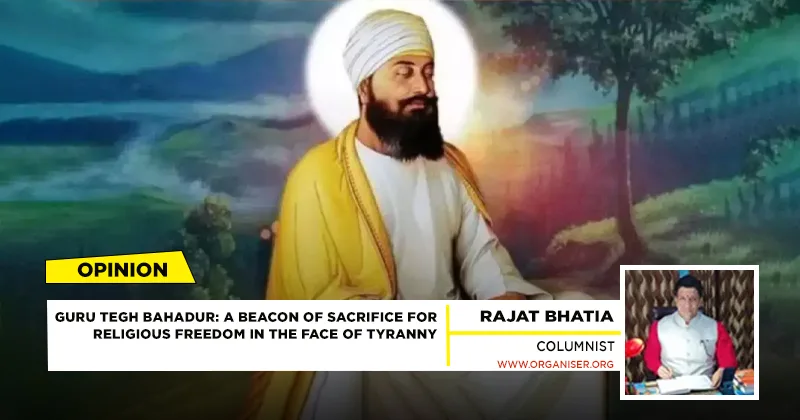
Guru Tegh Bahadur: A beacon of sacrifice for religious freedom in the face of tyranny

Guru Tegh Bahadur, the ninth Guru of Sikhism, is revered as a beacon of sacrifice and unwavering commitment to religious freedom. During a time when the Mughal emperor Aurangzeb sought to impose his fanaticism by demolishing temples, suppressing cultural diversity, and forcibly converting Hindus to Islam, Guru Tegh Bahadur emerged as a fearless protector of the oppressed

Rajat BhatiaRajat Bhatia
Dec 6, 2024, 03:45 pm IST
in Bharat, Opinion, Culture
Follow on Google News
FacebookTwitterWhatsAppTelegramEmail

Aurangzeb, who had a fanatic and religious mindset, issued many orders in India to please the Caliphs and Qazis, the main of which was: the order to demolish the famous temples of India issued in April 1669. In August 1669, the Vishwanath temple in Varanasi was demolished and a mosque named Gyanvapi was built at that place. The Somnath temple of Gujarat was also demolished by Aurangzeb. In the month of Ramzan in 1670, the famous Keshavrai temple of Mathura was also demolished. According to the orders of the cruel Mughals, famous temples were also demolished in places like Malwa, Odisha, Jodhpur, Ujjain, Udaipur, Maharashtra, Hyderabad etc., the number of which is about 40,000. To make the society capable and to re-establish harmony, the call of the time was that some great man, fearless and powerful, should lead the society selflessly. In such a period, destiny chose Guru Teg Bahadur Ji. All the qualities that the Indian nation needed were not present in anyone except Sant Shiromani Guru Teg Bahadur Ji. Guru Nanak Dev Ji was the first to oppose the atrocities of the Mughals. He addressed Babar as Jabar and asked the society to unite. Guru Arjun Dev Ji, the first martyr of the ten Guru tradition, took inspiration from Guru Nanak Dev Ji and took all the atrocities upon himself so that the society could protect the nation by awakening the spirit of manliness and unite and this happened with his sacrifice. Once again, in the need to unite the nation, Guru Teg Bahadur Ji moved forward on the path of sacrifice for the nation.

Due to the presence of Nanak Naam Leva Sangat in the entire Indian nation, Guru Ji kept getting news of Aurangzeb’s misdeeds in the society. In 1671, Aurangzeb made Iftikhar Khan the governor of Kashmir. To Islamize, Aurangzeb made Kashmiri Brahmins his target so that by weakening the Brahmins and breaking the backbone of the Indian society, religious inferiority could be created in the entire nation and the entire nation could be converted. According to British historian Macauliffe, “The mass experiment of Islamization first started in Kashmir by conversion.” According to Kojar Singh Kalaal, author of ‘Guru Vilas Padshahi’, the sacred threads of the Hindus who embraced Islam on the orders of Iftikhar Khan weighed 1.25 mons. According to a popular saying of the time, Aurangzeb would not eat until he got the news of the removal of 1.25 mons of sacred threads of Hindus.

The Kashmiri Pandits collectively organized a group discussion in Mattan and after getting everyone’s consent, a group of Kashmiri Brahmins under the leadership of Pandit Kriparam reached Anandpur Sahib. During the discussion between the Brahmins and Guruji, Guruji said that the only solution to these problems is that a truthful person with high ideals and conduct sacrifices himself for the protection of the nation. A nine-year-old boy Govind Rai, sitting nearby, said that who can be more worthy than you in the society at this time? The concept of sacrifice that was in the heart of Guru Teg Bahadur Ji was confirmed by his son Govind Rai. On hearing this, after getting permission from Guru Tegh Bahadur, Kashmiri Brahmins sent an order to Delhi that, “If the king can convert Guru Tegh Bahadur, then the entire Indian society will accept Islam with him by their own will.”

National poet Maithilisharan Gupt poeticized this moment-

Jao Vipvaro nirbhaye ho, likh do badshah ko pattar,   Teg Bahadur Musalmaan ho to yah mat phaille sarvatar,

Vahi agrani aaj hamara hum sab bharti uske sang, dekhe kaya uttar deta hai iska anyayi aurang

Aurangzeb got furious on seeing the letters sent by Kashmiri Brahmins. He tried his best to break Guru Ji, but Guru Ji was engrossed in the will of God and was firm. In front of Guru Tegh Bahadur Ji, his three devotees- Bhai Sati Das, Bhai Mati Das and Bhai Dayala Das were given unbearable tortures so that on seeing them, Guru Ji would agree to convert his religion. Aurangzeb’s cruelty was at its peak, but the aura on Tegh Bahadur Ji’s face was worth seeing. A cruel ruler like Aurangzeb lost to the spiritual power of Guru Ji and in frustration he ordered to behead Guru Ji. According to the then times, on 24 November 1675, after taking bath, Guru Ji recited Japuji Sahib in a peaceful manner under the Banyan tree, seeing which even the executioner Jalaluddin got worried because there was no fear of death on his face at all. After reciting Japuji Sahib, Guru Ji was beheaded as per the order of the emperor.

To humiliate the hero of India, Guru Tegh Bahadur Ji and the entire nation, Aurangzeb ordered that no one would cremate his dead body. Opposing this, Bhai Jaita Ji wrapped his dead body in cotton and kept it in his house and set the whole house on fire and then set out for Anandpur Sahib with the head. When Bhai Jaita Ji handed over Guru Ji’s head to his son Govind Rai, Guru Govind Rai addressed Bhai Jaita Ji as ‘Rangreta Guru ka beta’.

Govind Rai cremated Guruji’s head with respect after reciting the holy Gurbani. Guru Tegh Bahadur Ji’s sacrifice for the nation was described by Gobind Singh Ji in Vichitra Natak-

Tilak janju rakha prabh taka, kano bado kalu mahi saka,

Sadhna hetu itti jinni kari, sees diya par si na uchari,

Dharam hetu saka jin kiya, seesu diya paru sirur na uchari..

 

Topics: AurangzebGuru Teg Bahadur
ShareTweetSendShareSend
✮ Subscribe Organiser YouTube Channel. ✮
✮ Join Organiser's WhatsApp channel for Nationalist views beyond the news. ✮
Previous News

Andhra Pradesh: Complaint filed against DGP PV Sunil Kumar by LRPF, allegations of service violations

Next News

How Bharat should view Jaish-e-Mohammad chief Masood Azhar’s public lecture in Pakistan

Related News

Somnath Mandir's Journey Through Bloodshed and Rebirth (This image is generated from AI)

Somnath Stands Tall: How Hindu civilisation survived repeated Islamic attacks

Representative Image

What Have the Mughals Ever Done for India? A point-by-point rebuttal to The Economist’s selective narrative

350th Martyrdom Day of Sri Tegh Bahadur Ji: Fight for fundamental Freedom

NCERT and Akbar: Reclaiming civilisational memory

(From Left To right) Representative image of Babur, Akbar and Aurangzeb

Recalibrating the Past: Applauding NCERT’s historiographical course correction on Mughal Realpolitik

Representative Image

NCERT corrects leftists propaganda by introducing “Dark Ages”; No more glorification of tyrants like Babar, Akbar

Load More

Latest News

The Vedic age saw remarkable women sages, known as Rishikas, who composed hymns and shaped India's spiritual and philosophical heritage

Rishikas of Vedic Age: How Gargi, Maitreyi & other women shaped ancient India’s spiritual and philosophical tradition

Police in AAP-Ruled state of Punjab lathi charge sit-in protesters

Punjab: ITI candidates seeking jobs lathi-charged outside PSPCL HQ; opposition slams AAP Govt over police action

From constables to DGP, India's police system follows a structured chain of command that governs law enforcement across the country

From Constable to DGP: Understanding India’s police hierarchy, powers & recruitment system

The terracotta dice that challenges historical assumptions and highlights India's millennia-old civilisational heritage

How a 4,500-year-old terracotta dice is reviving the debate on India’s civilisational continuity & Vedic heritage

The Porumamilla inscription and the ancient science behind a reservoir that survived 650 years

India’s 655-Year-Old Water Policy: The Porumamilla inscription that turned stone into a manual of hydrology

India’s Permanent Representative to the United Nations Ambassador Harish Parvathaneni

India slams Pakistan at UNSC for peddling false narratives on Jammu & Kashmir

Keralam: Pathanamthitta temple property occupied beyond lease period reclaimed by devotees

A series of high-level engagements signals New Delhi's growing focus on building interoperable security networks across the Indo-Pacific

India strengthens Indo-Pacific security architecture with new defence and maritime partnerships

Prime Minister Narendra Modi

“Makes every Indian proud”: PM Modi hails India’s 7.7 per cent GDP growth in FY 2025-26

Once known for maoist violence, Minpa now leads healthcare revolution with telemedicine services in Sukma

From Maoist Stronghold to Healthcare Hub: How Chhattisgarh’s Minpa is transforming through telemedicine & development

Load More
  • Privacy
  • Terms
  • Cookie Policy
  • Refund and Cancellation
  • Delivery and Shipping

© Bharat Prakashan (Delhi) Limited.
Tech-enabled by Ananthapuri Technologies

  • Home
  • Search Organiser
  • Bharat
    • Assam
    • Bihar
    • Chhattisgarh
    • Jharkhand
    • Maharashtra
    • View All States
  • World
    • Asia
    • Africa
    • North America
    • South America
    • Europe
    • Australia
  • Editorial
  • Operation Sindoor
  • Opinion
  • Analysis
  • Defence
  • Culture
  • Sports
  • Business
  • RSS @ 100
  • Entertainment
  • More ..
    • Sci & Tech
    • Vocal4Local
    • Special Report
    • Education
    • Employment
    • Books
    • Interviews
    • Travel
    • Health
    • Politics
    • Law
    • Economy
    • Obituary
  • Subscribe Magazine
  • Read Ecopy
  • Advertise
  • Circulation
  • Careers
  • About Us
  • Contact Us
  • Policies & Terms
    • Privacy Policy
    • Cookie Policy
    • Refund and Cancellation
    • Terms of Use

© Bharat Prakashan (Delhi) Limited.
Tech-enabled by Ananthapuri Technologies