Bangladesh: How the Vested Property Act is used to grab land of Hindus and their temples
July 14, 2026
  • Read Ecopy
  • Circulation
  • Advertise
  • Careers
  • About Us
  • Contact Us
Android AppiPhone AppArattai
Organiser
  • ‌
  • Bharat
    • Assam
    • Bihar
    • Chhattisgarh
    • Jharkhand
    • Maharashtra
    • View All States
  • World
    • Asia
    • Europe
    • North America
    • South America
    • Africa
    • Australia
  • Editorial
  • International
  • Opinion
  • RSS @ 100
  • More
    • Op Sindoor
    • Analysis
    • Sports
    • Defence
    • Politics
    • Business
    • Economy
    • Culture
    • Special Report
    • Sci & Tech
    • Entertainment
    • G20
    • Azadi Ka Amrit Mahotsav
    • Vocal4Local
    • Web Stories
    • Education
    • Employment
    • Books
    • Interviews
    • Travel
    • Law
    • Health
    • Obituary
  • Subscribe
    • Subscribe Print Edition
    • Subscribe Ecopy
    • Read Ecopy
  • ‌
  • Bharat
    • Assam
    • Bihar
    • Chhattisgarh
    • Jharkhand
    • Maharashtra
    • View All States
  • World
    • Asia
    • Europe
    • North America
    • South America
    • Africa
    • Australia
  • Editorial
  • International
  • Opinion
  • RSS @ 100
  • More
    • Op Sindoor
    • Analysis
    • Sports
    • Defence
    • Politics
    • Business
    • Economy
    • Culture
    • Special Report
    • Sci & Tech
    • Entertainment
    • G20
    • Azadi Ka Amrit Mahotsav
    • Vocal4Local
    • Web Stories
    • Education
    • Employment
    • Books
    • Interviews
    • Travel
    • Law
    • Health
    • Obituary
  • Subscribe
    • Subscribe Print Edition
    • Subscribe Ecopy
    • Read Ecopy
Organiser
  • Home
  • Bharat
  • World
  • Operation Sindoor
  • Editorial
  • Analysis
  • Opinion
  • Culture
  • Defence
  • International Edition
  • RSS @ 100
  • Magazine
  • Read Ecopy
Home World

Bangladesh: How the Vested Property Act is used to grab land of Hindus and their temples

In Bangladesh, radical Islamists are targeting the Hindus and other minorities on a scale that has not been seen in a long time. While the major agenda is to create an all-Islamic state, the other big reason is real estate

Vicky NanjappaVicky Nanjappa
Nov 27, 2024, 12:00 pm IST
in World, South Asia, Asia, International Edition
Follow on Google News
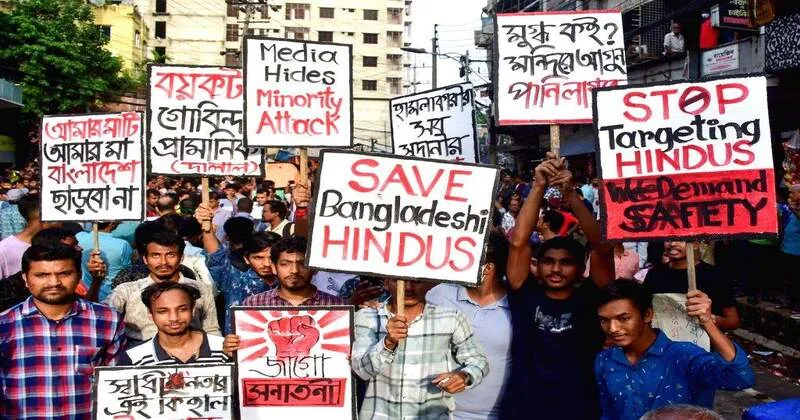
Protest in Bangladesh

Protest in Bangladesh

FacebookTwitterWhatsAppTelegramEmail

The Ministry of External Affairs has strongly condemned the attacks on Hindus in Bangladesh and the arbitrary arrest of Chinmoy Krishna Das, who is the spokesperson of the Bangladesh Sammilit Sanatan Jagran Note.

Even as the condemnation grows from various quarters in Bharat, three Hindu Mandirs were targeted in Chattogram. The Mandirs targeted are the Loknath Mandir in Firangi Bazaar, Mansa Mata Mandir and Kali Mandir in Hazari Lane.

Atrocities against the minorities in Bangladesh, particularly the Hindus, have been a regular affair. While it has existed for long, the ouster of Sheikh Hasina has only made it worse.

In Bangladesh, 91 per cent of the population is Muslim, while 8.95 per cent belong to the other faiths-Hindus, Buddhists, Ahmadiyas and Christians. For many years, not only have these communities faced persecution, but they have been denied basic justice despite there being some laws and measures in place. The fact of the matter is that there are safeguards in the laws in Bangladesh for the minorities, but they are very often or never implemented.

Technically, a secular nation

The Constitution of Bangladesh and other laws say that all religions must be protected and religious freedom should be upheld. It is the duty of the government to enforce these protections, the Constitution also states. It also states that all people should have the right to profess, practise or propagate all religions subject to law, public order and morality.

The Constitution establishes Islam as the state religion; however, in 2010, a Supreme Court decision reversed a 1975 amendment and stated that secularism is the Constitutional principle.

Going by this, the government is duty-bound to protect minorities. However, attacks against minorities continued and witnessed a rise between 2009 and 2017. This is largely because the religious minorities are at the bottom of the hierarchy and the lack of proper political representation makes matters worse for them.

The draconian Vested Property Act

It has been documented that Hindu Mandirs and places of worship of other minorities have been repeatedly attacked by the Muslim mob. The problem, however, is that there is very little or no legal recourse available for the minorities whose places of worship are attacked.

The Vested Property Act of 1974 has been criticised. It has also been described as the longest-running and most damaging among all the laws that are weaponised against the Hindus and other minorities.

In the year 1965, the Enemy Property Act was enacted following the India-Pakistan war. It authorised the Bangladesh government to confiscate the properties of those who had migrated from Pakistan to India. The ones who migrated the most were the Hindus from what was then known as East Pakistan, now known as Bangladesh. In 1974, the Vested Property Act was enacted, which allowed enemy property to vest in the Bangladesh government.

This is the most misused law and has very often been used to grab large portions of land owned by the minority community. Most of the cases relating to property seizures involve thugs affiliated with politicians or land sharks.

When the aggrieved seeks legal recourse, those who have grabbed the land show it as vested property. With the backing of the establishment, these thugs always get away, and the property remains with them. If the matter is taken to the court, it takes decades to decide. By the time the case is decided, the aggrieved party is penniless and eventually ends up letting go of that property as he or she is unable to manage it.

It is about land and supremacy

The Centre for Alternatives and Bangladesh Peace Observatory, in a report published this year, said that as much as 70 per cent of the violence against religious minorities in the country is about land. The violence is carried out through destructive actions on the minority’s properties or their places of worship.

Data would show that as much as 59 per cent of the incidents of violence were committed through the destruction of properties owned by minorities and their places of worship. Eleven percent of them were involved in direct disputes over land. In around 27 per cent of the cases, there are incidents of physical assault or murder. Two per cent is related to gender-based violence, while one per cent is election-centric.

Most of the violence stems from disinformation on social media. In 2016, there were attacks on the houses and Mandirs or Hindus in the Nasirnagar area following a social media post. While the violence was attributed to a post by a man called Rasraj, investigations later found that there was no such person who existed. This means that a false campaign was run, and it was intentional in nature. Similar disinformation campaigns led to the burning down of a Buddhist Temple in Ramu and violence in Cumilla during the Durga Puja celebrations.

The other issue is that the law never gets to these persons, and 99 out of 100 times, the criminal gets away scot free, and this has increased the insecurity among the Hindus and other minority communities.

The role of Benazir Ahmed

To understand how institutional these gory acts against the Hindus are, one must visit the case of the former national police chief of Bangladesh, Benazir Ahmed. He had served in various capacities and retired in 2022. He has also received several state accolades, such as an integrity award.

However, his crimes were exposed following an investigative report by the national daily Kaler Kantho, which accused him of massive corruption and abuse of power. The report said that Ahmed had acquired over 50 acres of land in various parts of the country and billions of taka in at least bank accounts.

It also said that since 2017, he grabbed over 81 hectares of land from Hindus by coercion in the Sahapur Union. He then went on to set up the Savanna Eco Resort and Natural Park on the same land. He is also accused of grabbing land from Hindus and Christians in Gazipur district near Dhaka.

Also Read: Amidst violence against Hindus in Bangladesh, a larger agenda to separate West Bengal from Bharat surfaces

He is accused of forcibly acquiring land from Christians in the Nagari area in the Gazipur district. Several families were forced to sell their lands to him when he was the police chief. All these aggrieved persons later said that none of them had sold their land voluntarily.

With him being placed under sanctions by the United States for human rights violations, Ahmed left the country on May 4 this year. Despite him being out of the country, the Hindus have complained of harassment by the police and his cohorts.

While the atrocities were always being committed, there has been a steep rise since Sheikh Hasina was forced out of power. In the wake of any strong voice and the international community falling silent, the hopes for the Hindus and other minority communities are only fading with each passing day.

Topics: Attacks on Hindus in BangladeshVested Property ActChinmoy Krishna DasBangladesh
Share9TweetSendShareSend
✮ Subscribe Organiser YouTube Channel. ✮
✮ Join Organiser's WhatsApp channel for Nationalist views beyond the news. ✮
Previous News

Former Attorney General Rohatgi says no bribery charges against Gautam Adani, nephew in US indictment

Next News

Ayodhya Ram Mandir’s first Prana-Pratishtha anniversary to be celebrated on ‘Pratishtha Dwadashi’ – Here’s why

Related News

Haridas Chandra Tarani Das, the organiser of the proposed 81-foot bhagwan Ram murti was arrested in Bangladesh

Bangladesh: Haridas Chandra Tarani Das arrested over 81-foot Ram Murti Row; Hindu rights group slams selective justice

Different shades of diplomacy and foreign policy

The previous and present appearance of the Bangladesh Army Chief spikes speculations about the radicalisation of the army and increasing affiliation to Pakistan

Growing radicalisation of Bangladesh Army

Amid ongoing attack against Hindus and their faith, massive torchlight procession was held in protest by Hindus against the insult to Bhagwan Ram, in Dhaka

Bangladesh: Unprecedented assertion for dignity and security

Former Prime Minister of Bangladesh Sheikh Hasina

Bangladesh: Sheikh Hasina vows return despite death sentence; Aims for restoration of democracy & rule of law in Dhaka

Yoga Day celebrations in Shanghai, China

International Yoga Day: Global celebrations echo the message of health, well-being and timeless ancient Indian wisdom

Load More

Latest News

IB Officer Ankit Sharma

Delhi Riots 2020: Who was IB officer Ankit Sharma? The officer dragged, lynched and dumped in drain by Islamists

Rupee-Rupiah trade, digital payments and strategic cooperation mark a new chapter in the India-Indonesia economic partnership.

India, Indonesia advance de-dollarisation with Rupee-Rupiah local currency settlement framework

BMS hosts 15th BRICS Trade Union Forum (TUF) Summit 2026 in Hyderabad; Calls for worker-centric global order

A car fire inside the Airport Tunnel on the Gurugram–Dwarka Expressway showcased how smart safety systems can save lives

Airport Tunnel Fire: How smart safety systems on the Gurugram–Dwarka Expressway averted a major disaster

India's petroleum exports are set to surge 25 per cent, strengthening its position as a global energy export powerhouse

India’s Energy Revolution: How a 25% surge in petroleum exports is transforming India into a global export leader

Shri Nandkishore Goenka ji

Renowned social worker Nandkishore Goenka passes away; RSS pays tribute to his lifelong commitment to Goseva

The organisers of the 'Melbourne Meets Modi' community have issued a strongly worded open letter to Rahul Gandhi

Don’t insult Indian-Australians: Melbourne Meets Modi organisers demand apology from Rahul Gandhi over paid crowd claim

Tiruvananthapuram Mayor Adv. V.V. Rajesh administers oath to BJP councillor R. Sugatan at Viyyoor Central jail, Thrissur

Keralam: Tiruvananthapuram BJP Councillor R Sugatan retakes oath in Viyyoor Central Jail after Kerala HC intervention

Bhojshala Case: Supreme Court Declines Muslim Plea, No Namaz Allowed on Premises

Bhojshala: SC refuses to stay Madhya Pradesh HC order; No namaz allowed within premises, Bars structural changes by ASI

Tamil Nadu: Supreme Court stays Madras HC order directing state govt to ensure no cow slaughter

Load More
  • Privacy
  • Terms
  • Cookie Policy
  • Refund and Cancellation
  • Delivery and Shipping

© Bharat Prakashan (Delhi) Limited.
Tech-enabled by Ananthapuri Technologies

  • Home
  • Search Organiser
  • Bharat
    • Assam
    • Bihar
    • Chhattisgarh
    • Jharkhand
    • Maharashtra
    • View All States
  • World
    • Asia
    • Africa
    • North America
    • South America
    • Europe
    • Australia
  • Editorial
  • Operation Sindoor
  • Opinion
  • Analysis
  • Defence
  • Culture
  • Sports
  • Business
  • RSS @ 100
  • Entertainment
  • More ..
    • Sci & Tech
    • Vocal4Local
    • Special Report
    • Education
    • Employment
    • Books
    • Interviews
    • Travel
    • Health
    • Politics
    • Law
    • Economy
    • Obituary
  • Subscribe Magazine
  • Read Ecopy
  • Advertise
  • Circulation
  • Careers
  • About Us
  • Contact Us
  • Policies & Terms
    • Privacy Policy
    • Cookie Policy
    • Refund and Cancellation
    • Terms of Use

© Bharat Prakashan (Delhi) Limited.
Tech-enabled by Ananthapuri Technologies