Celebrating 75 Years of the Indian Constitution: A testament to unity in diversity
June 7, 2026
  • Read Ecopy
  • Circulation
  • Advertise
  • Careers
  • About Us
  • Contact Us
Android AppiPhone AppArattai
Organiser
  • ‌
  • Bharat
    • Assam
    • Bihar
    • Chhattisgarh
    • Jharkhand
    • Maharashtra
    • View All States
  • World
    • Asia
    • Europe
    • North America
    • South America
    • Africa
    • Australia
  • Editorial
  • International
  • Opinion
  • RSS @ 100
  • More
    • Op Sindoor
    • Analysis
    • Sports
    • Defence
    • Politics
    • Business
    • Economy
    • Culture
    • Special Report
    • Sci & Tech
    • Entertainment
    • G20
    • Azadi Ka Amrit Mahotsav
    • Vocal4Local
    • Web Stories
    • Education
    • Employment
    • Books
    • Interviews
    • Travel
    • Law
    • Health
    • Obituary
  • Subscribe
    • Subscribe Print Edition
    • Subscribe Ecopy
    • Read Ecopy
  • ‌
  • Bharat
    • Assam
    • Bihar
    • Chhattisgarh
    • Jharkhand
    • Maharashtra
    • View All States
  • World
    • Asia
    • Europe
    • North America
    • South America
    • Africa
    • Australia
  • Editorial
  • International
  • Opinion
  • RSS @ 100
  • More
    • Op Sindoor
    • Analysis
    • Sports
    • Defence
    • Politics
    • Business
    • Economy
    • Culture
    • Special Report
    • Sci & Tech
    • Entertainment
    • G20
    • Azadi Ka Amrit Mahotsav
    • Vocal4Local
    • Web Stories
    • Education
    • Employment
    • Books
    • Interviews
    • Travel
    • Law
    • Health
    • Obituary
  • Subscribe
    • Subscribe Print Edition
    • Subscribe Ecopy
    • Read Ecopy
Organiser
  • Home
  • Bharat
  • World
  • Operation Sindoor
  • Editorial
  • Analysis
  • Opinion
  • Culture
  • Defence
  • International Edition
  • RSS @ 100
  • Magazine
  • Read Ecopy
Home Politics

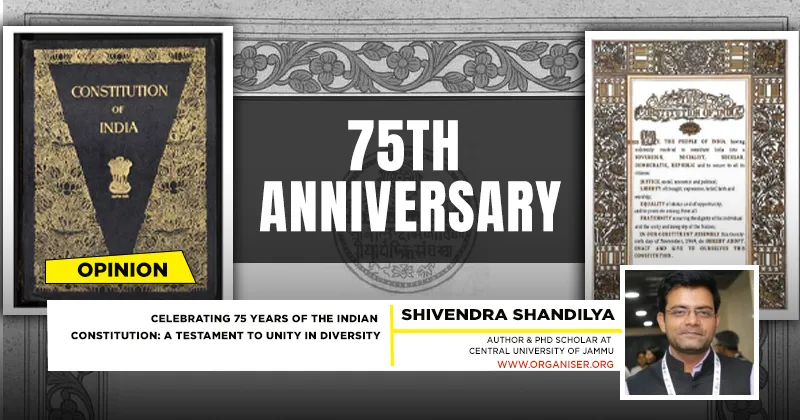
Celebrating 75 Years of the Indian Constitution: A testament to unity in diversity

As India celebrates 75 years of its Constitution, it stands as a powerful testament to the country's strength in embracing unity in diversity. Since its adoption in 1950, the Indian Constitution has been the cornerstone of India’s democracy, uniting a nation rich in diverse cultures, languages, and religions

Shivendra ShandilyaShivendra Shandilya
Nov 26, 2024, 05:30 pm IST
in Politics, Bharat
Follow on Google News
FacebookTwitterWhatsAppTelegramEmail

The Constitution of India is the supreme law of the land. It is a comprehensive written document that outlines the framework for the country’s fundamental principles, government structure, procedures, powers, responsibilities, and the rights and duties of its citizens. Adopted by the Constituent Assembly on November 26, 1949, and effective from January 26, 1950, it originally consisted of 395 Articles and 8 Schedules, making it the longest national constitution in the world, with approximately 145,000 words. Drafting this historic document required extensive deliberation by the Constituent Assembly, which convened for 11 sessions over 167 days, spanning 2 years and 11 months.

Fundamental Rights and Their Role

The Constitution guarantees every individual certain fundamental rights essential for ensuring a good quality of life and fostering equality in a democracy. These rights, enshrined in Articles 14 to 32, are pivotal for the development and security of all citizens, including minorities. Fundamental rights are justiciable, meaning citizens can approach the courts to enforce them. While they may be restricted for the public good, they serve as vital checks on government power and ensure freedoms such as speech and expression.

The six fundamental rights are:

1. Right to Equality

2. Right to Freedom

3. Right against Exploitation

4. Right to Freedom of Religion

5. Cultural and Educational Rights

6. Right to Constitutional Remedies

The Right to Education, introduced under Article 21(A) by the 86th Amendment Act, exemplifies the Constitution’s adaptability to evolving societal needs.

Directive Principles of State Policy

The Directive Principles of State Policy (Part IV) reflect the Constitution’s aim to achieve socio-economic justice and establish a welfare state. Although these principles are non-justiciable, they are fundamental to governance, drawing inspiration from the Irish Constitution. They promote equitable resource distribution and economic justice, addressing issues like livelihood, education, health, and fair pay, thereby underscoring the values of justice, equality, and fraternity.

 Inclusivity in Diversity

The Constitution accommodates India’s immense diversity by safeguarding cultural, linguistic, and religious rights. Article 29 protects the right to preserve one’s culture, language, or script, while the Eighth Schedule recognizes 22 official languages, allowing states to legislate their regional languages under Article 345.

Articles 25-28 guarantee religious freedom and uphold secularism, ensuring equal treatment of all religions. Local governance mechanisms like the Panchayati Raj system and autonomous councils in the Northeast promote grassroots decision-making and respect for indigenous practices. The Fifth and Sixth Schedules provide self-governance structures for tribal areas, ensuring inclusivity and representation.

Federal Structure and Cooperative Federalism

India’s federal structure distributes powers between the central and state governments, respecting local identities while maintaining national unity. States enjoy legislative autonomy on region-specific issues, addressing local needs without undermining the nation’s integrity. The emphasis on cooperative federalism ensures stability and cohesion in India’s diverse socio-political landscape.

Landmark Judgments and Legislative Achievements

Over the last 75 years, the Constitution has guided India’s governance and societal progress. Key Supreme Court judgments have safeguarded constitutional principles:

  • The Kesavananda Bharati case (1973) established the Basic Structure Doctrine, protecting the Constitution’s core values from amendment
  • The Maneka Gandhi case (1978) broadened the scope of the right to life and personal liberty, ensuring just and fair laws
  • The Vishaka case (1997) introduced guidelines to prevent workplace sexual harassment, advancing women’s rights.

Effective legislation has also bolstered constitutional ideals. The universal adult franchise ensures broad political participation, while reservation policies address historical injustices by empowering marginalised communities. Initiatives like women’s reservation in legislative bodies highlight India’s commitment to gender equality.

A Living Document for a Just Future

The Indian Constitution remains a living document, evolving to address contemporary challenges. Its principles of justice, liberty, equality, and fraternity continue to inspire citizens to strive for a fair and inclusive society. As India celebrates 75 years of its Constitution, citizens must engage actively with its values by:

  • Educating themselves and others about constitutional principles
  • Participating in democratic processes like voting
  • Advocating for equality and inclusivity.

The journey of the Indian Constitution has been marked by notable achievements and challenges. Upholding its ideals is a shared responsibility, essential for steering India towards a more just, equitable, and prosperous future.


Topics: Constitution DaySamvidhan Divas75 Years of the Indian Constitution
Share1TweetSendShareSend
✮ Subscribe Organiser YouTube Channel. ✮
✮ Join Organiser's WhatsApp channel for Nationalist views beyond the news. ✮
Previous News

Uttar Pradesh: Teacher Muhammad Shahid arrested for molesting minor Hindu girl, offers Rs 1 lakh to convert

Next News

Pakistan: Shoot-at-sight orders issued against PTI protestors demanding Imran Khan’s release; Army takes over

Related News

Bronze bust of Dr Bhimrao Ramji Ambedkar at the UNESCO Headquarters in Paris

India elevates Dr Ambedkar to global stage: Bronze bust unveiled at UNESCO Garden of Peace in Paris

We, the people @ Samvidhan Divas 2025: Civilisational values and Civic duties in Constitutional democracy

Samvidhan Diwas: The spirit of constitution was rooted in Bharatiya ideals

Constitution Day: Islamism, Maoism and Dynastism Threats to Constitutional Democracy

J&K to celebrate constitution day on November 26

Constitution Day to be celebrated in J&K; Govt directs all institutions to do preamble reading on Nov 26

Uttar Pradesh CM Yogi Adityanath

Opposition parties trying to break society into caste under divide and rule policy: UP CM Yogi Adityanath

Load More

Latest News

She showed the "Made in Pakistan" label attached to the bedsheet

Made in Pakistan bedsheet sold at Pune religious fair? Viral video triggers investigation

India's first Prime Minister Jawahar Lal Nehru and India's current Prime Minister Narendra Modi

From ‘Ship to Mouth’ under Nehru to free rations for 80 crore under Modi: Inside India’s food security revolution

Picture from the site of protest

22 million followers, a few hundred on ground: Cockroach Janta Party faces its first reality check at Jantar Mantar

Uttar Pradesh CM Yogi Adityanath

From lawlessness to good governance: How Uttar Pradesh rewrote its law and order story under Yogi Adityanath

Govt mulls Budget press printing for NEET- UG RE-exam question papers (This is an AI generated image)

NEET-UG Re-Exam Security Overhaul: Government mulls budget press printing, IAF transportation to prevent paper leaks

Rahul, Kharge and Jairam vs. India's Great Nicobar Vision (This is an AI generated image)

Great Nicobar Project: Why Congress is opposing Modi government’s strategic mega plan

Union Home Minister Amit Shah and Delhi Police derail sinister plan of Cockroach Janata Party and its founder (This image is generated by AI)

CJP Protest Derailed: How Amit Shah, Delhi Police, Intelligence foiled sinister plan of Cockroach Janata Party

(Left) Victorious Indian Men-s hockey team who who won Gold in U-18 Asia Cup (Right) U-18 Women's hockey team who won bronze medal in the Asia Cup

U18 Asia Cup 2026: Indian Men’s hockey wins gold, women secure bronze medal; PM Modi & Amit Shah hail the teams

India’s semiconductor roadmap shifts from import dependence to silicon sovereignty, aiming for a self-reliant ecosystem by Viksit Bharat 2047

From Import Dependence to Silicon Sovereignty: India’s bold semiconductor roadmap for Viksit Bharat 2047

Keralam Chief Minister V.D. Satheeshan

Jamaat-e-Islami Hind Team Meets CM Satheeshan, Senior Ministers, fuel debate over influence in UDF government

Load More
  • Privacy
  • Terms
  • Cookie Policy
  • Refund and Cancellation
  • Delivery and Shipping

© Bharat Prakashan (Delhi) Limited.
Tech-enabled by Ananthapuri Technologies

  • Home
  • Search Organiser
  • Bharat
    • Assam
    • Bihar
    • Chhattisgarh
    • Jharkhand
    • Maharashtra
    • View All States
  • World
    • Asia
    • Africa
    • North America
    • South America
    • Europe
    • Australia
  • Editorial
  • Operation Sindoor
  • Opinion
  • Analysis
  • Defence
  • Culture
  • Sports
  • Business
  • RSS @ 100
  • Entertainment
  • More ..
    • Sci & Tech
    • Vocal4Local
    • Special Report
    • Education
    • Employment
    • Books
    • Interviews
    • Travel
    • Health
    • Politics
    • Law
    • Economy
    • Obituary
  • Subscribe Magazine
  • Read Ecopy
  • Advertise
  • Circulation
  • Careers
  • About Us
  • Contact Us
  • Policies & Terms
    • Privacy Policy
    • Cookie Policy
    • Refund and Cancellation
    • Terms of Use

© Bharat Prakashan (Delhi) Limited.
Tech-enabled by Ananthapuri Technologies