Waqf can lead to the collapse of India’s banking and other financial institutions
June 16, 2026
  • Read Ecopy
  • Circulation
  • Advertise
  • Careers
  • About Us
  • Contact Us
Android AppiPhone AppArattai
Organiser
  • ‌
  • Bharat
    • Assam
    • Bihar
    • Chhattisgarh
    • Jharkhand
    • Maharashtra
    • View All States
  • World
    • Asia
    • Europe
    • North America
    • South America
    • Africa
    • Australia
  • Editorial
  • International
  • Opinion
  • RSS @ 100
  • More
    • Op Sindoor
    • Analysis
    • Sports
    • Defence
    • Politics
    • Business
    • Economy
    • Culture
    • Special Report
    • Sci & Tech
    • Entertainment
    • G20
    • Azadi Ka Amrit Mahotsav
    • Vocal4Local
    • Web Stories
    • Education
    • Employment
    • Books
    • Interviews
    • Travel
    • Law
    • Health
    • Obituary
  • Subscribe
    • Subscribe Print Edition
    • Subscribe Ecopy
    • Read Ecopy
  • ‌
  • Bharat
    • Assam
    • Bihar
    • Chhattisgarh
    • Jharkhand
    • Maharashtra
    • View All States
  • World
    • Asia
    • Europe
    • North America
    • South America
    • Africa
    • Australia
  • Editorial
  • International
  • Opinion
  • RSS @ 100
  • More
    • Op Sindoor
    • Analysis
    • Sports
    • Defence
    • Politics
    • Business
    • Economy
    • Culture
    • Special Report
    • Sci & Tech
    • Entertainment
    • G20
    • Azadi Ka Amrit Mahotsav
    • Vocal4Local
    • Web Stories
    • Education
    • Employment
    • Books
    • Interviews
    • Travel
    • Law
    • Health
    • Obituary
  • Subscribe
    • Subscribe Print Edition
    • Subscribe Ecopy
    • Read Ecopy
Organiser
  • Home
  • Bharat
  • World
  • Operation Sindoor
  • Editorial
  • Analysis
  • Opinion
  • Culture
  • Defence
  • International Edition
  • RSS @ 100
  • Magazine
  • Read Ecopy
Home Bharat

Waqf can lead to the collapse of India’s banking and other financial institutions

The Waqf Act of 1954 has raised concerns over its impact on property rights and the financial sector, with the Waqf boards claiming ownership of properties, including land and assets, leading to difficulties for property owners and financial institutions

Jayakrishnan KJayakrishnan K
Nov 24, 2024, 01:00 pm IST
in Bharat, Special Report
Follow on Google News
FacebookTwitterWhatsAppTelegramEmail

India is still a savings economy where people invest in land, buildings, gold, bonds, shares, etc. so that they can sell or mortgage these assets in the event of an emergency. But recent revelations about the robbery by the waqf boards hold out unforeseen threats to such investors.  Not just investors; in fact, the entire financial sector has enough reasons to worry.

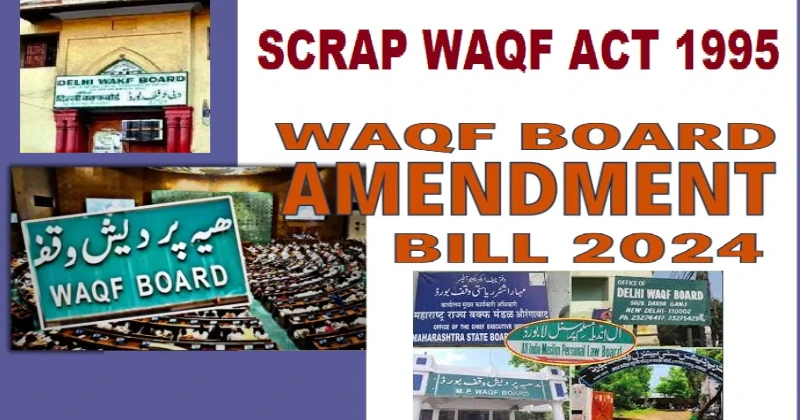
The problem has its genesis in the Waqf Act of 1954, a creature of the Jawaharlal Nehru-led Congress government. The law was amended in 1995 and the waqf boards were made even stronger in 2013 by subsequent Congress-led governments. Now there is a situation where a man trying to sell or mortgage the property he owns with proper documentation in order to marry off his daughter, to raise funds for his children’s education, or to meet medical expenses is unable to do so.

The immensity of the problem grabbed national attention last year when residents of seven villages in Tamil Nadu found out that the waqf board claimed ownership of their landed property including a 1500 year old temple. Right now 600-odd families of the Munambam area in Kerala’s Ernakulam district are fighting a battle for survival after the waqf board issued them notice to vacate the premises they legally own. Similar cases are being reported from other States too, for instance Karnataka.

A body formed by the government to fulfil one aspect of a particular religion is now taking over any property it fancies using the enormous power given to it. Even the judiciary can only remain a mute spectator because the Waqf Act bars it from hearing cases of waqf-related claims. Section 85 of the Act says: ‘‘No suit or other legal proceeding shall lie in any civil court, revenue court and any other authority in respect of any dispute, question or other matter relating to any waqf, waqf property or other matter which is required by or under this Act to be determined by a Tribunal.’’ This blatantly violates the fundamental rights guarantee by the Indian Constitution; it is also in violation of Article 32 – right to approach a court seeking protection of one’s fundamental rights. This, when a citizen can approach even the Supreme court when one’s fundamental rights are violated even by the state. Is the waqf board above the state to enjoy such immunity? It is surprising that the Supreme Court did not strike down certain powers given to the waqf board under the Waqf Act.

The waqf boards’ potential to derail the financial sector, including the banking system and the share market, is not discussed widely. Imagine a person pledging his property for a bank loan.  The bank, after following due procedures, grants the loan. The debtor does not repay the money. The bank, after following due process of law, initiates recovery proceedings.

Then comes the real problem. The waqf board enters the scene with a claim that the property pledged is waqf property and that as per Section 40 of the Waqf Act only the waqf board is empowered to decide whether the property in question is waqf property or not. And going to court is not an option before the bank. As per Section 85 of the Waqf Act, the waqf tribunal shall decide the case.

The bank then approaches the man who took the loan. He points out that the property is indeed in his name and the bank’s legal team had examined the documents he submitted. He also claims that he is not in a position to repay the loan and asks the bank to take over the property. When the bank says the waqf board has raised a claim over the property, the debtor washes his hands of the matter saying that the issue is now between the bank and the waqf board.

The hapless bank is now forced to stand before the waqf board pleading for mercy.

This will soon become a reality where banks will fight losing battles with waqf boards, particularly when the loan-seeker is a Muslim. (Non-Muslims are less likely to donate their assets as waqf.) What will the banks do in order to recover such losses and sustain their operations?  Increase their service charges drastically. The customers pay for someone else’s crime.

Similar cases could soon be reported from the share market as shares too held by Muslims could be dedicated as waqf. When a company’s shares are dedicated as waqf, its assets cannot be taken over by banks in case of default; liquidation of assets is not possible as the waqf board will raise an objection; and the shares of a company cannot be traded freely in the stock market because there is no knowing whether the seller has already dedicated the shares as waqf.

How not to fall prey to the cunning of the waqf boards 

In a situation where there is no uniform civil code and there are laws like the Waqf Act, one can expect trouble from several quarters when least expected. Precautions are essential to avoid falling into traps set by the waqf boards until the Waqf Act is amended again or abolished. While entering into any deal involving the property of a Muslim, one must insist that the owner of the property get a certificate from the waqf board concerned citing that the waqf board does not have any claim of whatsoever nature over the said property. The same shall be provided in writing and as email by the waqf board. The document shall have a validity period, like 24 hours from the time of issue mentioned in it, in order to avert further claims from the waqf board at a later stage.

The aggressive use of the Waqf Act is undoubtedly part of an agenda to make India an Islamic state. It is the duty of all secular-minded citizens to resist it unitedly. Such unity may not look “politically correct”, but it is the need of the hour.


Topics: Waqf ActCongress Governmentnon muslimsWaqf Act of 1954
Jayakrishnan K
Jayakrishnan K
Jayakrishnan K is an advocate by profession. [Read more]
ShareTweetSendShareSend
✮ Subscribe Organiser YouTube Channel. ✮
✮ Join Organiser's WhatsApp channel for Nationalist views beyond the news. ✮
Previous News

Islamists pelt stones on the survey team at Shahi Jama Masjid in UP’s Sambhal; police use tear gas to control situation

Next News

Lachit Divas 2024: A tribute to the great warrior of the East who was never celebrated by Indian historians

Related News

Karnataka | Rs.108 Crore Government Land Scam: Criminal action approved against 15 officials after five-month delay

‘Every grave or dargah is not automatically Waqf property’: Madras High Court’s landmark verdict

PWD Minister of Karnataka Satish Jarkiholi

Karnataka: Engineer accused in Lokayukta raid promoted within 2.5 months; Citizens criticise the decision of the govt

Karnataka cabinet’s decision to withdraw 52 criminal cases, including protest and Dargah-linked cases, has drawn BJP criticism

Karnataka: Row erupts as govt drops criminal cases against Congress leaders; BJP calls move opaque and selective

Hijab controversy returns to Karnataka politics; Hindu outfits warn of fresh protests in coastal districts

Karnataka BJP president B. Y. Vijayendra

Karnataka: “Tumakuru event is not an achievement convention but funeral ceremony of a failed govt,” says BY Vijayendra

Load More

Latest News

Uttar Pradesh: Digital democracy dialogue ‘Triveni’ concludes; Focused on inclusive growth & cultural discourses

RSS Pune organises workshop on “Preparing for the AI Era”; Experts stress on AI literacy and Atmanirbharata in AI

Assam Governor Lakshman Prasad Acharya leads sacred Buddha relics mission to Mongolia

India- Mongolia Relations: Celebrating the spiritual neighbourhood

The AN-32: Service, sacrifice and the search for a successor

The Baya River of Bihar: How Jan Andolan brought the dying stream back to life

Oplus_16908288

Love Jihad in Assam: Illias Ahmed trapped Noida Hindu girl with fake identity; Held in Guwahati, victim untraceable

UK bans social media for under-16s: Tightens online vigilance to insulate children from digital risks

Maoist Arms Dump Recovered in Malkangiri

Odisha: Another major Maoist arms dump recovered in Malkangiri; Four hidden caches unearthed in last eight days

RSS Sarsanghchalak Dr. Mohan Bhagwat

Consumer centric ‘US model of growth is unsustainable’; Six earths will be needed: RSS Sarsanghchalak Dr Mohan Bhagwat

Addressing the Samapan Samahroh of 15-day Sangh Shiksha Varg, RSS Akhil Bharatiya Sah Prachar Pramukh Pradeep Joshi

Dehradun | Anti-national forces & foreign conspiracies seeking to weaken Bharat: Pradeep Joshi askes people to be alert

Load More
  • Privacy
  • Terms
  • Cookie Policy
  • Refund and Cancellation
  • Delivery and Shipping

© Bharat Prakashan (Delhi) Limited.
Tech-enabled by Ananthapuri Technologies

  • Home
  • Search Organiser
  • Bharat
    • Assam
    • Bihar
    • Chhattisgarh
    • Jharkhand
    • Maharashtra
    • View All States
  • World
    • Asia
    • Africa
    • North America
    • South America
    • Europe
    • Australia
  • Editorial
  • Operation Sindoor
  • Opinion
  • Analysis
  • Defence
  • Culture
  • Sports
  • Business
  • RSS @ 100
  • Entertainment
  • More ..
    • Sci & Tech
    • Vocal4Local
    • Special Report
    • Education
    • Employment
    • Books
    • Interviews
    • Travel
    • Health
    • Politics
    • Law
    • Economy
    • Obituary
  • Subscribe Magazine
  • Read Ecopy
  • Advertise
  • Circulation
  • Careers
  • About Us
  • Contact Us
  • Policies & Terms
    • Privacy Policy
    • Cookie Policy
    • Refund and Cancellation
    • Terms of Use

© Bharat Prakashan (Delhi) Limited.
Tech-enabled by Ananthapuri Technologies