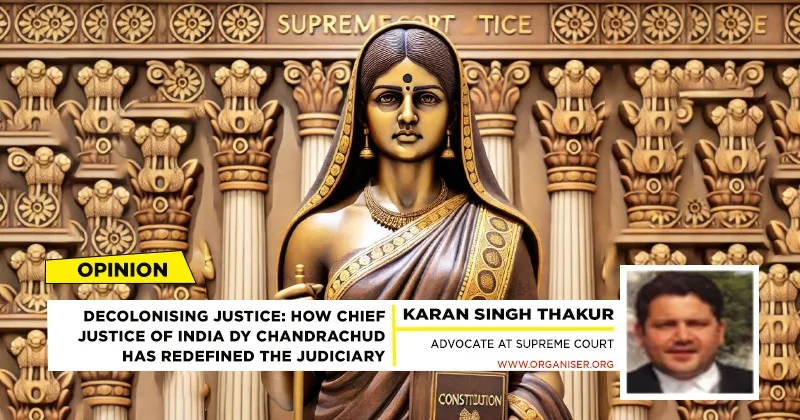
Decolonising Justice: How Chief Justice of India DY Chandrachud has redefined the judiciary
September 13, 2026
  • Read Ecopy
  • Circulation
  • Advertise
  • Careers
  • About Us
  • Contact Us
Android AppiPhone AppArattai
Organiser
  • ‌
  • Bharat
    • Assam
    • Bihar
    • Chhattisgarh
    • Jharkhand
    • Maharashtra
    • View All States
  • World
    • Asia
    • Europe
    • North America
    • South America
    • Africa
    • Australia
  • Editorial
  • International
  • Opinion
  • RSS @ 100
  • More
    • World Hindu Congress 2026
    • Op Sindoor
    • Analysis
    • Sports
    • Defence
    • Politics
    • Business
    • Economy
    • Culture
    • Special Report
    • Sci & Tech
    • Entertainment
    • G20
    • Azadi Ka Amrit Mahotsav
    • Vocal4Local
    • Web Stories
    • Education
    • Employment
    • Books
    • Interviews
    • Travel
    • Law
    • Health
    • Obituary
  • Subscribe
    • Subscribe Print Edition
    • Subscribe Ecopy
    • Read Ecopy
  • ‌
  • Bharat
    • Assam
    • Bihar
    • Chhattisgarh
    • Jharkhand
    • Maharashtra
    • View All States
  • World
    • Asia
    • Europe
    • North America
    • South America
    • Africa
    • Australia
  • Editorial
  • International
  • Opinion
  • RSS @ 100
  • More
    • World Hindu Congress 2026
    • Op Sindoor
    • Analysis
    • Sports
    • Defence
    • Politics
    • Business
    • Economy
    • Culture
    • Special Report
    • Sci & Tech
    • Entertainment
    • G20
    • Azadi Ka Amrit Mahotsav
    • Vocal4Local
    • Web Stories
    • Education
    • Employment
    • Books
    • Interviews
    • Travel
    • Law
    • Health
    • Obituary
  • Subscribe
    • Subscribe Print Edition
    • Subscribe Ecopy
    • Read Ecopy
Organiser
  • Home
  • Bharat
  • World
  • Operation Sindoor
  • Editorial
  • Analysis
  • Opinion
  • Culture
  • Defence
  • International Edition
  • RSS @ 100
  • Magazine
  • Read Ecopy
Home Bharat

Decolonising Justice: How Chief Justice of India DY Chandrachud has redefined the judiciary

India’s judiciary has evolved under Chief Justice DY Chandrachud as it embraced cultural identity and modern values to make justice more relatable and accessible

Adv Karan ThakurAdv Karan Thakur
Nov 8, 2024, 09:00 pm IST
inBharat, Opinion, Law
Follow on Google News
Facebook
Twitter
WhatsAppTelegramEmail

The recent unveiling of the new statue of Lady Justice at the Supreme Court marks a significant milestone in the journey towards the decolonization of the Indian judiciary, led by Chief Justice DY Chandrachud. This initiative not only represents a symbolic departure from colonial legacies but also aims to reshape the judicial landscape of Bharat in a manner that resonates with contemporary Indian society.

Embracing Cultural Identity

One of the most striking changes is the replacement of the traditional Western robe with a saree, reflecting India’s rich cultural heritage. This shift symbolizes a broader commitment to integrating Indian traditions and values into the judicial system. By embracing cultural identity, the judiciary can become more relatable to the public, fostering trust and engagement. When citizens see their customs and heritage represented in the judiciary, they are more likely to feel that the legal system serves their interests and needs.

Strengthening Constitutional Supremacy

The new statue’s design features the Indian Constitution replacing the traditional sword, emphasizing the supremacy of constitutional law in the administration of justice. This move reinforces the idea that the judiciary exists to uphold democratic principles and protect individual rights rather than to serve as an instrument of colonial power. By prioritizing constitutional values, Chief Justice Chandrachud is advocating for a judicial system that not only respects the law but also aligns with the aspirations of a diverse and democratic society.

Advocating for Sensitivity and Awareness

The removal of Lady Justice’s blindfold conveys a crucial message: justice must be sensitive to the various contexts in which individuals find themselves. This principle encourages judges and legal practitioners to consider the socio-economic and cultural backgrounds of the parties involved in legal proceedings. Such sensitivity can lead to fairer, more empathetic judgments, ensuring that the outcomes reflect the complexities of individual cases. By fostering a more nuanced understanding of justice, the judiciary can address the needs of marginalized communities more effectively.

Modernising Legal Frameworks

Chief Justice Chandrachud’s vision includes moving away from colonial-era laws, such as the Indian Penal Code, towards more contemporary legal frameworks like the Bharatiya Nyaya Sanhita. This modernization is essential for ensuring that the legal system keeps pace with the rapidly evolving social landscape of India. By updating laws to address contemporary issues—such as digital rights, environmental justice, and gender equality—the judiciary can provide relevant and effective solutions to the pressing challenges faced by society.

Enhancing Judicial Accountability

Decolonisation under Chief Justice Chandrachud also emphasizes the importance of judicial accountability and transparency. By promoting a culture of responsibility within the judiciary, he aims to build public trust and confidence in legal institutions. This can be achieved through improved oversight mechanisms, public engagement initiatives, and educational programs that demystify the judicial process. A more accountable judiciary not only strengthens the rule of law but also empowers citizens to assert their rights.

Fostering Inclusivity and Representation

Another critical aspect of this decolonization effort is the commitment to inclusivity and representation within the legal profession. By encouraging diversity among judges and legal practitioners, the judiciary can ensure that a wide range of perspectives is considered in the administration of justice. This inclusivity will lead to a more equitable legal system that effectively represents the interests of all citizens, particularly those from marginalized backgrounds. A judiciary that reflects India’s demographic diversity will resonate more deeply with the public, enhancing its legitimacy and effectiveness.

Criticism from the Left Ecosystem

Despite Chief Justice DY Chandrachud’s efforts to reshape the judiciary to better align with India’s cultural identity and contemporary values, the left-wing ecosystem has expressed skepticism and criticism of these initiatives. Critics argue that these changes risk shifting focus away from established legal traditions, interpreting the decolonization effort as an attempt to redefine the judiciary in a manner that may compromise its objectivity. They contend that symbols such as the saree-clad Lady Justice and the removal of the blindfold could erode the principles of impartiality and equality, arguing that the emphasis on cultural representation may overshadow the judiciary’s commitment to universal justice standards. Furthermore, they suggest that decolonization could pave the way for selective legal reforms that prioritize cultural identity over universal principles of human rights, especially when conservative values might shape new interpretations. However, proponents of the Chief Justice’s vision see these changes as necessary steps to make the judiciary more accessible and relevant to Indian society, countering colonial residues with an institution that resonates with the public and is attuned to modern societal needs.

Chief Justice of India DY Chandrachud’s efforts to redefine the judiciary through the lens of decolonization have the potential to profoundly transform the Bharat judicial system. By embracing cultural identity, strengthening constitutional supremacy, advocating for sensitivity and awareness, modernizing legal frameworks, enhancing accountability, and fostering inclusivity, the judiciary can evolve into a more responsive, equitable, and representative institution. This transformation not only enhances public trust but also ensures that the legal system aligns with the values and aspirations of contemporary India. Through these initiatives, the judiciary can emerge as a beacon of hope and justice, reinforcing the commitment to a fair and just society for all its citizens.


 

Topics: Supreme CourtDY Chandrachud
Share8
Tweet
SendShareSend
✮ Subscribe Organiser YouTube Channel. ✮
✮ Join Organiser's WhatsApp channel for Nationalist views beyond the news. ✮
Previous News

Mizoram: Security forces foil seize huge cache of explosives, plot to smuggle them arms to Myanmar insurgents foiled 

Next News

Karnataka: State government fails to distribute eggs to students despite the donor giving them money to purchase 

Related News

Registrar of Copyrights in India has rejected an application of computer scientist to make AI as an Author

DABUS loses copyright battle in India: Human author must be named; The tradition of Apūrvatā to Maulikatā

1993 Blasts Case: SC Rejects Abu Salem’s Release Plea

From 1993 Mumbai blasts to Portugal extradition: SC rejects Abu Salem’s bid for early release

Two Supreme Court cases have put India’s constitutional safeguards for tribal land, representation and self-governance under renewed scrutiny

Demography as a Weapon: The Supreme Court’s twin test on tribal protections

SC Backs Eviction from Tamil Nadu Temple Land

SC backs eviction from Tamil Nadu Temple land: Muslim occupants cannot claim rights through illegal sale

Jaipur Terror Case: Supreme Court Refuses to Release Sarwar Azmi

Jaipur Terror Case: Supreme Court refuses to release Sarwar Azmi, cites national security

CJP’s agenda behind “school thik karo campaign” exposed; SC refuses PIL against curbs on filming inside govt schools

Load More

Latest News

Representative Image- Indian Railways

Cabinet approves three railway projects worth Rs 10,783 crore, to connect 4790 villages across five states

Vande Mataram: The eternal mantra of national consciousness

A representative image

Team Skill India set for biggest ever WorldSkills push, to compete in 11 new categories at WorldSkills Shanghai 2026

AI-generated representative image

Fragile Five to Fastest-Growing Major Economy – Incredible India’s Transformation in 12 Years

India joins 24 nations in global 6G push

India joins 24 nations in global 6G push, endorses call for secure and resilient networks

Ministry of Defence's ten-year defence diplomacy framework “RAKSHA”, at Kartavya Bhawan in New Delhi. (Source: AI generated Image)

RAKSHA: Ten years of Defence diplomacy turned a decade boosting export and global cooperation

(Left) Naga leader Dr. S. C. Jamir: (Right) RSS Sarsanghchalak Dr Mohan Bhagwat

Bridging Perspectives: Dr SC Jamir meets RSS’ Dr Bhagwat, highlights mutual respect, secularism, and Naga aspirations

Tiger Bright coffee from Koraput’s tribal farmers featured in BRICS Summit media kits in New Delhi

From Eastern Ghats to BRICS: Koraput Coffee puts Odisha’s tribal enterprise on global map

The RSS has spent a century building influence through organisation, social networks and ideological formation beyond the electoral arena

RSS at 100: How the Sangh built a century-long network of influence beyond Indian politics

India on a Platter: BRICS Dinner Menu Celebrates Regional Culinary Heritage

BRICS Dinner Menu: From Khandvi, mushroom kebabs to pulao global leaders get a taste of Bharat’s culinary heritage

Load More
  • Privacy
  • Terms
  • Cookie Policy
  • Refund and Cancellation
  • Delivery and Shipping

© Bharat Prakashan (Delhi) Limited.
Tech-enabled by Ananthapuri Technologies

  • Home
  • Search Organiser
  • Bharat
    • Assam
    • Bihar
    • Chhattisgarh
    • Jharkhand
    • Maharashtra
    • View All States
  • World
    • Asia
    • Africa
    • North America
    • South America
    • Europe
    • Australia
  • Editorial
  • Operation Sindoor
  • Opinion
  • Analysis
  • Defence
  • Culture
  • Sports
  • Business
  • RSS @ 100
  • Entertainment
  • More ..
    • Sci & Tech
    • Vocal4Local
    • Special Report
    • Education
    • Employment
    • Books
    • Interviews
    • Travel
    • Health
    • Politics
    • Law
    • Economy
    • Obituary
  • Subscribe Magazine
  • Read Ecopy
  • Advertise
  • Circulation
  • Careers
  • About Us
  • Contact Us
  • Policies & Terms
    • Privacy Policy
    • Cookie Policy
    • Refund and Cancellation
    • Terms of Use

© Bharat Prakashan (Delhi) Limited.
Tech-enabled by Ananthapuri Technologies