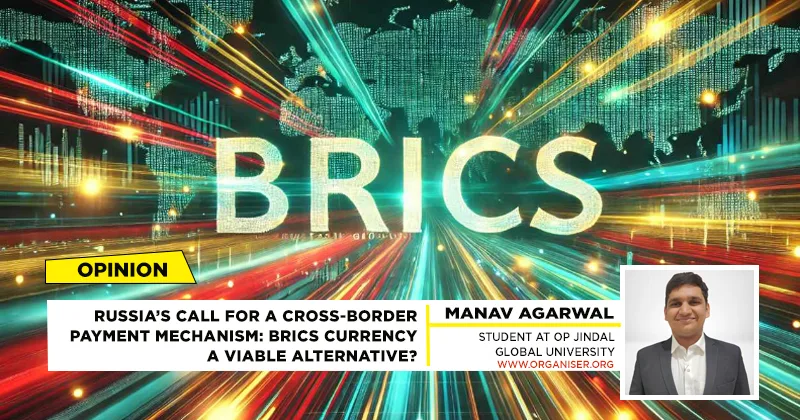
In December 2019, it was reported that the BRICS nations were moving towards the creation of a Unified Payment System. Russia has been pushing for the creation of such a system for cross-border payments settlement among the BRICS nations in their respective domestic currencies under the umbrella of a single BRICS currency. Moves towards this were furthered especially after the US blocked Russia from accessing its USD reserves and transacting in the West’s SWIFT mechanism for settling international transactions. The present BRICS summit in Kazan, to be held from October 22 to 24, will also include discussion in this regard. A report from the Russian Finance Ministry and the Bank of Russia lists out potential options for the same project ranging from a network of commercial banks in these countries with transactions in domestic currencies, establishing direct links between central banks, creating centres for mutual trade in commodities, and using distributed ledger technology (DLT) or a new multilateral platform for settlement with tokens.
Russia has been constantly pushing for the use of national currencies of member countries like India, Brazil, South Africa, and China along with the new entrants like Saudi Arabia, Iran, and Egypt. This was with an aim to strengthen the economic cooperation and increase the efficiency of trade settlement among these countries without relying on the US Dollar. This is especially important because the global average cost of sending $200 from one country to another is 6.25 per cent. However, this becomes much more expensive for the developing world. For instance, the cost of sending money in the form of remittances or financial assistance would be 52% from Türkiye to Bulgaria and on average 30% for sub-Saharan Africa, Uganda, and Kenya. Moreover, there are also efforts to create a blockchain-based platform called the BRICS Bridge Multisided Payment Platform which will connect member nations’ financial networks, enabling payments through central bank digital currencies. It will act as a politically neutral and technologically advanced solution that meets the needs of both businesses and individuals in BRICS countries bypassing the heavy transaction costs and geopolitical pressures the US could exert on these countries as it did on Russia unilaterally in 2022.
The eventual aim is for the creation of a BRICS-wide currency called The Unit, which would be pegged 40% to gold and 60% to a basket of the BRICS members’ national currencies. Alongside this, Russia is pushing for the creation of a BRICS clearing centre and a reinsurance company as part of the BRICS economic bloc’s efforts to create the unified payment system.
The Central Banks across the world have also been increasing their gold reserves with BRICS countries like China actively diversifying their holdings by reducing its dollar reserves. According to Reuters, these moves would simultaneously enhance the interoperability and compatibility of CBDC and DLT-based payments system enabling seamless, quick and faster settlements of international trade and transactions.
The System for Transfer of Financial Messages (SPFS) is a Russian payment system that allows financial institutions to exchange electronic messages about financial transactions. The Central Bank of Russia developed SPFS in 2014 as a Russian alternative to the Western financial messaging network SWIFT. The Cross-Border Interbank Payment System, a financial system in China allows for the clearing and settlement of cross-border transactions in Chinese yuan (RMB). The People’s Bank of China (PBOC) authorized CIPS in 2015 to internationalize the use of yuan. The Structured Financial Messaging System (SFMS) is a secure messaging system for international funds transfers enhanced data storage. The Unified Payments Interface (UPI) further allows users to transfer money between bank accounts instantly using a mobile app. Even the Central Bank of Iran announced that the SEPAM and the Russian SPFS, were connected following the signing of a deal between the two central banks on the same day. The new unified payment system would integrate these financial mechanisms to create an integrated ecosystem unlocking unique and lucrative opportunities for global investors in currencies other than the Dollar.
An interesting prospect could be the development of a BRICS Rating Agency, independent fo western agencies like Moody’s, S&P, and Fitch Global Ratings. After multiple sanctions on the Russian economy, it became difficult for Russian companies to obtain accurate and impartial credit evaluations. Both Russia and China have raised concerns that Western agencies have been pressured to undervalue their businesses, making it more expensive to attract foreign investment. It could address these concerns, potentially involving the BRICS Bew Development Bank and enabling independent financial evaluations, which could make it easier for companies within the bloc to raise capital.
Project mBridge as initiated by the Bank of International Settlements (BIS) also aims to promote a multi-CBDC transaction system making use of the Blockchain technology, with signatories including China, Hong Kong, Thailand, UAE, and Saudi Arabia. Recently, Saudi Arabia expressed its openness to trade crude in different currencies like the Yuan, after the 50- year-old agreement of Petro dollar signed in 1974 lapsed in 2024. Adopting similar concepts,
the BRICS+ countries have aimed to increase economic interconnectedness and mutual trade in commodities. For example, they plan to establish a grain exchange platform to promote food security globally. With BRICS nations collectively accounting for 30 per ecnt of the world’s arable land, 40 per cent of grain production, 50 per cent of fish production, and 50 per cent of dairy production, this platform will also explore settlement options in national currencies, further solidifying economic ties among BRICS countries.
Another initiative is the launch of the BRICS+ diamond dialogue platform, with its first informal inaugural meeting being held on October 9th in Moscow with all the finance ministers of the BRICS nations. With the participation of the African diamond-producing countries, this initiative aims to strengthen trade and business ties and develop a common position by representatives of all segments of the diamond pipeline from mining to retail for stable development of the industry. This can also open avenues for expanding into sectors like international investments, credit, etc. The New Development Bank, setup in 2015, planned on lending more in local currencies with issuance of its first Rand bond in South Africa in August 2023. It also issued Masala Bonds; an Indian rupee denominated bond outside India and even Panda Bonds denominated in the Chinese renminbi. This facility would allow for financing projects of one BRICS country using the currency of another, like renewable energy projects in South Africa financed using the Chinese Yuan.
Thus, the unified payments network holds the potential to catapult the growth of these BRICS+ economies. Firstly, it reduces their dependence on the US Dollar gradually and encourages diversification of assets hence, insulating them from moves like the US and Western sanctions and inflationary pressures exported to other countries. Secondly, it makes the transfer and settlement of transactions between these countries significantly cheaper, seamless, and less time consuming. Thirdly, through the integration of their individual payments systems like SFPS, UPI, etc; through Blockchain-based DLT technologies and CBDCs, the potential for inclusion of many more developing and underdeveloped countries becomes much higher. Fourthly, as explained earlier it also unlocks unique benefits for the BRICS+ countries not only in terms of expanding bilateral trade, but also to raise funds to finance their developmental projects in different industries like the diamond dialogue platform for instance. Lastly, it can also facilitate addressing of geopolitical and critical issues such as long-term economic stability and food security globally through creation of mechanisms like the BRICS grain exchange, the BRICS Rating Agency among others. Hence, this new system holds a lot of promise in terms of economic and geopolitical opportunities and implications it can have on BRICS countries and the global economy by effectuating de-dollarization in different ways.