The colonial narrative often taught in schools paints a simplistic picture: that the British merely “inherited” power from a declining Mughal Empire. This narrative has been systematically promoted to justify colonial rule, erasing the contributions of regional powers like the Marathas, Sikhs, and others who had already weakened the Mughals. Such a portrayal is a classic example of epistemological violence—the manipulation of knowledge systems to impose a particular worldview, here to minimise Indian agency and resistance.
The Decline of the Mughal Empire
The decline of the Mughal Empire was neither sudden nor solely due to internal decay, as often portrayed in British accounts. After the death of Emperor Aurangzeb in 1707, the empire was already a shadow of its former self. The long, costly wars he waged, especially against the Marathas in the Deccan, drained the treasury, overstretched the military, and destabilised the administrative structure.
Aurangzeb’s successors lacked both his military acumen and political authority, leading to internal power struggles, regional uprisings, and a weakening central authority. However, what truly diminished the Mughal hold over India was not just the internal decay but the rise of powerful regional entities that emerged to fill the vacuum left by a faltering empire.
The Rise of Regional Powers
Several regional powers rose to prominence as the Mughals declined. These forces were not only instrumental in challenging Mughal authority but also resisted British colonial ambitions.
The rise of Maratha Empire under Hindvi Swaraj: Founded by Chhatrapati Shivaji in the late 17th century, the Marathas became a formidable force, especially after Aurangzeb’s death. By employing guerrilla tactics and their knowledge of the Deccan terrain, they successfully resisted Mughal advances. Under leaders like Peshwa Baji Rao I and later Mahadji Scindia, the Marathas extended their control over large parts of India. By the mid-18th century, the Marathas were effectively the dominant power in India, even installing a puppet Mughal emperor in Delhi.
The Sikh Empire:
In northern India, the Sikh Empire, led by Maharaja Ranjit Singh, was another major force that defied both Mughal and British attempts to control the region. The Sikhs had a long history of resistance against Mughal oppression, and under Ranjit Singh, they created a well-organised and powerful empire, spanning from the Khyber Pass to Tibet. The Sikh Empire remained a significant bulwark against British expansion in the northwest until after Ranjit Singh’s death.
Other Regional Powers:
Alongside the Marathas and Sikhs, other regional powers such as the Nizam of Hyderabad, Mysore under Tipu Sultan, and Bengal under Siraj-ud-Daulah asserted their independence from Mughal control and, later, British influence. These powers significantly contributed to the fragmentation of Mughal authority, establishing a complex political landscape long before the British East India Company began to exert its dominance.
British Manipulation of Indian Politics
Contrary to the colonial narrative that presents the British as mere successors to the Mughals, the truth is that the British expanded their influence in India by manipulating the fragmented political landscape. They were far from the neutral or passive recipients of power; instead, they actively undermined regional rulers through a mix of diplomacy, betrayal, and military force.
The Battle of Plassey (1757), which marked the beginning of British political control in India, was not a battle of conquest, but one of treachery. Mir Jafar, a commander in Nawab Siraj-ud-Daulah’s army, was bribed by the British to switch sides, securing a British victory. This pattern of exploiting internal divisions would continue.
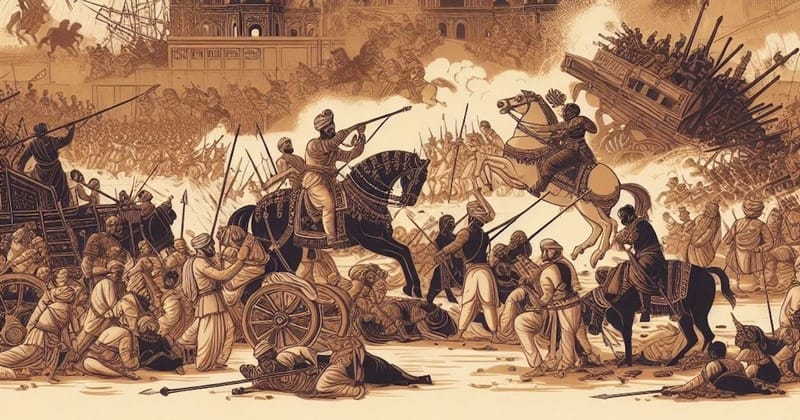
The British used similar tactics in their wars against the Marathas and Tipu Sultan of Mysore. By forming temporary alliances with one Indian faction to defeat another, the British slowly consolidated their control. This strategy was particularly effective during the Anglo-Maratha Wars (1775–1818), where the Maratha Confederacy, despite its earlier successes against the Mughals, was outmanoeuvred by the British using divide-and-rule tactics.
The Myth of British Succession to Mughal Power
The British narrative, which presents their colonisation of India as a logical succession after the fall of the Mughals, is an oversimplification that erases the complexities of Indian resistance. By the time the British East India Company began to assert its dominance in the mid-18th century, the Mughal Empire had already been reduced to a symbolic entity, with actual power wielded by regional rulers like the Marathas, Sikhs, and others. The Mughal emperor became a mere figurehead, and real political authority had already shifted to these regional powers.
The portrayal of the British as the legitimate heirs of the Mughals thus serves a dual purpose: it justifies their colonisation as part of a “civilising mission” and minimises the contributions of Indian rulers who fiercely resisted both Mughal and British dominance.
Epistemological Violence in Colonial Historiography
The British colonisers employed epistemological violence—the distortion of knowledge systems—to impose a colonial version of history that suited their imperial ambitions. Through the education system, particularly after the Macaulay Minute on Education (1835), the British ensured that future generations of Indians would be taught a version of history that downplayed indigenous resistance and framed British rule as benevolent and necessary.
This colonial education system emphasised the “decline” of the Mughals while ignoring the fact that regional powers had already fragmented the empire and were effectively ruling large parts of India. By erasing or marginalising the agency of Indian rulers and fighters, the British could present themselves as bringing order to a chaotic, fractured subcontinent.
Reclaiming Historical Agency
In post-colonial India, scholars and historians have worked to dismantle this narrative, uncovering the roles of the Marathas, Sikhs, Tipu Sultan, and others who played a crucial role in shaping Indian history. These regional powers were not passive actors in a British takeover but were active resistors of both Mughal and British domination. The colonial narrative, by ignoring these dynamics, perpetuates epistemological violence by denying the agency and contributions of Indian leaders.
By recovering these suppressed histories, we can better understand the true complexities of India’s political landscape during the 18th and 19th centuries, challenging the simplistic narrative of Mughal decline and British succession. This reclamation of historical agency is crucial for a fuller understanding of India’s rich and diverse past.
The idea that the British merely succeeded the Mughal Empire is a product of epistemological violence—a deliberate manipulation of history to legitimise colonial rule. The rise of regional powers like the Marathas, Sikhs, and others significantly weakened the Mughals long before the British entered the scene. By exploiting these regional divisions, the British East India Company managed to consolidate power, but the process was far more complex and contested than the colonial narrative suggests. Recognising and reclaiming these suppressed histories is essential for a more accurate understanding of India’s past, and for undoing the epistemological violence inflicted by colonialism.