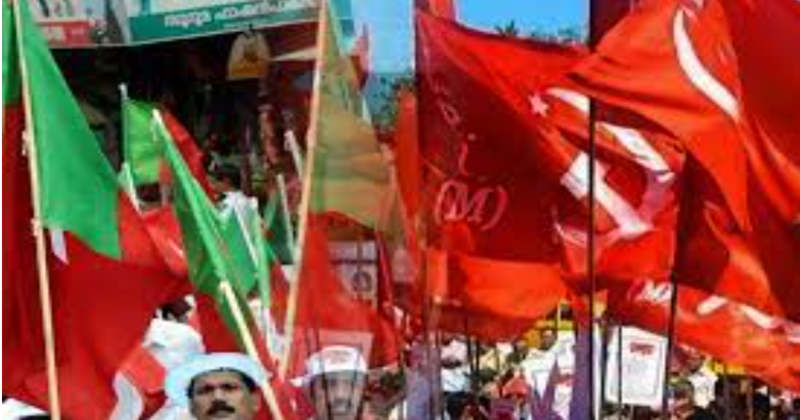
A Threat to Bharat’s Unity and Integrity? We always take pride in our diversity and democratic ethos, however, we often found grappling with internal challenges that threaten our development, unity, and integrity. While external threats are always in the spotlight, it is the internal machinations that quietly undermine our fabric. Among these, the banned Popular Front of India (PFI) and, CPI (ML), and Congress stand out, often seen as separate political entities with distinct ideologies. These three may appear to the common man as legitimate parts of the democratic system; however, they are backed by a network of well-organized groups, NGOs, and political parties. While they present themselves as forces advocating for rights, in reality, their agendas seem to be deeply divisive. Morever, a deeper examination reveals a troubling parallelism in their long-term strategies, which seem aligned to disrupt and destabilise the nation.
Banned PFI: A Radical Islamist Agenda in Disguise
The Popular Front of India (PFI) has long been accused of promoting an Islamist agenda under the guise of socio-economic upliftment. While the organization portrays itself as an advocate for Muslim empowerment, its internal documents expose a much darker reality. These documents detail plans for establishing Islamic rule in India, beginning with the socio-political and economic mobilization of the Muslim community. PFI’s agenda is rooted in the idea of reclaiming political power for the Muslim community, which they allege was unjustly taken away by the British. They frame their long-term goal as the re-establishment of Islamic law in India, targeting the year 2047 as a symbolic milestone—100 years after India’s independence.
The PFI strategy is clear: it aims to exploit existing grievances within the Muslim community, particularly by invoking historical incidents such as the demolition of the Babri Masjid, communal riots. By perpetuating an Islamic victimhood narrative, the banned PFI and several Islamic organisations and parties foster a deep mistrust between the Muslim community and the government. This agenda is not merely limited to rhetoric; PFI and several other organisations actively recruit and train members in physical combat, including the use of weapons, under the pretense of self-defense. Their ultimate goal, as the documents reveal, is to wage selective violence, demonstrating strength and instilling fear in non-Muslims, all while maintaining a façade of peaceful activism.
Moreover, the banned PFI’s outreach was not restricted to domestic operations. The organization cultivated relationships with international Islamic countries like Turkey and seeks to expand these alliances. This global Islamist solidarity is intended to provide external support during moments of confrontation with the Indian state. The recent bans and crackdowns on PFI have exposed their intentions to wage a cultural and ideological war against the secular fabric of India. The deeper question that arises is: Can a group that explicitly seeks to establish Islamic law truly be interested in the well-being of a pluralistic nation like India, or is their real motive a complete societal overhaul?
CPI (ML): Revolutionary Communism and the Subversion of the State
While PFI’s agenda is cloaked in religious extremism, CPI (ML) adopts the language of Marxist-Leninist revolution. CPI (ML) envisions a “protracted people’s war” to overthrow the existing system and replace it with a communist state. Like PFI, CPI (ML) and other Left centric organisations focus on mobilizing the people in separate identity groups as workers, peasants, SC’s, ST’s and minorities. However, their end goal is not Islamic rule but the complete dismantling the democratic system.
These Maoists strategy hinges on infiltrating urban areas, which they regard as the strongholds of government power. The revolution, according to their doctrine, will start in rural areas, where the state’s military presence is weaker, and eventually, they will surround and capture the cities. This long-term view aligns eerily with PFI’s gradual mobilization of communities towards a larger goal. Both organizations emphasize secretive, decentralised networks that indoctrinate members, preparing them for a final showdown against the state.
An essential element of CPI (ML)’s strategy is the deliberate infiltration of state institutions such as the police, paramilitary forces, and even the military. Their goal is to exploit weaknesses within the system, mobilizing discontented members of these forces and preparing them for the eventual uprising.
As the famous line of the movie says “Govt is yours but functionaries are ours” (It may be possible that you may form the government at the centre but the system(functionaries) would remain ours. So, the left want to have a system that will be controlled as per their commands, not from the tables of elected representatives or constitutional bodies.
They also focus on the working class but refrain from overtly organizing trade unions, opting instead for underground party cells that can mobilize during the final stages of revolution. Their meticulous planning and long-term vision beg the question: Is CPI (ML) a legitimate political entity fighting for workers’ rights, or is it a subversive force plotting the downfall of the Indian state?
Congress: The Enabler of Divisive Politics?
At the heart of this analysis is the Congress party, a political entity that once led the country’s fight for independence but has, over the decades, transformed into a party accused of appeasement politics and vote-bank strategies. While Congress does not explicitly align itself with the violent revolutionary tactics of PFI or CPI (ML), its actions (or inactions) have often provided a conducive environment for these groups to thrive. But the network of these organisations always pro-Congress in private and as well as in public masquerading as strategic alliances.
Historically, Congress has been accused of Muslim appeasement, beginning with policies under Jawaharlal Nehru and continuing through Indira Gandhi’s Emergency era, up to contemporary times under the leadership of Sonia Gandhi and Rahul Gandhi. The party has consistently positioned itself as a secular entity, but its track record reveals a pattern of policies and actions that cater disproportionately to the Muslim community, creating the perception that Congress is a party for Muslims rather than one that upholds the interests of all Indians.
More recently, Congress’s reluctance to confront Islamist radicalism and its tacit support for Left-wing ideologies raised questions about its real agenda. For example, the Congress leadership’s soft stance on organizations like banned PFI, even in the face of mounting evidence of their extremist agenda, has been criticized as a form of political pandering. Similarly, Congress has failed to take a strong stance against the violent revolutionary activities of CPI (ML), often aligning with Left-wing ideologies in a bid to counterbalance the BJP’s Hindutva politics.
By positioning itself as a centrist party that appeals to a broad coalition of voters, Congress has inadvertently allowed extremist factions to flourish under its umbrella. The party’s emphasis on minority appeasement, coupled with its alliances with radical Left factions, suggests that it is less interested in national unity and more concerned with short-term electoral gains. The real question here is: Does Congress genuinely stand for secularism and democracy, or is it complicit in enabling the very forces that seek to destabilize Bharat?
A Converging Threat to National Integrity
While PFI, CPI (ML), and Congress may appear ideologically different, the parallels in their strategies are difficult to ignore. All three entities exploit societal divisions—whether religious, caste-based, or class-based—to mobilize support for their respective causes. They frame themselves as champions of the marginalized, yet their ultimate goals are far from inclusive. The banned PFI seeks to establish Islamic rule, CPI (ML) aims for a communist revolution, and Congress is accused of enabling these divisive forces through its politics of appeasement.
The long-term strategies of PFI and CPI (ML) both involve the infiltration of government institutions, the indoctrination of their supporting communities, and the eventual overthrow of the current system. Congress, by contrast, uses democratic processes to secure power but is criticized for providing political cover to these radical groups. This triangulation creates a potent threat to India’s development, unity, and integrity. By allowing radical Islamists and revolutionary communists to operate under the guise of secularism and democracy, Congress risks undermining the very foundation of Bharat.
The real motive of these organizations, therefore, must be questioned. Are pro-Islamic organisations truly interested in the socio-economic development of the Muslim community, or are they using this as a smokescreen for its larger agenda of Islamic domination? Is CPI (ML) and left organisations genuinely concerned with the rights of workers, or is it laying the groundwork for a violent revolution that will dismantle the democratic state? And finally, is Congress truly a party of secularism, or is it complicit in the rise of these extremist factions for political expediency?
Conclusion: A Call for National Vigilance
The convergence of these forces—PFI, CPI (ML), and Congress—presents a significant challenge to India’s future. While each may operate under different banners, their shared reliance on societal divisions and subversive strategies poses a real threat to Bharat’s development, unity, and integrity. It is time for people to recognize the dangers of these long-term agendas and take a firm stand against the forces that seek to undermine our sovereignty.
The real question of every concerned citizen is: Can we afford to remain passive in the face of such coordinated efforts to destabilize our nation, or must we confront these forces head-on to safeguard Bharat’s future?