On August 5, 2024, the Prime Minister of Bangladesh Sheikh Hasina resigned from the post and fled to India following violent protests that erupted in Bangladesh after the order of the Supreme Court of Bangladesh to re-instate the pre-2018 quota system in government jobs. The demonstrations were followed by large-scale violence against Awami League workers and Hindus. Several reports emerged where Hindu households and temples were looted, set on fire and targeted amid the ongoing political unrest in Bangladesh.
The newly inaugurated ISKCON temple in Meherpur, Khulna division was set on fire by perpetrators. The attacks on the Hindu minority were so massive that the Prime Minister of Bharat Shri Narendra Modi posted on X wishing the newly formed interim Government and asking them to ensure safety and protection of Hindus in Bangladesh. Realizing the gravity of the situation, the Chief Adviser of the Interim Government Muhammad Yunus admitted that atrocities on Hindus had indeed taken place and assured the minority community of justice. But the mainstream media was quick to downplay the severity of the attacks on the Hindus in Bangladesh and accused social media influencers of spreading falsehood. Further, they claimed it as revenge attacks as the Hindu community was seen close to the Sheikh Hasina led Awami League Government.
Stray incidents were highlighted to show how Muslim community had come forward to save the minority Hindu community. As the attacks on the Hindu community in Bangladesh continue amid the political turmoil, we look at the history of the ethnic cleansing of the Hindus in Bangladesh.
Historically, Bangladesh was part of Bharat since ancient times. It was ruled by several Hindu kings and among the most prosperous regions until the arrival of Bakhtiyar Khilji, who conquered Bengal in 1204 AD. Later on, Bengal was annexed by the Mughals. The Muslim kings employed various means for conversion of Hindu society in the Bengal region. The population of Muslims, which was negligible at the turn of the millennium, rose substantially in Bengal region which is evident from the census figures from 1872 to 1941. In 1872, the Muslims share in population of Bengal was 49% which rose to around 55 per cent in 1941. On the other hand, the population of Hindus reduced from more than 50 per cent to around 41 per cent for the corresponding period. As Bengal was a major trading center, it attracted the attention of colonial powers in the 16th century. The British and Dutch established their companies in Kolkata. The Portuguese also developed their base in Chittagong region.
The Bengal province was partitioned by Lord Curzon in 1905. This was a major step as it divided Bengal into two provinces on communal lines, the Eastern part been a Muslim majority region while the western a Hindu majority area. This was supported by the Muslim aristocracy led by the Nawab of Dhaka Khwaja Salimullah who used this as an opportunity for consolidation of Muslims and revival of the thought of a separate province for Muslims in Bharat. The All-India Muslim League was also formed in Dhaka in 1906 to secure the interests of Muslims in Bharat, which later was instrumental in Partition of Bharat along religious lines. There were incidents of violence against Hindus in East Bengal. Hindus in East Bengal were subjected to violence at regular intervals.
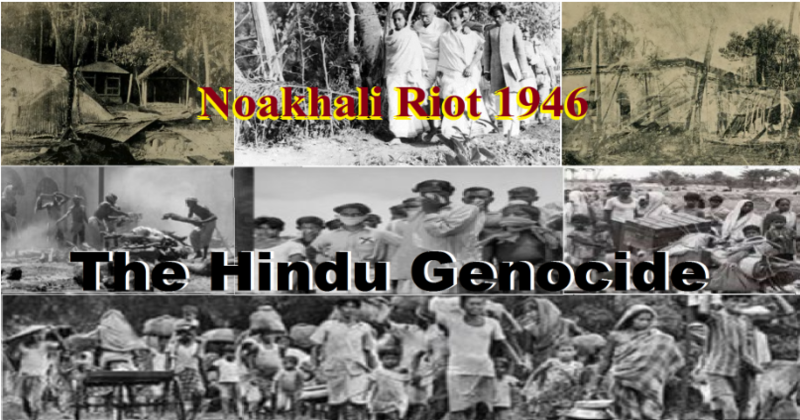
The most dreadful massacre faced by Hindus was during the Direct-Action Day call by Muhammad Ali Jinnah led All-India Muslim League for a separate Pakistan through the use of violence. There was looting of shops owned by Hindus, arson, abduction, rape and murders of Hindus in Kolkata. The violence by Muslims, under the supervision of Chief Minister of Bengal Huseyn Shaheed Suhrawardy, resulted in massacre of thousands of Hindus. The massacre continued for next few days. Finally, the Hindu community retaliated, thereby resulting in the communal violence subsiding. Later the violence spread to other regions of Bengal especially Noakhali and Tippera. Over five thousand Hindus were massacred and villages after villages were forcefully converted to Islam.
After partition, East Bengal became East Pakistan. The population exchange between East Pakistan and Bharat was relatively slow. Soon after independence, persecution of Hindus started. Processions of Hindu festivals were attacked, posters were put up against Durga Pooja, houses were set on fire during Vijayadashami. There was large scale persecution of Hindus in the 1950. There was large scale persecution of Hindus in Kalshira, Nachole, Dhaka, Muladi, Sitakunda, Noakhali, Sylhet, Mymensingh and Jessore. Homes of Hindus were looted, women were raped and people from Hindu community were murdered. In his resignation letter, the then Labour and Law Minister of Pakistan, Shri Jogendranath Mandal mentioned about the Kalshira massacre[16]. Mandal also mentioned how the Upper caster and the Scheduled Castes Hindus were ignored and mall-treated by the Government and administration. This resulted in large scale exodus of Hindus from East Pakistan to Bharat. A. Roy, a researcher, mentions in his book Genocide of Hindus and Buddhists in East Pakistan and (Bangladesh) that over 5 lac Hindus were massacred and over 3.5 million took refuge in Bharat due to the 1950 massacre of Hindus in East Pakistan.
The 1971 Bangladesh Liberation War is one of the worst chapters in the history of genocides of Hindus. The Pakistani armed forces under the command of General Tikka Khan, the Butcher of Bengal, specifically targeted Hindus. The death toll figures range from 3 lakhs to 3 million, mostly comprising of Hindus. Statistics reveal that around 3-4 lakh women were raped, majority of them Hindus. Sexual violence was used as a form of weapon and Hindu women were considered as war booty. The Jamaat-E-Islami and the Razakars, the East Pakistani militia force, were at the forefront in the violence against the Hindus. Over 10 million Bengalis, mostly Hindus, fled to Bharat for safety.
After Bangladesh became an independent nation, it was declared a secular state. However, with the passage of time, Islam was declared as state religion in 1988 when Hussain Mohammad Ershad was the President of Bangladesh.
Hindus faced persecution in Bangladesh during multiple occasions in 1964, 1975, 1992, 2013, 2022 as well. The share of Hindu population in Bangladesh reduced from around 28% during independence to under 8 per cent during the latest census figures in 2022. If the current trend of decrease in population continues then no Hindus may be left in next 30 years in Bangladesh[19] [20]. Another threat to Hindu existence in Bangladesh is the Vested Property Act. Hindus lost millions of acres of land holdings due to the controversial Act. Though the Act was later repealed, but the land that was confiscated is yet to be restored to the Hindus.
In recent years, the demand for Greater Bangladesh[23] have been raised, though this is not a new idea. Jamaat-E-Islami and Hefazat-E-Islam are working behind this plan, in which Paschim Banga, Bihar, Jharkhand, Odisha and all North-Eastern states of Bharat and parts of Myanmar are included. Accordingly, through demographic changes and militant action, they plan to annex these regions with the objective of establishing a Muslim majority country by the name of Greater Bangladesh. What is astonishing that when Muslims face persecution from fellow Muslims for political reasons, they turn to non-Muslim countries for seeking refuge. From Tasleema Nasrin to Sheikh Hasina, seek refuge in Bharat as their safety and security is guaranteed in Bharat only.
Since last 1300 years, Islam is fighting against Hindus to establish Islamic rule in Bharat. This is one of the longest struggles by Muslims for Dar al-Islam, meaning sovereignty of Muslims and over any particular territory and treating people following other religions as dhimmis. Hence, they use every opportunity in Bharat and the sub-continent to target Hindus. The protests against the quota system in Bangladesh later turned ugly resulting in large-scale violence against Hindus and the extremist organizations in Bharat also waiting for an opportunity to replicate the events of Bangladesh. The protests against CAA throughout Bharat were directed to consolidate Muslims and also pressurize the Government to relax the provisions to give citizenship to Muslims from neighboring countries as well, thereby assisting in speeding up the increase in the population of Muslims at a faster pace. It is for the Hindus in Bharat and elsewhere to understand the designs of the Muslims or else they would face the same fate as the Hindus of Pakistan and Bangladesh. Hindus would be subjected to forceful conversion to Islam or violence, looting, murder, Hindu women would be subjected to sexual violence till they accept Islam. To remind the slogan raised by Muslims during partition of Bharat in 1947, Lad Ke Liya Pakistan, Hans Ke Lenge Hindustan, (We got Pakistan by fighting, we will get Hindustan smiling).