Calcutta Massacre: A look at history
July 29, 2026
  • Read Ecopy
  • Circulation
  • Advertise
  • Careers
  • About Us
  • Contact Us
Android AppiPhone AppArattai
Organiser
  • ‌
  • Bharat
    • Assam
    • Bihar
    • Chhattisgarh
    • Jharkhand
    • Maharashtra
    • View All States
  • World
    • Asia
    • Europe
    • North America
    • South America
    • Africa
    • Australia
  • Editorial
  • International
  • Opinion
  • RSS @ 100
  • More
    • Op Sindoor
    • Analysis
    • Sports
    • Defence
    • Politics
    • Business
    • Economy
    • Culture
    • Special Report
    • Sci & Tech
    • Entertainment
    • G20
    • Azadi Ka Amrit Mahotsav
    • Vocal4Local
    • Web Stories
    • Education
    • Employment
    • Books
    • Interviews
    • Travel
    • Law
    • Health
    • Obituary
  • Subscribe
    • Subscribe Print Edition
    • Subscribe Ecopy
    • Read Ecopy
  • ‌
  • Bharat
    • Assam
    • Bihar
    • Chhattisgarh
    • Jharkhand
    • Maharashtra
    • View All States
  • World
    • Asia
    • Europe
    • North America
    • South America
    • Africa
    • Australia
  • Editorial
  • International
  • Opinion
  • RSS @ 100
  • More
    • Op Sindoor
    • Analysis
    • Sports
    • Defence
    • Politics
    • Business
    • Economy
    • Culture
    • Special Report
    • Sci & Tech
    • Entertainment
    • G20
    • Azadi Ka Amrit Mahotsav
    • Vocal4Local
    • Web Stories
    • Education
    • Employment
    • Books
    • Interviews
    • Travel
    • Law
    • Health
    • Obituary
  • Subscribe
    • Subscribe Print Edition
    • Subscribe Ecopy
    • Read Ecopy
Organiser
  • Home
  • Bharat
  • World
  • Operation Sindoor
  • Editorial
  • Analysis
  • Opinion
  • Culture
  • Defence
  • International Edition
  • RSS @ 100
  • Magazine
  • Read Ecopy
Home Bharat

Calcutta Massacre: A look at history

The Calcutta Massacre serves as a somber reminder of the devastating consequences of communal hatred and the importance of striving for unity and peace. The legacy of the Calcutta Massacre continues to resonate, offering lessons on the dangers of divisive politics and the need for communal harmony in today's world

Rajat BhatiaRajat Bhatia
Aug 12, 2024, 06:00 pm IST
in Bharat, Asia, Opinion, International Edition
Follow on Google News
FacebookTwitterWhatsAppTelegramEmail

The Bengal region, an important part of the British Empire in India, was famous for Indian literature, spiritual and religious sentiments. Calcutta, one of its cities, which was also known as Bengal Presidency, used to be the administrative and judicial capital of the then British Empire. Bengal Presidency included present-day Bihar, Chhattisgarh, Odisha, Bengal, Bangladesh and some parts of Assam, with a total population of 7 crore 80 lakhs.

With the aim of improving the governance system of the British Empire to weaken the cultural unity despite geographical, linguistic, communal characteristics, Lord Curzon proposed to divide Bengal on 19 July 1905. Under this proposal, Bengal was to be divided into two parts, East and West Bengal. The eastern part of Bengal was present-day Bengal, Bangladesh, Assam and the western part was Bihar, Orissa, etc. This partition proposal was approved by the Viceroy on 16 October 1905. The biggest political party of that time, Indian National Congress, opposed this proposal under the leadership of party president Gopal Krishna Gokhale, while on the other hand, Nawab Salimullah, Syed Ahmed Khan, Mohammad Ali Jinnah, Liaquat Ali Khan, accepted this partition to play the politics of religion and community. Taking support of people from religious sentiments, Syed Ahmed Khan, Mohammad Ali Jinnah founded All India Muslim League in 1906, the main objective of this party was to give religious form to the nationalist politics of India. In 1911, King George shifted the capital of the British Empire from Calcutta to Delhi and also reunited Bengal, which was divided on the basis of language, due to which Bihar, Orissa and Assam could not join Bengal again. During the Second World War, the military power of the British Empire weakened. Taking advantage of this, Netaji Subhash Chandra Bose included the soldiers of the Indian British Army captured by Germany in the Indian National Army and inspired them to fight against the British Empire. This rebellious thinking of Netaji was the main reason for India’s independence. As a result, the British government suffered a setback in its financial and military power. They had become so weak that they were unable to handle a colony like India.

The sun of the British Empire, never sets, had set forever in India. England’s Prime Minister Sir Clement Attlee decided to free India. For this task, he formed a committee of three members (Pethick Lawrence, Stafford Cripps and A.V. Alexander) named ‘Cabinet Mission’, whose main objective was to hand over the empire to India.

The decade of 1940s, when India’s politics leaving nationalistic approach and turning towards communal issues. The internal politics of India was deteriorating due to the mutual differences and different ideologies of the two biggest political parties of that time – Indian National Congress and All India Muslim League. The members of the Cabinet Mission gave many proposals to both the political parties for change of power, but the partition of India was decided under the proposal of 16 June 1946, but Congress rejected it, but on the other hand, All India Muslim League accepted the proposal of Pakistan, a Muslim majority area. The ideological differences increased further when Congress rejected the partition proposal. Then the Cabinet Mission gave both the parties a chance to form an interim government, this proposal was also rejected by Congress and Jinnah decided to form the government. But due to Muslim League being a religious and small party, the Viceroy rejected Jinnah’s proposal. On the other hand, the Viceroy asked the Congress in harsh words to form the government, Mohammad Ali Jinnah considered this as his insult and decided to use unconstitutional methods to forcibly take the right of Muslims i.e. Pakistan.

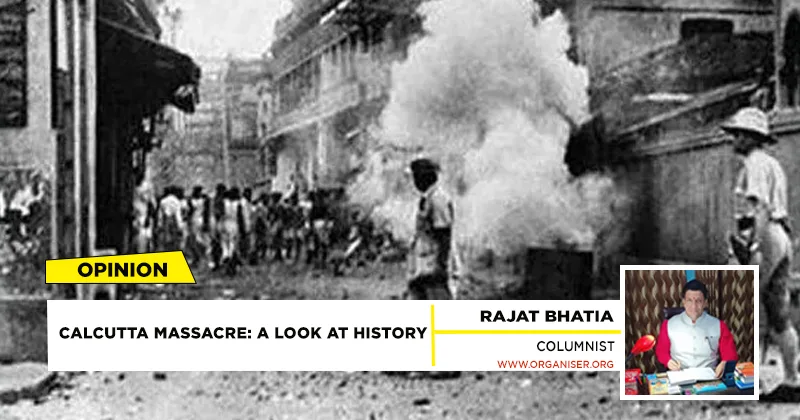
Muslim League leader Hussain Syed Suhrawardy asked Bengal Governor Sir Frederick Boros to send all policemen on leave by assuring peace. On August 16, 1946, Muslim League leaders Mohammad Ali Jinnah, Liaquat Ali Khan and Syed Suhrawardy inspired the people of the Muslim community for land jihad by citing Mohammad and  the verses of Quran, which is written in black letters in history as ‘Direct Action’.

In the absence of police in the city, Muslims massacred Hindus and Sikhs, committed rapes, robberies and thefts. This massacre, which started from Calcutta, reached the city of Noakhali (in present-day Bangladesh) on August 19, this place was a Hindu majority place, but after the partition of India, due to the formation of East Pakistan, this area became Muslim majority, in which 95% of the population became Muslim and 4 per cent of the population became Hindu.

After the ‘Direct Action’ plan, the British government, seeing the dreadful face of the Muslims, decided to divide India on religious grounds and within no time, undivided India was divided into two parts, one East Pakistan and the other West Pakistan. But due to administrative weakness, after the war of 1971, East Pakistan was separated from Pakistan on the basis of language and a new country was born, which was named Bangladesh.

At present, on one hand, a government influenced by leftist ideology has come to power in Bengal by appeasing the community, whose political ideology is also of Hindu hatred like the Muslim League. On the other hand, in Bangladesh, civil war has started due to  political intervention Western and America.  The situation has become such that even the Prime Minister Sheikh Hasina had to leave the state. In such an environment, the American deep state and Western brokers  will establish a puppet government, which can have the greatest impact on India in the coming times.

If we talk about Bengal and Bangladesh of 1946 and the present time, then the Jihadi mentality is exactly the same. Even after so many years, the nature of Jihadi mentality is full of hatred towards Hindus and Bharat. Even now, Jihadi terrorist organizations are sitting on India with the dream of Ghazwa-e-Hind. Now the people of India have to think that they should create a nation-rich society with some  nationalist ideology so that such unfortunate moments can be avoided.

Topics: Bengal PresidencyEast PakistanMohammad Ali JinnahCalcutta Massacre
Share6TweetSendShareSend
✮ Subscribe Organiser YouTube Channel. ✮
✮ Join Organiser's WhatsApp channel for Nationalist views beyond the news. ✮
Previous News

Assam: Police arrests self-proclaimed “Mullah” in Hailakandi for luring and blackmailing Hindu college girls

Next News

Hindu Genocide in Bangladesh: Eminent personalities urge Indian parliament to pass resolution against communal attack  

Related News

People gather in large numbers during an anti-Pakistan protest, in Muzaffarabad, Pakistan-occupied Jammu and Kashmir

POJK: Tumbling template of terroristan

Mohamad Ali Jinnah (File Image)

Herof 2.0 or black storm; Are Baloch freedom fighters trying to cut Balochistan, real jugular vein of Pakistan

Maharaja Hari Singh

J&K: How Maharaja Hari Singh was betrayed by his own Army chief British officer Major General HL Scott

Bangladesh’s turn against India puts it at risk of once again becoming “East Pakistan.”

Who was Mohd Iqbal and why Delhi University removed chapters on him from political science syllabus?

“People of North East Never accepted British Rule”: Anandita Singh, Researcher, Northeast Study Centre

Load More

Latest News

(Left) Congress Leader Priyanka Gandhi (Right) IIT Madras Director Prof. V. Kamakoti,

Who is Prof V Kamkoti? Why Congress and Gandhi Family find problem with his name in the NEET reforms committee?

US President Donald Trump, Saudi Arabian Crown Prince Mohammed bin Salman, and Iranian cleric Mojtaba Khamenei

Saudi Arabia joins US in deadly strike on Iran-backed Iraqi Shia militia Popular Mobilisation Forces

Former Keralam CM Pinarayi Vijayan , ADGP MR Ajitkumar IPS (Left to Right)

Keralam: CAT refuses urgent relief to suspended ADGP MR Ajitkumar in Pinarayi ‘Rescue Operation’ case

Priyanka Gandhi's Gau Mutra jibe directed towards IIT Madras Prof Kamakoti Exposes Congress' Anti-Hindu Mindset

Gandhi family’s anti-Hindu face exposed again; Priyanka’s ‘Cow Urine expert’ Jibe at Prof Kamkoti faces backlash

Raul Morales faces hate crime and attempted murder charges over the stabbing of a Jewish man and an Asian man in New York

New York Knife Jihad: Jewish, Asian men stabbed as suspect shouted ‘Allahu Akbar’, ‘Justice for Islam’

Guru Purnima honours the timeless Guru-Shishya tradition and the Guru’s role in guiding seekers towards self-knowledge and spiritual wisdom (AI-generated image)

Guru Purnima 2026: Honouring the eternal Guru-Shishya tradition and the timeless path of self-knowledge

Barkhan DC Mureed Bugti killed in Balochistan

Balochistan: Deputy Commissioner of Barkhan Mureed Bugti killed after abduction; 11 workers kidnapped in Kech, Khuzdar

Karnataka High Court

Karnataka: HC slams Bengaluru police for arresting doctor who reported suspected illegal Bangladeshi immigrants

Gulveer Singh wins India's first-ever CWG men's 10,000m medal with silver

CWG 2026: Gulveer Singh Scripts history with India’s first-ever men’s 10,000m silver medal in Glasgow

Pakistan Defence Minister Khwaja Asif

PoJK Polls: Pakistan Defence Minister Khwaja Asif justifies killing of JAAC supporters, equates Protesters with India

Load More
  • Privacy
  • Terms
  • Cookie Policy
  • Refund and Cancellation
  • Delivery and Shipping

© Bharat Prakashan (Delhi) Limited.
Tech-enabled by Ananthapuri Technologies

  • Home
  • Search Organiser
  • Bharat
    • Assam
    • Bihar
    • Chhattisgarh
    • Jharkhand
    • Maharashtra
    • View All States
  • World
    • Asia
    • Africa
    • North America
    • South America
    • Europe
    • Australia
  • Editorial
  • Operation Sindoor
  • Opinion
  • Analysis
  • Defence
  • Culture
  • Sports
  • Business
  • RSS @ 100
  • Entertainment
  • More ..
    • Sci & Tech
    • Vocal4Local
    • Special Report
    • Education
    • Employment
    • Books
    • Interviews
    • Travel
    • Health
    • Politics
    • Law
    • Economy
    • Obituary
  • Subscribe Magazine
  • Read Ecopy
  • Advertise
  • Circulation
  • Careers
  • About Us
  • Contact Us
  • Policies & Terms
    • Privacy Policy
    • Cookie Policy
    • Refund and Cancellation
    • Terms of Use

© Bharat Prakashan (Delhi) Limited.
Tech-enabled by Ananthapuri Technologies