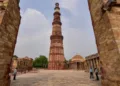
“Islamists came from a wretched land, which had no construction of significance. In Bharat they saw grand Mandirs, palaces and forts. They took a fancy to construct forts and maqbara, the only two things that a murderous looter needed. They knew that no one respects them while they are alive . So they used to construct a big maqbara for themselves in their lifetime only.”
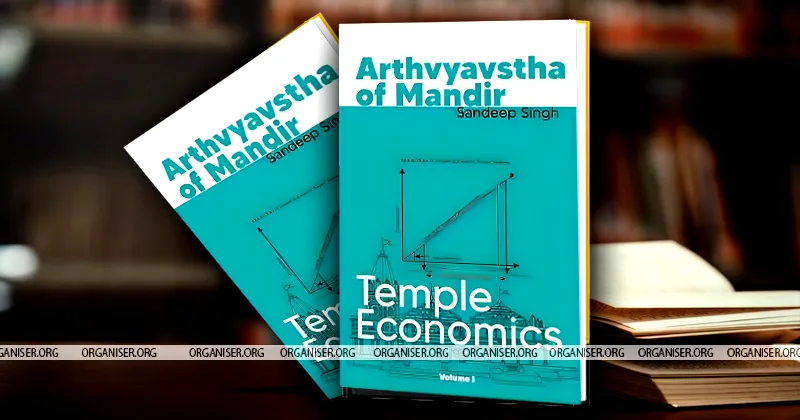
[Excerpt from the same book, Temple Economics Volume I – Sandeep Singh]
Bharat had undergone several Islamic onslaughts. The soul of Bharat, on one hand, has been deeply wounded by perpetual attacks and atrocities of Islamic period, whereas on the other, the heroic resistance to these invaders had kept the hindu civilisation alive till today. The colonial era and secular era succeeded the Islamic invasions, and, they too, destroyed the mandir and their Arthvyavastha systematically.
As we have seen in the first part i.e. “Part I – Arthashastra of Mandirs”, Singh has encompassed all the aspects, whether large or small, pertaining to this subject. In the first part of the book, he discusses the structure of mandir on various bases, while delving into the core concepts of Sanatan Dharma. He majorly draws the attention of readers to the grand glory of aarthik (economical) activities — being regulated in the mandirs — by giving latest instances, case studies, historical facts. Now he moves further in the second part, with the destruction of Mandirs by different invaders at different time periods.
Now, the author moves further with part II. In the Part -II named as “Destruction of Mandir and its Arthvyavastha (Destruction of Temple Economics), the author states – “Bharat’s arthvyavastha is directly linked to the growth of Mandirs. The destruction of mandirs bought ruins to Bhartiya Arthvyavastha. The growth and fall in economy in proportion to construction and destruction of the mandir, respectively is more steep, because of multiplier effect.”
As a master of classification, of concepts and facts, Singh, classified the four stages in which Bharat lost mandir based arthvyavastha which are –
- Islamist Invasion
- Portuguese Christian Invasion
- British Christian Invasion
- Secular Invasion
While describing the vital role played by Bappa Rawal in building Mandirs by 8th century, the author additionally mentioned how he (Legendary Bappa Rawal) decimated the Arab invaders by persistent 15 attacks, consequently the Arabs didn’t dare to attack Bharat for straight 400 years. This is the bravery “Bharat ke sapoot” (the sons of Bharat) have.
Author discusses the fact that persistent destruction by Islamic invaders, likewise construction of the mandirs by Hindus, takes place using several methods ; slaughtering cows in Mandirs, ban on worshipping in Mandirs, defacing statues built on the walls of the mandirs, forced mass conversions and mass genocide so that no one can offer puja in Mandirs, are certain prominent methods used by Islamic invaders.
Another classification Singh does in the context of invaders destructing hindu mandirs, into three parts, namely –
- Islamists were focused in their approach in destroying a marked mandir.
- Islamist were focused in their approach in destroying every single mandir, big or small in their area of control.
- Irrespective of their origin, every Islamist invader destroyed Mandirs during their regime.
The three point classification with references — of several authentic books, which were originally written by court historians of these barbaric Islamic invaders — in each of the points, will prove a finest document for a person researching on the islamic iconoclasts and mandir destructors. Particularly the third one, as the author described mandir destructors period wise i.e. from Islamist slave invaders of 1206 CE to Islamist bahamani invaders of 1820 CE.
Unlike, modern Hindus (in most of the cases) hindus of pre colonial era were of proactive approach. Persistent onslaughts by Islamic invaders were fought by persistent construction of Mandirs. Author points out that Chatrapati Shivaji Maharaj played a pivotal role in this. Singh quoted Veer Savarkar’s book i.e. Hindu-Pad-Padshahi about Chatrapati’s zeal of reconstructing and constructing Mandirs ~
“It was in 1627 CE that Shivaji was born. The ancient chroniclers of his life tell us that, as he grew, the lad began to feel keenly the political subjugation of the Hindu race. He saw with bleeding heart how the mandirs of his Gods were trampled down by alien feet and how the ashes of ancient glory were dishonoured and desecrated. […] He for one would risk all and work and fight and, if need be, die in facing fearful odds for the ashes of his forefathers and the mandirs of his Gods; or, if he be destined to win and survive and remain a victor in the field, then he would lay the foundations of a great and glorious Hindu Empire, even as Vikramaditya or Shalivahana did – an empire, that would be a notable realisation of the anxious dreams of generations of his people, of the object of the longing prayers of the saints and sages of his faith.”
The spirit of reclaiming the things that were ours originally, should be there in any period or yuga for any community and following this approach of reclamation — author says — Chhatrapati destroyed the mosque at Tiruvannamalai which was built after destroying a mandir and rebuilt the mandir. He talked at length about the contribution of marathas and peshwas in rebuilding the mandirs. One can’t miss the name of Ahilya Bai Holkar when talking about the reconstruction of Mandirs. How much a reader should thank this author for simplification of essential facts of history ; because he lists the mandirs ; which were (in tabular format) deconstructed by iconoclast Aurangzeb and reconstructed by Devi Ahilya Bai Holkar, with proper timeline. Additionally Singh also described the other vital works done by Ahilya Bai Holkar in the same field (again in tabular form).
In the later unit, the author mentions the ‘contribution’ of missionary and secular invasion in the destruction of mandir based Arthvyavastha, from Portuguese Christian invasions to British and secular invasions.
About Portuguese Christian Invasions author rightly said — “Portuguese Christian Invaders were no different than Islamist invaders. After the invasion they did everything what Islamist invaders did. Torture, forced conversion. rape and genocide of our ancestors, destruction of our mandirs, construction of church using parts of destroyed mandirs, you name it and they had done it. Portuguese Christian Invaders matched Islamist in every step. Their behaviour was of a true Abrahamic brother.”
The remaining strength behind decimation of our Mandirs were Britishers ; who made such rules and regulations deliberately to loot mandir in a legal framework. Readers will get to know, how this ‘legacy’ was carried forward by secular forces sitting in government of that time by ideologically subverting and brainwashing the Hindus against their own system of worship ‘sthan’ (place).
As the author had described various facets of mandir based Arthvyavastha, in the first part, in the second he paid special attention to the gradual loss of each and every facet. The prominent facet of mandir based Arthvyavastha is Kumbh mela — and like every other Indic system of knowledge and prosperity — it is still getting attacked. Singh describes the attackers and their strategies of attacks in depth.
Depicting the role of international media as a major attacking force on kumbh mela during Chinese virus i.e. Coronavirus is well explained with the instance of the ‘Washington Post’ report, published on 8 may 2021, — “In India’s surge, a religious gathering attended by millions helped the virus spread.” But the reality with facts, as told by Kumbh Mela IG Sanjay Gunjyal, was kept aside, as it’s the solely talent of leftist ecosystem. Bhartiya media, Islamists, politicians, urduwood, corporate Bharat, foreign universities too played the role of attackers in the same case. Author throws light on each and every attacking force while delving into their deeds and intrigue.
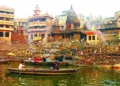
Shiv’s city — Kashi (Varanasi) — has a special place in the hearts of Hindu and hindu civilisation. Author had discussed the special city as a special case. The attacks by invaders were multifacet i.e. physical, financial, spiritual, economical, educational. Hindus have fought back at every aspect, again, deeply discussed by the author.
In the part III named as – “Loss of Mandir Ecosystem, Post – Independence”
In this part, he points out the factors affecting the gradual loss of the mandirs only, specifically post – independence. Author discusses several prominent forces, the obvious ones were Seculars, Communists and Abrahmics.
About secularists he said rightly that — “The more harm one does to we Hindus, the greater secular he or she becomes. Brown Sepoys alias Seculars, have been promoted, rewarded, awarded by the successive governments since transfer of power in 1947. This has led to more destruction of mandirs.”
In the case of communists he said — “Communists will never found attacking religious places of Abrahmics…Sadly it is only the Hindu communists who attack their own Mandirs. Abrahamic communists never even utter a word against their religion. This is the result of sustained brainwashing through education.”
And for Abrahamics he points out ……well a person who has that so-called secular approach must read the author’s take on Abrahamics in the book itself, to give themselves a reality check.
Along with this, Singh, exposes the instigator factor in the same context i.e. PIL and RTI, which mostly works on anti – hindu framework, while also describing the tools media and NGOs.
Everyone have heard about the Sabarimala case and the anti hindu tradition judgement by ‘honourable court’ but mostly people were oblivious of the anti hindu framework behind the entire case, which aim was to label the Hindu Sanskriti as patriarchal, misogynistic orthodox, narrow minded and what not.
The Sabarimala mandir had faced several attacks long before the much discussed case. Author points out the interesting facts that a PIL seeking entry of women to Sabarimala has been filed not by women or not even by any women organisation but Indian young lawyers association ex President Naushad Khan.
Everyone knows the condition of women in Islam, if not they can read the book by Ram Swarup which was written under the very same title i.e. “Woman in Islam.” By reading this book, one can understand that despite the cruel treatment and evil practices for women in Islam, Islamist have always paid attention to the temporary evil practices which are being practiced in Hindu Dharm because of perpetual Islamic invasions in the medieval history of Bharat and unfortunately have become permanent due to zero shastra adhyayan by most of the Hindus…(as we don’t have rigid and anti- women practices in our scriptures)……strange no??
Readers must read this particular unit of Sabarimala case, as it’ll break down the narratives nourished by Islamic – communists alliance.
And then comes the part IV named “Need to Reestablish Mandir Ecosystem”
In this part, author ends the first volume by giving empirical evidence of mandir based Arthvyavastha where he makes a comparison between the temples of modern economy Vs mandir based Arthvyavastha by again giving interesting case studies and finally talking about mandir rate of growth whiled dealing with numbers and more pivotal aspects.
This book will work as a proud and precious document for practicing Hindus, eye – opener treasure for so called woke people and a tight slap to the attempts of Leftists and Islamists… blaming, humiliating and defaming the Hindu Dharm. Hence saying, this book can appeal to even atheists. A must read for all.