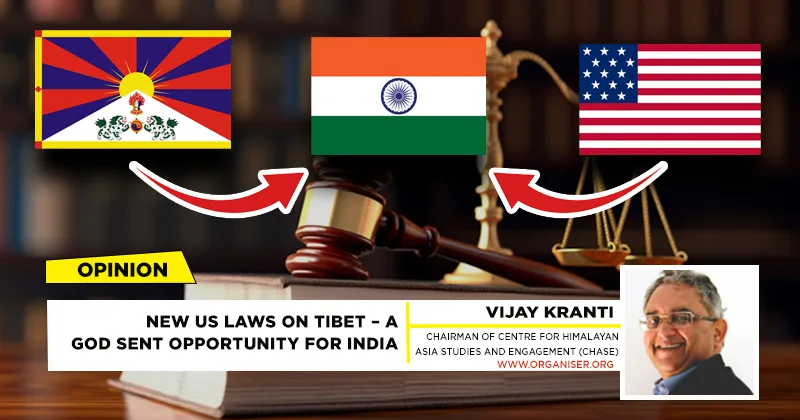
Chinese Government’s threatening message to US President Joe Biden over the latest US Congress bill, which recalibrates the US policy on Tibet and China, and also Beijing’s abusive reactions over the visit of a high-level bipartisan US Congress delegation to meet Dalai Lama in India has exposed President Xi Jinping and his government’s vulnerabilities on their celebrated colony Tibet. Both Houses of the American Congress (Parliament) passed a historic new Bill this month, which calls upon the Chinese government to resolve the Tibetan issue amicably through a dialogue with the exiled Dalai Lama and his representatives. But what has irritated and jolted President Xi severely is that while the Bill is entitled innocently as the ‘Resolve Tibet Act,’ the actual text of this and previous two similar bills on Tibet resolutely challenges and blasts every single narrative on which Xi has been resting his claims over Tibet and also has mounted his campaign to grab the next reincarnation of Dalai Lama.
Biden is expected to sign this Bill anytime in the coming days. Once signed, this Bill becomes an Act of the US Constitution, which, in combination with the previous two bills, namely the “Tibet Policy Act-2002” and the “Tibet Policy and Support Act-2019”, obliges all future Presidents and all arms of the US government to undertake pro-active action against the Chinese government and its leaders to stop them from taking any anti-Tibet steps.
These US laws put special emphasis on stopping Beijing and the Chinese Communist Party from making any attempts to impose their puppet Dalai Lama on Tibet and the Tibetan people in the event of the present Dalai Lama’s demise.
The timing of the visit, the composition of this American delegation, and the real content of these US bills hold significant significance for the Dalai Lama’s exile establishment in Dharamshala and India’s China-Tibet policy. The fact that the delegation left the US immediately after the Bill cleared its final revised passage in the House of Representatives shows the levels of commitment and common excitement of both political parties of America to share it with the Dalai Lama in India. Initially, this Bill was referred to as ‘HR-533’ and was passed, like every other vote on it, with near unanimity in the House of Representatives in February of early this year. However, following its clearance by the Senate in June with a slight amendment, it was again passed by the House of Representatives on June 12.
It was perhaps more than a coincidence that the delegation arrived in New Delhi during the ongoing visit of the US National Security Advisor Jake Sullivan, who was here to hold high-level discussions with his Indian counterpart and other senior leaders of the Modi government. The diplomatic community in New Delhi had already noticed that the NSA’s visit was happening immediately after Modi had resumed his third term as the Prime Minister of India. Other meetings and ‘courtesy calls’ of the Congressional delegation with Indian officials and leaders in New Delhi would not have missed probing the overlapping and further expanding their common interests on the issue of Tibet. And more than these points, no observer could miss the point that this ever-increasing overreach of the US on Tibet is directly proportional to its threat perceptions about Xi Jinping’s desperation to dislodge and occupy America’s position as the real superpower. After all, Tibet is China’s most vulnerable soft belly.
The bipartisan seven-member delegation of the US Congress arrived in Dharamshala on 18 June under the leadership of Republican Representative Michael McCaul. Also, it included famous Democrat and former House speaker Nancy Pelosi, whose visit to Taiwan two years ago had irritated and pushed Beijing to a near-war hysteria against Taiwan. Other members of this delegation included House Foreign Affairs Committee Ranking Member Gregory W. Meeks (D-NY), House Rules Committee Ranking Member Jim McGovern (D-MA), House Foreign Affairs Subcommittee on the Indo-Pacific Ranking Member Ami Bera (D-CA), and Representatives Mariannette Miller-Meeks (R-IA) and Nicolle Malliotakis (R-NY). What reflected the personal emotional attachment of these senior American leaders to this visit was that their family members also joined the entourage to meet the Dalai Lama. Besides being welcomed by a massive cheering Tibetan crowd along the two-kilometre path in McLeodganj, the delegation had a special meeting with the Dalai Lama. It was given a formal reception by Penpa Tsering, the elected ‘President’ of the ‘Tibet Exile Government’ at the Tibetan Exile Parliament House. The culminating event of the visit was a colourful, tumultuous and unprecedented civic reception for the American parliamentarians at the main Tibetan temple in front of Dalai Lama’s residence.
Equally riotous was the reaction from Beijing. The Chinese spokesman in Beijing raised serious objections about the delegation’s visit and asked the US to “fully recognize the anti-China separatist nature of the Dalai group.” Warning US President Biden against signing the Bill into an Act, he threateningly said, “China will take resolute measures to firmly defend its sovereignty, security and development interests.” In his briefing for foreign media in Beijing, spokesman Lin Jian demanded that the US government “have no contact with the Dalai group in any form, and stop sending the wrong signal to the world.”
Using his official X-handle, the spokesman for the Chinese embassy in New Delhi tried to educate the US delegation with the oft-repeated Chinese narrative that the selection of Dalai Lama has always been the prerogative of the Chinese government in Beijing. He even claimed that the present Dalai Lama (14th in the five-century tradition) was selected and installed by the Chinese representative at the Lhasa ceremony in 1940. But while making this utterly false claim, he forgot the fact that the Tibetan government exclusively organized the ceremony and it was attended and placed on record by many international diplomatic representatives and other guests, and that the status of the Chinese representatives in that event was nothing more than any other guest.
In Dharamshala, too, the delegation leader, Rep. McCaul, said that before they left the US for India, the members received a letter from the Chinese Communist Party warning them against going to Dharamshala. “But we did not let the CCP intimidate us… That is why we are here today in defiance of that warning,” he said.
As Ms Youdon Aukatsang, a youthful member of the Tibetan Parliament, put it, “This is a historic visit by such a high-level foreign delegation, and that too after passing a bill on Tibet in the American Parliament. This Bill challenges every falsehood of Chinese propaganda on the status and history of Tibet. I’ve never seen such an enthusiastic public reception by the Tibetan community to a visiting foreign delegation in McLeod Ganj.”
Another Tibetan activist and renowned Tibetan intellectual, Tenzin Tsundu, summed up the significance of this US bill and the visit of the US delegation, saying, “This is first time in the history of Tibetan struggle for freedom that any country has come out openly and formally in support of Tibet with clear assertions that Tibet is an occupied country and that Tibet has never been a part of China. Not only this, they have expressed support for Tibetan people’s right for self-determination. This is going to open doors for a new international discourse on Tibet and challenge to the colonial occupation of Tibet by China.”
More than anything else, it is the actual text of all these bills of 2002, 2019, and 2024, passed by the US Congress, which reflect the real spirit of American support for Tibet. While the “Tibet Support Act-2002” was an effort to reorganize all previous US Congress resolutions, rules and orders of the US administration in the past decades, the other two bills amount to re-polishing and recalibrating the American future strategy and plans about Tibet as defined in the first Bill. In short, at least seven major assertions and points underlined in these bills pointedly challenge and blast every single claim and narrative of Xi Jinping on Tibet. Put together, these American assertions on Tibet and China amount to rejecting Xi’s most shouted idea of the ‘One China Policy’. These points also reflect the emergence of an unambiguous American approach towards China. It is worth noting that the US Congress has recently passed yet another Bill entitled “Uyghur Policy Act-2023” about ‘East Turkistan’, China’s other colony, which was given the Chinese name ‘Xinjiang’ after it was occupied in 1949 – just two years before Mao’s PLA occupied Tibet in 1951.
The primary seven points underlined in these US bills are:
- “Tibet is an occupied country” and “Tibet remains an unsettled issue”. This means that the US government not only recognizes the status of Tibet as a country which China colonizes but also that it is the responsibility of the world community to ‘settle’ the issue of Tibet as per internationally accepted rules and values. Following the occupation of Tibet by China in 1951, this was the first time that any government formally branded Tibet as a ‘colony’. In his dealings with other countries, President Xi declared Tibet its ‘Core issue’ and an important element of his ‘One China Policy’.
- “Tibet was never a part of China in history”. This US assertion completely negates and challenges the claims of Xi and previous Chinese governments that Tibet was always an integral part of China. Notably, one major reason behind the failure and collapse of the 2002-2008 Beijing-Dharamshala talks was that the Dalai Lama refused to formally accept this demand of China. The best concession Dalai Lama was ready to make to Beijing was that while he would not negate the historic fact that China and Tibet have been two different countries, he was ready to accept Tibet under the Chinese constitution provided Beijing agreed to give ‘genuine autonomy’ to Tibet.
- US bills define the geographic definition of ‘Tibet’ not limited to ‘Tibet Autonomous Region (TAR)’ as Xi and Chinese governments want the Dalai Lama and other countries to accept. According to the US Congress, Tibet includes TAR and all areas of the former provinces of Kham and Amdo of original Tibet. In the 1960s, China reorganized Tibet to create TAR (about a third of actual Tibet) and distributed areas of Kham and Amdo into adjoining Chinese provinces of Yunnan, Sichuan, Qinghai and Gansu. This difference in the definition of Tibet was yet another reason behind the collapse of the Beijing-Dharamshala talks because the Dalai Lama’s side refused to accept the Chinese assertion that only TAR is Tibet.
- Earlier US bills have called upon China to start a dialogue with Dalai Lama and his representatives ‘without any preconditions’. However, the latest Bill expanded the definition of ‘representatives’ to include the ‘elected representatives of Tibet’. This means including the Central Tibetan Administration (CTA) in this list. In practical terms, this includes the ‘Sikyong’ (elected President) and the Tibetan Exile Parliament, and it also comes as a de facto recognition of CTA as the ‘Government of Tibet’. This also extends the shelf life of the Tibetan side indefinitely because the Dalai Lama, being an individual human being, has a limited life span. In contrast, the elected Parliament will be there as long as the Tibetan refugee community survives. This initiative of the US Congress demolishes President Xi’s hopes that the Tibetan issue will not survive after the present Dalai Lama’s life.
- On the issue of the reincarnation of Dalai Lama and other senior Tibetan ‘Tulkus’ (incarnate Lamas), the US bills have made it clear that the selection, installation and education of the next Dalai Lama or other Tulkus is the exclusive domain of Dalai Lama and the Tibetan community and that China or the CCP have no locus standee in this matter. Moreover, these bills make it obligatory for future US Presidents and all US official agencies to Challenge and stop the Chinese government from installing the next Dalai Lama. It also directs the US President and the State Office to take punitive actions against all those Chinese leaders and officials engaged in this selection process. This takes away the wind from Xi’s sails, who is waiting for the Dalai Lama to pass away so that he could impose a Dalai Lama of the CCP’s choice on Tibet.
- The bills call upon the US government to launch an ‘International Diplomatic Coalition’ of like-minded democratic governments across the world to promote the cause of Tibet on the above lines. This directly challenges Xi’s assertion of Tibet as a ‘Core Issue’ and an ‘internal matter’ of China. This idea of the US Congress has opened new doors for all those countries who are suffering and are seeing danger to their sovereignty and security with the rise of a bully, China, especially for countries like India, Nepal and Bhutan, which are direct victims of China’s aggression because of its illegal and colonial occupation of Tibet, which used to be a buffer between these countries and China throughout history. The recent passage of a similar bill in the Canadian Parliament and the emerging moods in the European Parliament indicate that this US idea of an International Diplomatic Coalition has good potential.
- The previous Acts also oblige future US Presidents to ban any new Chinese consulate office in the USA unless China agrees to let the USA open its full-fledged independent consulate in Lhasa. The Indian government should welcome this initiative of the USA because New Delhi has been unsuccessfully trying to reopen its consulate in Lhasa, which the late Indian Prime Minister Nehru had voluntarily surrendered along with many other prevailing Indian privileges to China as a part of the controversial ‘Panchsheel Agreement’ in 1954. Interestingly, Nehru surrendered the Indian consulate along with three Indian trade missions in Tibet, the right to maintain a contingent of Indian armed soldiers inside Tibet, and the right to maintain the telephone, telegraph and postal facilities merely on the ground that Nehru considered these Indian privileges as a ‘legacy of imperialism’.
All this shows that the timing of the visit, the composition of this American delegation and the actual content of these US Bills hold big significance not only for the Dalai Lama and the people of Tibet but also for India, which has been suffering from China’s bullying for over 70 years because of China’s illegal and colonial presence in Tibet. Tibet used to play as a safety buffer between India and China for millennia. Interestingly, the new American laws say everything formally and clearly, which New Delhi wanted to tell Beijing but never had the courage to say in plain words. It is high time New Delhi grabs this as a God-sent opportunity and joins the proposed ‘International Diplomatic Coalition’. Rather, India can also play an important role in expanding such a coalition to a dozen countries in South Asia and Southeast Asia that are suffering because of China’s water bullying on the strength of controlling Tibetan rivers. These countries, fed by Tibetan rivers since time immemorial, are now feeling the fear of perpetual droughts because of over-exploitation by China. And countries like India and Bangladesh are facing the danger of being bombed with manipulated floods by China from across the Tibetan borders.