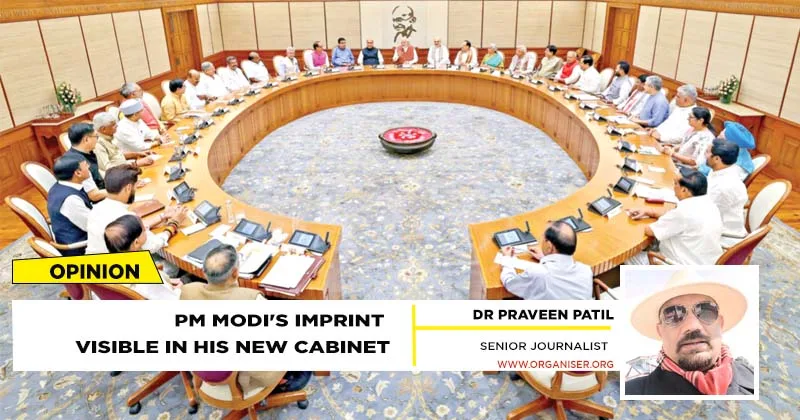
On the evening of June 9, Modi 3.0 took shape at the forecourt of the Rashtrapati Bhavan and Bharatiya Janata Party, without even batting an eyelid, retained the top six Ministries, Defence, Home Affairs, Finance, External Affairs, Agriculture and Health. For those liberal-Leftist elites who were expecting a return to their favourite enterprise of the “coalition era”, this must have come as a great disappointment. In fact, the first non-BJP leader to take oath on that day in Raisina Hill was HD Kumaraswamy, the JDS Parliamentarian from Mandya, Karnataka. Prime Minister Narendra Modi’s imprint is all about symbolism and the message that he conveys through what he does and doesn’t do.
Making a Point
While the whole media universe was busy talking about the importance of Janata Dal (United) and Telugu Desam Party for the survival of National Democratic Alliance (NDA), PM Modi subtly made a point by showing that he is not bothered by the size of his allies and gave the much smaller JDS the first opportunity. The official argument, of course, would be based on the political seniority of Kumaraswamy, who first assumed the office of the Chief Minister of Karnataka nearly two decades ago, in 2006.
The two Maharashtrian allies, Shiv Sena and Nationalist Congress Party were side-lined in this Cabinet formation, despite the fact that elections are due in the State in six months. This is the other part of the Modi messaging construct, the glaring absences. Electoral performances have consequences, and this is most visible in the three star Ministers, who missed out this time, Smriti Irani, Rajeev Chandrashekhar and Anurag Thakur. Modi empowers you, but you must also be able to deliver electorally. Irani and Chandrashekhar both lost their respective electoral battles and although Thakur won his seat for the fifth time, he couldn’t ensure the victory of Rajinder Rana in the Assembly by-election of Sujanpur which is his home seat. There is a bit of history here, as Rana had defeated Thakur’s father PK Dhumal in 2017, which had dashed the hopes of the latter of becoming the CM. This election was billed locally as a revenge for that 2017 defeat conversely detrimental to BJP’s interests in the State. In fact, this primary concept of electoral performances having consequences is writ large across the lately complicated State of Uttar Pradesh where 11 Ministers in the previous Government had contested elections but only four retained their seats and all four have been made Ministers – if you are empowered, you must deliver electorally.
Formidable Non Jat Force
The pattern of Ministry formation is also indicative of BJP’s strategic thinking in the other electorally problematic State of Haryana where a huge 60 per cent of the elected MPs – three out of five – found a place in the Modi Cabinet. A part of the strategic concept of unifying Hindus politically also traverses through a path of counterbalancing the aggressiveness of some dominant castes in a particular sub-geography, for it creates long-term distribution of political equities to the non-dominant Hindu groups in that geography.
Long Term Investment
The Maharashtra experiment of BJP is a bit of an alternate strategy to that of Haryana. The surprise elevation of Murlidhar Mahol as Minister of State for Civil Aviation and Co-operation is where the story rests. Having tried and failed to woo the Maratha voters through the inorganic route of Shiv Sena and NCP, BJP has now decided to make long term investment organically to saffronise the community. Mahol is a young Maratha leader, who has risen from ward level politics to become a Corporator and then Mayor and finally a Parliamentarian of Pune in 2024. He now needs to replicate his organic growth model across different areas of Maharashtra. Of course, this path will be a long one filled with a lot of struggles, whereas electoral dynamics are existential problems of today. This is where the five+six formula should be in place; empowering five leaders – Nitin Gadkari, Piyush Goyal, Devendra Fadnavis, Eknath Shinde and Ajit Pawar – to coordinate strategically in the next six months will go a long way in pulling off a miracle in Mumbai.
The return of Ram to Ayodhya, the return of Kashmir to the mainstream by repealing Article 370, unification of Hindus beyond caste/ethnic identities are all once-in-many-centuries accomplishments
This Modi 3.0 Ministry is arguably the most South-heavy Cabinet in the history of saffron Governments. Karnataka has five strong Ministers, including two veteran debutants belonging to the two dominant castes of Vokkaliga and Lingayat – Kumaraswamy and V Somanna respectively – which is the evolving strategy of the Li-Vo combo that can become virtually undefeatable in the State if nurtured properly. The two Telugu-speaking States also have the same number of five Ministers, which will ensure that both Andhra and Telangana will remain in limelight for the next five years unlike the previous term when they had gone virtually invisible. Kerala, for the first time, has an elected BJP MP as a Minister which gives the party a historic opportunity to showcase to the Malayali populace what actual good governance model is all about.
Muslims Deriving Benefits
Strategically sound, geographically wide and ethnically well-represented, the third Modi Cabinet is arguably the most rounded and most diverse. Yet, the usual suspects are making the usual noises about how there is no Muslim representation in the Modi Government. This is how they build narratives, by conflating two different aspects and attacking Modi as being “communal”. Cabinet formation is a political process and actual governance is an administrative process. Creating confusion between these two processes is how the liberal intelligentsia sows the seeds of division. In the last ten years of the Modi Government, there has not been a single incident of religious discrimination against Muslims when it comes to governance, like distribution of free grains, building houses under PM Awas Yojana or distributing cooking gas under Ujwala Yoajana or any other form of DBT. This is a true testimony to the Modi administrative process that adheres to Sabka Saath Sabka Vikas. Yet, the Muslims get all the benefits and take a political decision to vote strategically with only one aim of defeating Modi.
Numerous Accomplishments
Whatever the liberal intelligentsia arguments are, Narendra Modi has already cemented his place in history, not just as the only modern Prime Minister to win three back-to-back mandates but also as a great socio-political reformer who reawakened a civilisation. The return of Ram to Ayodhya, the return of Kashmir to the mainstream by repealing Article 370, unification of Hindus beyond caste/ethnic identities are all once-in-many-centuries accomplishments that have already come to pass in the previous decade. His legacy could be even greater. There are three key challenges and opportunities for four different Ministries that will define this Modi third term and also his eventual legacy.
First rests on the shoulders of a man, who has an unmatched record as a consensus builder and administrator par excellence. He converted the very backward State of Madhya Pradesh into India’s agrarian miracle of the 21st Century. Shivraj Singh Chouhan has the onerous task of bringing various protesting farmers on board but still implement the much needed reforms in India’s agronomy. If anyone can do it, it is this former CM of Madhya Pradesh. India needs its agronomy to expand exponentially in the next five years and Chouhan knows that it is a historic opportunity for him to deliver.
The second is not new but a continuation of the previous term. It is the technological challenge and opportunity that has once again been handed over to the technocrat, Ashwini Vaishnav. One sincerely hopes that he takes a more radical approach this time around instead of simply framing new laws. The human world is on the edge of the greatest technological transformation and India needs to define her role in this new world. Much before that, India needs to assert her sovereign rights over technologies that are deployed within our boundaries and data that is generated here. Data nationalisation is the first step in this direction, do we have the gumption to do it?
The third and perhaps the most important opportunity is that of geoeconomics. It actually involves two different Ministers working in tandem, Finance Minister Nirmala Sitharaman and External Affairs Minister S Jaishankar. Together, they have already built the foundation of this new economic order in the previous Modi term by initiating international trade in Indian rupees. If they can take this direction to its logical conclusion and address the very first principle of Western currencies and Eurodollar debt markets being nothing but a form of colonialism, the rise of Bharat will truly be glorious. In many ways this will pave India’s path of becoming a Vishwa Guru!