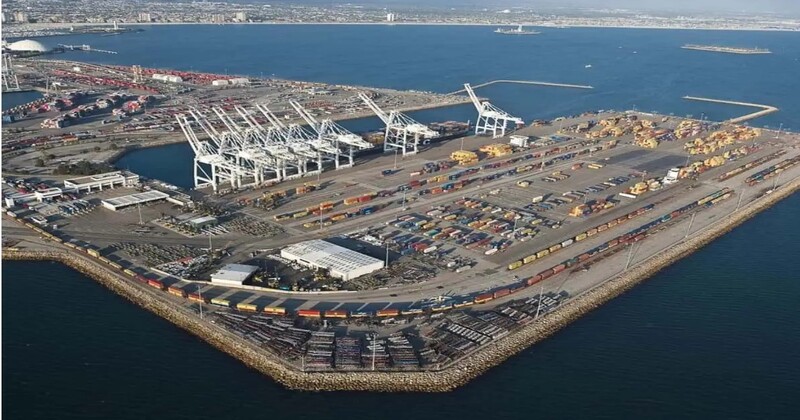
India and Iran inked a 10 year contract recently for the operation of a terminal at the strategically significant Chabahar port in Iran. Chabahar is a deep water port in Iran’s Sistan-Baluchistan province. It is the closest Iranian port to India, and is located in the open sea, which further provides easy and secure access for large cargo ships.
Union Minister for Shipping, Ports and Waterways Sarbananda Sonowal witnessed the signing of the agreement between India Ports Global Ltd (IPGL) and Ports and Maritime Organisation of Iran (PMO) in Tehran. It has been reported that IPGL will invest approximately $120 million to equip and operate for the duration of the pact. India has also extended a credit window in rupees equivalent to $250 million for mutually identified projects to improve infrastructure related to the port.
The trajectory of the port takes us back to the 1970s. Tehran realised the strategic importance of the port during the Iran-Iraq war during the 1980s. Fast forwarding to 2002, the Indian and Iranian counterparts held discussions on developing the port, which is located 72 km west of Pakistan’s Gwadar port.
In 2003, Iranian President Khatami and the then Indian Prime Minister, Atal Bihari Vajpayee, signed the progressive roadmap for strategic cooperation. Chabahar was one of the key projects among other important projects that India and Iran agreed to work together on. Chabahar holds the potential to link South Asia with the Persian Gulf, Afghanistan, and Central Asia, extending to the regions in Europe. The New Delhi Declaration, signed by the two leaders, recognised that both countries growing convergence and the lynchpin of pivotal connection should be coupled with strategic and economic considerations. For India, Chabahar is that balm that will provide relief from a headache created by its hostile neighbour Pakistan.
However, the timelines for the project faced setbacks from India’s growing ties with the US under then President George W Bush. The US declared and labelled Iran as on of the evils along with Iraq, and north Korea. This pushed India to abandon the project in Iran. Thus, the Chabahar port deal became a distant reality back then.
Zooming out quickly and focusing on the next phase. While India spent about $100 million to construct a road of about 200 km from western Afghanistan to Iran-Afgan border to link it with Chabahar, the port project itself continued at snail’s pace. However, in 2015 discussions between Iran and P-5+1 (UN Security Council’s five permanent members plus Germany) witnessed fruition.
In April 2015, after the world powers announced Joint Comprehension Plan of Action (JCPOA) framework to restrict Iran’s nuclear programme in return for sanctions relief and commit to finalising a comprehensive deal by the end of June, the then Afghan President Ashraf Ghani visited India to bring its attention to the importance of Chabahar port.
PM Modi agreed to work closely with Iran to bring the port project into action and translate the port’s reality as a viable gateway to Afghanistan and Central Asia. It was agreed that the additional routes to the existing ones would provide momentum to Afghanistan’s economic reconstruction efforts. This led to the signing of a Trilateral agreement between the three countries to smoothen the coordination and establish establish International Transport and Transit Corridor in May 2016, when PM Modi visited Iran.
In 2017, when the US witnessed change in its leadership led by Donald Trump, the Washington’s attitude towards Tehran became more convoluted. But the South block appeared determined to not astray from its path. New Delhi was able to bend the situation in its favour by managing to get a waiver from the US for the Chabahar port, citing Afghanistan as a reason.
India’s perspective should not be viewed in isolation. India’s move stemmed from the fact that China was and is still vehemently expanding its ambitious Belt and Road Initiative (BRI) and other massive infrastructure projects across the geographies.
The developments seen in recent years have been noteworthy. IPGL has been operating Chabahar port through its wholly owned subsidiary, India Ports Global Chabahar Free Zone (IPGCFZ) since December 2018. It has been reported that the port has handled over 90,000 twenty five foot equivalent units (TEUs) of container traffic and over 8.4 million metric tonnes (MMT) of bulk and general cargo since then.
Till date, a total of 2.5 million tonnes of wheat and 2,000 tonnes of pulses have been trans-shipped from India to Afghanistan through Chabahar. In 2021, India supplied 40,000 litres of environmentally friendly pesticide through the port to Iran when it was a locust attack.
In August 2023, on the sidelines of the BRICS summit hosted by Johannesburg, PM Modi met with President Ebrahim Raisi and discussed the pending long-term contract on Chabahar.
The operationalisation of the Chabahar port deal has potentially become an important node of connectivity between India and landlocked countries located in Central Asia and Afghanistan. However, the most optimum commercial and strategic potential could be discerned when the development of the port becomes an integral part of the larger connectivity project of the International North South Transport Corridor (INSTC).
The multi-modal project initiated by Russia envisages linking the Indian Ocean and Persian Gulf to the Caspian Sea via Iran, and further to Northern Europe vis St Petersburg in Russia. The ongoing war between Ukraine and Russia has dampened the pace and for now it seems a bit difficult to convince Europe to work out its detrimental relations with Russia.
Nevertheless, scholars and diplomats have stated that INSTC and Chabahar port will complement each other and provide a secure and an alternate route to connect the varied geographies of Russia and Eurasia.
However, the recent comments and veiled attacks from the US to potentially be ready for sanctions by doing business with Iran have made it clear that the US will be closely observing the developments taking place and will not leave any stone unturned to scrutinise Iran. India is all set to go ahead with full throttle to look at the bigger picture and keep the geopolitical tensions out of this strategic connectivity equation. India has always reiterated that its partnerships are parallel. India does not believe in compromising or monopolising any of its ties.
The US needs to understand that India is not antithetical to the US. India has just changed its approach by primarily focusing on its national aspirations first. India is not a stifling competitor, but a cohort. The crucial port project has already been stalled for a very long period of time and its high time to prioritise what is best for India vis a vis the larger common good.