Pakistan, a bankrupt nation may be sending its ministers, officials, diplomats and even prime minister with begging-bowl seeking alms from wealthy nations, its ferociously ugly face mostly remains unknown to many.
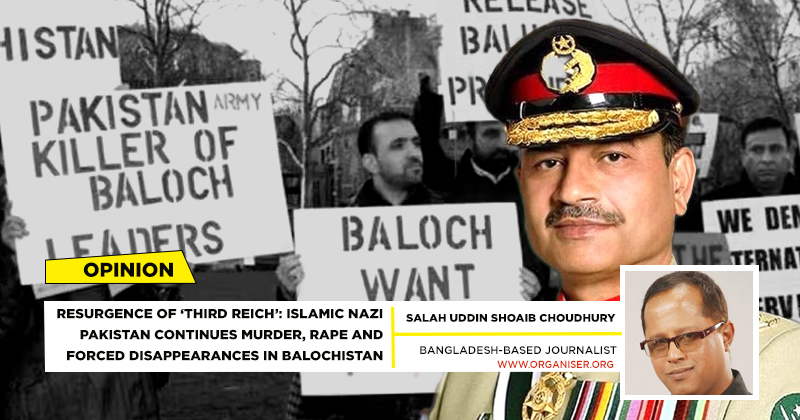
Much like the Third Reich under Adolf Hitler, the Islamist Nazi Pakistani army has adopted a strategy of terror, using rape, murder, and forced disappearances as tools of oppression. For decades, Balochistan has been the stage for a relentless campaign of brutality, where dissent is met with violence, and cries for freedom are stifled under the weight of tyranny.
Balochistan, which is also known as Baluchistan and Baluchestan is a historical region in Western and South Asia, located in the Iranian plateau’s far southeast and bordering the Bharatiya Plate and the Arabian Sea coastline. This arid region of desert and mountains is primarily populated by ethnic Baloch people.
In the shadow of global affairs, the plight of Balochistan often remains veiled, obscured by the complexities of geopolitics and overshadowed by the narratives of powerful nations. Yet, beneath this shroud of silence lies a tale of relentless suffering, where the echoes of injustice reverberate through the barren landscapes of this historic region.
Balochistan, a land of deserts and mountains, has long been the battleground for a struggle against Pakistani oppression. The Baloch people, seeking independence and liberty, have faced the wrath of the Pakistani military establishment, which operates with impunity, employing tactics reminiscent of the darkest chapters of history.
The international community’s response to this crisis has been muted, with many nations turning a blind eye to Pakistan’s atrocities in the name of political expediency. Arab nations, bound by a sense of brotherhood, have chosen to overlook Pakistan’s sins, even as innocent lives are lost and families torn apart.
In the chronicles of history, the parallels between Balochistan’s struggle and other movements for independence are stark. During Bangladesh’s war of independence in 1971, Arab nations stood in solidarity with Pakistan, branding the conflict as a jihad between Muslims and Hindus, despite the atrocities committed against the Bengali people. The echoes of this betrayal resonate in Balochistan today, as the international community remains silent in the face of Pakistan’s crimes.
Misinterpretation of Baloch liberation movement
The Baloch liberation movement is often misrepresented as a separatist activity, but a deeper understanding reveals that it is fundamentally a struggle for self-determination and the protection of human rights within the context of international law.
Firstly, the Baloch people have a distinct cultural and historical identity that predates the creation of modern nation-states in the region. Balochistan has a rich heritage and a unique linguistic and ethnic identity that sets it apart from the rest of Pakistan. The desire for autonomy or independence stems from a long-standing aspiration to preserve and promote this distinct identity, rather than a desire to break away arbitrarily.
Secondly, the grievances of the Baloch people are rooted in systematic discrimination, economic marginalisation, and political repression by the Pakistani state. Balochistan, despite being rich in natural resources, has remained one of the most impoverished and underdeveloped regions in Pakistan. The Baloch people have been marginalised in decision-making processes and denied their fair share of resources and opportunities, leading to widespread resentment and discontent.
Furthermore, the Baloch liberation movement is characterised by a commitment to non-violence and peaceful resistance, with many Baloch leaders advocating for dialogue and negotiation as a means to address grievances and achieve a peaceful resolution. While there have been instances of armed struggle by certain factions within the movement, these actions are often viewed as a response to state violence and repression rather than an inherent desire for separatism.
Moreover, the international legal framework recognises the right of peoples to self-determination, which encompasses the right to freely determine their political status and pursue economic, social, and cultural development. The Baloch liberation movement is grounded in this fundamental principle of international law, seeking to assert the rights of the Baloch people to govern themselves and determine their own future.
In this case, it is important to understand, the Baloch liberation movement is not a separatist activity in the traditional sense, but rather a legitimate struggle for self-determination and the protection of human rights within the framework of international law.
Under such adverse circumstance, social media has emerged as a lifeline for the Baloch people, providing a platform to amplify their voices and expose the truth behind Pakistan’s façade of legitimacy. Leaders like Mir Khan Baloch have taken to these platforms to shed light on the suffering of their people, documenting the disappearances, torture, and extrajudicial killings that have become commonplace in Balochistan.
Reports from human rights organisations paint a grim picture of the situation in Balochistan, with thousands of people disappearing at the hands of Pakistani security forces. The European Parliament, The Guardian, The Statesman, and other reputable sources have all documented the scale of Pakistan’s atrocities, yet the international community remains largely indifferent to the plight of the Baloch people.
Enforced disappearances have become a hallmark of Pakistan’s oppression in Balochistan, with victims ranging from political activists to journalists and students. The Baloch Voice Association, an NGO based in Paris, has called upon the UN to investigate these disappearances and hold the perpetrators accountable for their actions.
Yet, amid the darkness, there are voices of courage and resilience. Najma Mola Baksh, a Baloch woman, has traveled hundreds of miles to protest outside the National Press Club in Islamabad, demanding justice for her brother, who was murdered at the hands of Pakistani security forces. Her bravery serves as a beacon of hope in the face of adversity, inspiring others to speak out against injustice.
But for every Najma Mola Baksh, there are countless others who remain silent, fearful of reprisal from the Pakistani military establishment. The specter of rape, murder, and forced disappearance looms large over Balochistan, casting a shadow of fear and despair over its people.
Lack of international attention and recognition
The Baloch liberation movement’s lack of international recognition and attention can be attributed to several factors, including geopolitical interests, media bias, and the complexities of the conflict itself.
Geopolitical interests: Balochistan’s strategic location, bordered by Iran, Afghanistan, and the Arabian Sea, makes it a crucial geopolitical player in the region. Major powers often prioritise their strategic alliances and economic interests over human rights concerns, leading to a reluctance to intervene in internal conflicts like the one in Balochistan. Nations may be hesitant to criticise Pakistan, a key ally in the war on terror and a nuclear power, for fear of damaging diplomatic relations or destabilising the region.
Media bias and censorship: The lack of independent media coverage within Pakistan, coupled with government censorship and intimidation of journalists, makes it difficult for information about the Baloch liberation movement to reach international audiences. Baloch activists and journalists face threats, harassment, and even violence for reporting on human rights abuses and government repression. As a result, the international media may not have access to accurate and unbiased information about the situation in Balochistan, leading to a lack of awareness and understanding among the global public.
Complexities of the conflict: The Baloch liberation movement is a multifaceted conflict with deep historical roots and complex socio-political dynamics. The issues at play include economic exploitation, cultural marginalisation, environmental degradation, and political repression, making it challenging for outsiders to grasp the full scope of the conflict. Additionally, the presence of multiple armed groups and factions within the Baloch resistance movement further complicates efforts to achieve unity and present a coherent narrative to the international community.
Lack of international advocacy: Unlike other conflicts that have captured international attention, such as the Syrian civil war or the Israeli-Palestinian conflict, the Baloch liberation movement lacks strong international advocacy and lobbying efforts. Baloch activists and diaspora communities may struggle to garner support and raise awareness about their cause on the global stage, limiting their ability to influence international opinion and policy.
Overall, the combination of geopolitical interests, media bias, the complexities of the conflict, and the lack of international advocacy contribute to the Baloch liberation movement’s continued obscurity in the international arena.
The international community must heed the call of the Baloch people and stand in solidarity with their struggle for freedom and justice. Silence in the face of oppression is complicity, and indifference only serves to embolden the perpetrators of violence.
As the world looks on, let us not forget the suffering of the Baloch people, nor the sacrifices they have made in their quest for liberation. Theirs is a struggle that transcends borders and ideologies, a fight for the most basic of human rights – the right to live free from fear and oppression. It is a fight that deserves our support, our solidarity, and our unwavering commitment to justice.