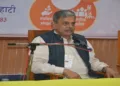

“Unique part of Bharatiya civilisation is that it has ‘Divinised Humanity,’ and ‘Humanised Divinity’ in the form of Avatars,” said Kerala Governor Dr Arif Mohammed Khan at Chennai Literature Festival, while underscoring the inclusivity of Bharatiya civilisation, transcending variables such as race, language, or faith.
The Chennai Literature Festival, which had made its debut in 2021, had its fourth edition from February 23-25, 2024 this year featuring personalities from the literary, academic and journalistic world across India. The lit fest was anchored around the theme of Ram Mandir, a cultural Renaissance bridging the North-South divide bringing to light the footprints of Shri Ram across the Southern parts of Bharat. The two-day event took place at Hotel Savera in Mylapore, Tamil Nadu, featuring few book launches and a series of discussions with eminent speakers and authors.
At the two-day mega event, Kerala Governor Dr Arif Mohammad underscored the importance of working towards the advancement of humanity at large, particularly in the context of discussions surrounding the Indian cultural renaissance, epitomised by the construction of the grand Ram Temple in Ayodhya.
Dr Khan commenced his address by acknowledging the pivotal role played by Shri K Parasaranji, in successfully arguing the Ayodhya land dispute case and subsequently being named a trustee in the Ram Janmabhoomi Teerth Kshetra Trust. He lauded Parasaranji’s unwavering dedication and professional excellence, citing his profound devotion to Prabhu Shri Ram and his adept exposition of Sanatan ideals and values in courtroom orations. He also highlighted Parasaranji’s esteemed status as the ‘Pitamah of the Indian Bar’.

In the fourth edition of the Lit Fest, the organiser, Indoi Samudaya Foundation honoured Parasaranji with the title ‘Shri Rama Ratnam.’
Shifting focus to the theme of the literary ‘Ram Rajya,’ Dr Khan elucidated its significance as symbolising an ideal society free from crime and war, characterised by peace, prosperity, and the well-being of its people.
Emphasising the significance Valmiki Ramayan, Kerala Governor elucidated Bhagwan Ram’s governance philosophy, wherein he viewed his kingdom and its people as deities, serving them with a paternal devotion that prioritised their welfare above personal interests. Dr Khan commended Parasaranji’s attainment of excellence in his work as a form of devotion to the ‘Supreme Being.’
Tamil Nadu, the Karmabhoomi of Shri Ram
Emphasising the omnipresence of Shri Ram, Tamil Nadu Governor RN Ravi said, “Shri Ram is everywhere. How can we deny him? If we deny Shri Ram, we deny Bharat, we deny everything.”
Governor Ravi described Tamil Nadu as the spring well of Bharatiya culture, with a rich history. He acknowledged the recent deviation from cultural roots but stressed the need to embrace heritage.
The Governor of Tamil Nadu remarked, “This place has been a fountainhead of our culture and Aadhyatam (spirituality) that has profoundly influenced Bharat’s identity, has experienced phases of perplexity. Over the past century, it has slightly deviated, with some attempting to disown our history and forge a new identity—an identity contrary to Bharat’s essence and detrimental to its core. This place has been the Karmabhoomi of Shri Ram. Every corner of this land narrates a story of Shri Ram, as evident in the ancient Tamil literature from the Sangam period.”
The Governor discussed the vision for ‘Viksit Bharat’, equating it with Ram-Rajya and emphasising social justice as a way of life. The Governor addressed the need for social transformation and the importance of deriving inspiration from legends. He urged the literary community to become pathfinders and play a pivotal role in documenting and reflecting the ongoing societal transformation.
RN Ravi described the transformative journey of Bharat as ‘revolutionary’ and also highlighted the country’s advancements in various fields, including the economy, science and technology, illustrating its rapid ascent on the world stage. The Governor remarked, “A mere decade ago, there were not many listeners and today, when Bharat speaks, the world listens with attention”. He also takes a dig at those who called Bharat’s growth story as ‘Hindu rate of growth’ and asserted Bharat’s emergence on the world stage. “They are busy disrespecting us meanwhile a new Bharat is emerging on the world stage.”
Highlighting the Bharat’s philosophy of Vasudhaiva Kutumbakam, he said, “We need to reclaim, re-energise and spread the values that have been overshadowed by Western and European influencers.
Idea of Akhand Bharat
J Nandkumar, Convenor of Prajna Pravah, illuminated the journey of Bharat’s identity, highlighting significant milestones and symbolic gestures that underscore its unity and resilience.
He initiated his discourse by contextualising the 2014 shift in governance as a pivotal moment in history, portraying it as an event that resonated globally. He emphasised the symbolic significance of representatives from neighbouring countries participating in the oath-taking ceremony, portraying it as a reaffirmation of Akhand Bharat’s cultural continuum.
Nandkumar passionately articulated how India’s soft power, embodied in practices like yoga, serves as a beacon of its cultural richness and spiritual heritage accepted by the world. He underscored the reclaiming of cultural symbols, citing the placement of Sengol in Parliament.
Talking about abrogation of Article 370 by Modi Government, Nandkumar said, “Despite the initial belief that Article 370 would remain unchanged, as envisaged by the constitutional framers, it was designed to be a temporary and transitional provision. However, over the past 5 or 10 years, many have come to realise that it is not fading away but rather gaining strength. Tampering with it could potentially result in further division but it was removed. That’s why I emphasise the need for us to reawaken to our cultural and ethno-sensational values.”
J Nandakumar vehemently condemned divisive political agendas and colonial vestiges that seek to fragment Bharat’s cultural fabric
On the historic Pran Pratishtha in Ayodhya, Prajna Pravah Convenor said, “On January 22, Pran Pratishtha took place. Several years ago, many of you might have wondered if phrases like Mandir Wahi Banayenge (We will build the temple there) were mere slogans. Despite skepticism lingering, I’m not sure how many of you truly believed it would happen in our lifetime. I, too, had harboured doubts. Even as I delivered 12 to 14 speeches daily during the agitation, returning to my office before sleep, I pondered if I would witness it. However, against my uncertainties, it did happen”.
“All these incidents whether Article 370 or Ram Mandir, I have recounted highlight our fortunate position. Those of us living in this era are truly fortunate, blessed to witness this auspicious dawn in its glorious form,” he said.
Drawing from the wellsprings of India’s spiritual heritage, Nandkumar expounded on the profound essence of Ekata (unity) and Akhandata (integrity) beyond mere political delineations.
He vehemently condemned divisive political agendas and colonial vestiges that seek to fragment Bharat’s cultural fabric. Nandakumar discussed the concept of Akhand Bharat, emphasising the significance of epics like Ramayan and Mahabharat. “In Mahabharat, the emergence of Bharat as a concept and its geographical nuances are vividly explained. The interconnected stories within this epic, such as Gandhari hailing from Gandhar Desha (present-day Afghanistan), Panchali from Panchala, and Ulupi, one of Arjuna’s wives, from Manipur, have been narrated, interpreted, and reinterpreted, shaping our cultural identity over time. These stories have not only become an integral part of our collective consciousness but have also been translated into a sacred geographical context.”
“Ram Manohar Lohia, despite being a staunch socialist and atheist, acknowledged the symbolic connections within Bharat, where Prabhu Shri Ram links the North with the South, Shri Krishna connects the West with the East, and the omnipresence of Shiva is recognised in every particle of the land. The idea of a culturally interconnected Bharat was deeply ingrained in the minds of storytellers, ultimately reaching the public consciousness”, he added while explaining the concept of sacred geography.
Nandakumar argued that the concept of a fragmented India is a creation of colonisers and perpetuated by frustrated elements after the independence. This fragmented portrayal was a deliberate imposition through their education system, with the primary goal of disintegrating and dividing Bharat.
Nandkumar also delved into the travels of Adi Shankaracharya, highlighting the establishment of Mathas in Dwarka, Puri, Sringeri, and Badrinath, symbolising the cardinal directions of Bharat. He underscored Shankaracharya’s journey to Srinagar, emphasising the concept of Akhand Bharat, which is still evident in the place known as Shankaracharya Hill. He emphasised the symbolic significance of twelve Jyotirlingas, in uniting Bharat culturally.
“The selection of these locations was not arbitrary but rooted in the idea of Akhand Bharat,” he said.
Drawing parallels with the Bhakti Movement, Nandkumar Ji highlighted its transformative role in rejuvenating the entire nation. He mentioned prominent figures like Basava, Chaitanya, Ramanuja, Ramananda, Surdas, Tulsidas, Meera, and Guru Nanak, who carried the spirit of the Bhakti Movement across different regions of Bharat.
Nandkumar Ji also highlighted almost the copy paste veneration of Bharat Mata by Narsi Mehta in Gujarat, Shankardeva, and Madhavadeva from Assam, Guru Nanak Dev Ji in Punjab and Andal in Tamil Nadu in defining Bharat during the Bhakti movement.
“Guru Gobind Singh established the Panj Pyare, a group that extended beyond the borders of Punjab. Daya Singh hailed from Sialkot in Pakistan, Dharam Singh from the Hastinapur-Meerut region, Bhai Himmat Singh from Puri, Odisha, and Bhai Mohkam Singh from Dwarka. Bhai Sahib Singh came from Bidar, Karnataka.”
“The concept of Akhanda Bharat also persisted during the Sikh period, Bhakti Movement, Veda period, and beyond. This inclusive idea was embraced not only by followers of Vaishnavism, Shaivism, Darshana, Upanishads, and Tantra but also by Athyashramis. The 51 Shakti Peetha concept exemplifies this unity, as Sati’s parts were scattered across the entirety of Bharat. From Kamakshi Amman in Tamil Nadu, where the naval part of Sati fell, to Vaishno Devi in Jammu and Kashmir, housing the skull, and Pavagadh in Gujarat, where the right foot of the Devi landed, the sacred geography held diverse fragments. Kamakhya witnessed the descent of the yoni, along with 47 other parts. These sacred memories, encapsulated in stories passed down through generations, connect us to our forefathers and form an integral part of our cultural heritage,” he said.
Nandkumar further said, “it was Guru Nanak Dev Ji who defined Hindustan and Hinduness first and not Veer Savarkar, Guru Golwalkar or Syama Prasad Mookerjee with his saying, “Sach ki Vani Aaave Nanak, Sach suniyasi, Sach ki vela, kaya kapat tuk tuk hosi Hindustan samahesi bole”.

The festival was curated by the esteemed temple activist and social media influencer, Shefali Vaidya. On the first day, sessions included fiction based on scriptures featuring authors Ami Ganatra and Abhinav Agrawal, Ek Bharat-Shreshtha Bharat through Education by Prof Santishree D Pandit, Vice-Chancellor, JNU and Prof Ujwala Chadradeo, Vice-Chancellor SNDT University, War Stories with Major Madhan Kumar, Maj Manek Jolly and Shiv Aroor, Media Narratives with Pradeep Bhandari, Prafulla Ketkar and Karthik Gopinath. Vivek Agnihotri in conversation with Shefali Vaidya talked about film making and Bharatiya civilisation, where he shared insights about his future project Delhi Files.
On the day two, the day started with presentations on Ramayan in dance by Ananda S Jayant and and Rama Temples in Tamil Nadu by Dr. Chitra Madhavan. Famous Vedic speaker, Dushyant Shridhar kept the audience spellbound with his fantastic pravachanam on the Footprints of Shri Rama in Tamil Nadu. Suren moderating an eclectic session, ‘Exploring New Genres’ participated by authors Aabhas Maldahiyar, Venkatesh Rangan and Anand Merathia. Tinku Venkatesh interacted with Anuradha Goyal and Kushal Mehra on Podcasting & Literature. On the protecting temples, Shefali Vaidya had a detailed conversation with prominent temple activist T R Ramesh.
With a resolve to strengthen the cultural bonds of Bharat while celebrating diversity, two key founders of the Indoi Samudaya Foundation Bharat Gopu and Shyam Sundar Znwar thanked all the speakers and participants. Organiser Weekly was the official media partner of the event with SMART.